
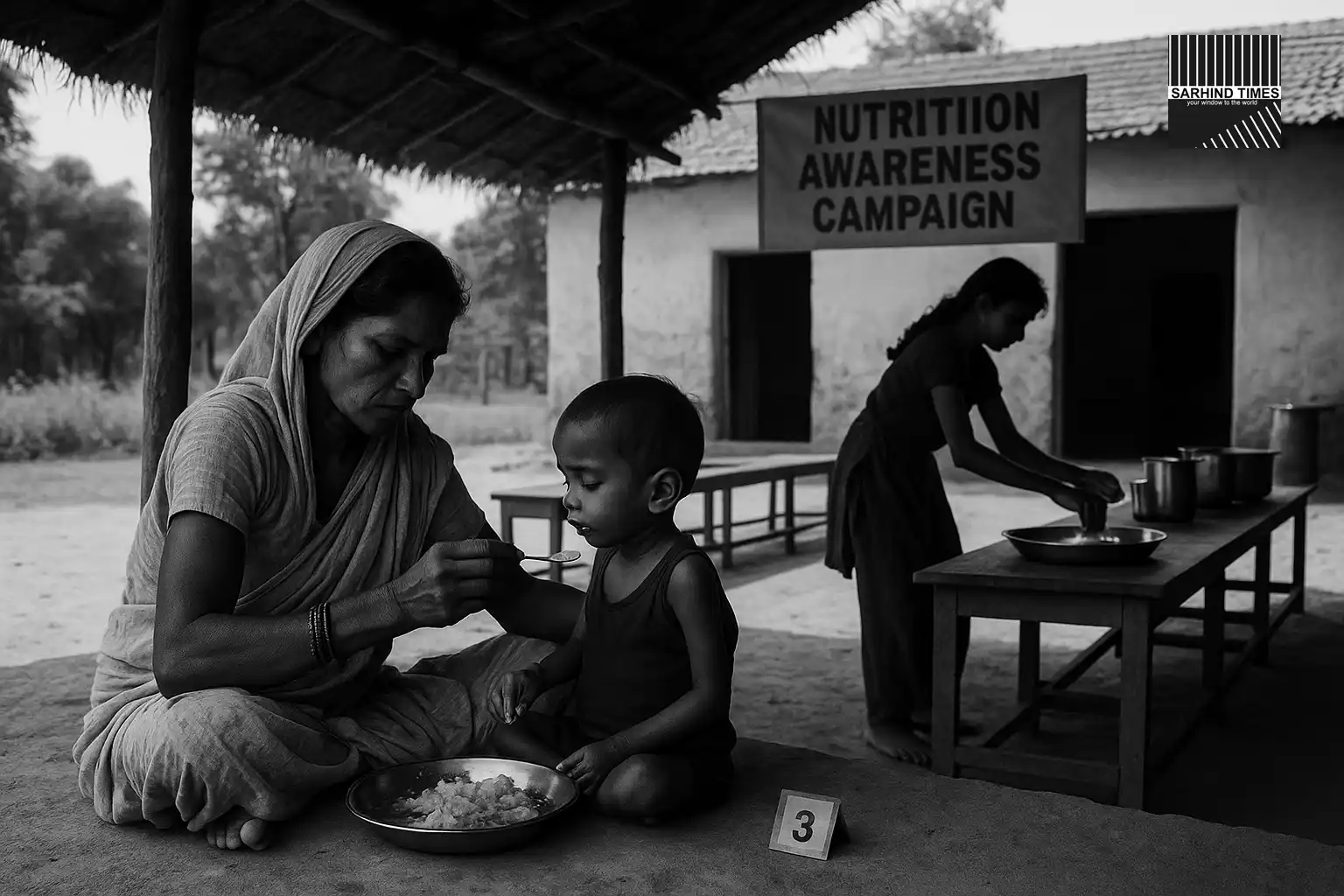
Despite progress in some indicators, India faces a dual burden of child under-nutrition and adult over-nutrition with implications for health, economy and policy
Dateline: New Delhi | 6 November 2025
Summary: A set of recent nutrition assessments reveal that India continues to struggle with high rates of child wasting and stunting, widespread anaemia among women and adolescents, while simultaneously seeing rising obesity and metabolic disorders among adults. Analysts say the “double burden” of malnutrition poses a major public-health and economic challenge for the country.
Overview: Charting the nutrition landscape
India’s nutritional profile remains complex and worrying. On one hand, child-undernutrition remains entrenched: according to the latest Global Hunger Index (GHI) for India, the country’s score is 25.8 (classified as “serious”), and it ranks 102nd of 123 countries assessed. The GHI data highlight that approximately 32.9 % of children under five are stunted (low height for age) and 18.7 % are wasted (low weight for height). At the same time, India is beginning to witness a clear rise in over-nutrition: child-obesity rates are increasing, and among adults, metabolic disorders such as diabetes, hypertension and obesity are rising markedly.
The challenge is multidimensional: under-nutrition affects child growth, cognitive development and future productivity; over-nutrition introduces a growing burden of non-communicable diseases (NCDs). The two worlds co-exist across rural and urban India, often within the same household or region, posing what experts term a “double burden” of malnutrition.
Recent policy efforts — including Anemia Mukt Bharat, the POSHAN Abhiyaan and the 2024 “Dietary Guidelines for Indians‑2024” — reflect the recognition of the problem. Yet despite visible momentum, data illustrate that progress remains uneven and far from sufficient.
This article examines the current nutrition indicators, key drivers of the crisis, policy implications, and what India must focus on to move the needle.
Child under-nutrition: stunting, wasting and diet quality
The stunting rate of roughly one in three children under five means that around 33 % do not reach their full growth potential. Stunting results from chronic under-nutrition, repeated infections, poor sanitation and inadequate diet during the first 1,000 days of life (from conception to age two). Wasting — at about 18.7 % — signals acute mal-nutrition and remains among the highest globally.
Both stunting and wasting vary significantly across states and social groups; rural regions, marginalised communities and tribal populations carry higher burdens. While exclusive-breastfeeding rates, complementary-feeding practices and immunisation coverages have improved in many places, progress is patchy.
Dietary-quality remains weak. Data from the Global Nutrition Report show that anaemia among women of reproductive age remains at about 53.0 % and India has not made progress in reducing it. Micronutrient deficiencies (iron, folate, vitamin A, vitamin D) remain widespread. Poor dietary diversity, heavy reliance on cereals and lack of affordable nutrient-dense foods continue to affect children’s growth and health.
Nutritional surveys (such as the Comprehensive National Nutrition Survey conducted 2016–18) provide granular data on micronutrient status among children and adolescents, showing a high prevalence of deficiencies. While newer rounds of large-scale surveys (such as NFHS-6) are underway, the lag in data release makes real-time monitoring more challenging.
Rising obesity and adult metabolic health issues
On the flip side of the nutrition coin, India is seeing a clear uptick in over-nutrition and metabolic dysfunction. The Global Nutrition Report points out that adult obesity and associated non-communicable diseases (NCDs) are not on track: India’s adult women (aged 18+) and men do not show sufficient decline in obesity or diabetes indicators.
Recent studies reinforce this: one national-level study found that over 71 % of Indian adults are metabolically unhealthy — meaning they may carry high blood sugar, cholesterol, or blood pressure despite appearing of normal weight. Another report revealed that at least one in five households has all adult members overweight or obese.
Furthermore, average salt intake among Indians exceeds 12 grams per day — more than double the World Health Organization recommended limit of 5 grams — posing further risk for hypertension and cardiovascular disease.
This shift creates new health-system demands: India must now manage both under-nutrition and NCDs simultaneously, requiring dual approaches in health service design, preventive care, public-health messaging and dietary transformation.
Reasons behind the nutrition paradox
Several inter-connected drivers explain how India can face both severe under-nutrition and rising obesity:
– **Dietary transition** – As incomes rise, there is increasing consumption of processed foods, sugars, oils and high-salt snacks, while traditional diets rich in pulses, millets, green vegetables and whole grains decline. This displacement contributes to overweight and NCD risk alongside persistent micronutrient deficiencies.
– **Urbanisation and sedentary lifestyle** – Urban residents often get less physical activity, more sedentary jobs, and consume more calorie-dense convenience foods, increasing obesity risk even when diets remain poor in micronutrients.
– **Poverty and inequality** – Weight/obesity and under-nutrition coexist in the same households: children may be under-fed while adults consume surplus calories but nutrient-poor foods. Income inequality, insecure livelihood and limited access to quality diets drive this dynamic.
– **Health-system and programme lag** – While programmes exist to tackle under‐nutrition (such as supplementation, child-feeding, antenatal care), the shifting burden toward NCDs is still less integrated into preventive systems. Health services are often designed either for infectious/mal-nutrition or “luxury” NCD care, not both.
– **Data-lag and policy mismatch** – Many national surveys have gaps, older rounds, under-reporting of adult over-nutrition, and limited disaggregation by social group; thus policies may be based on outdated or partial information.
– **Cultural and behavioural patterns** – Traditional high-salt foods, rapid dietary shifts in peri-urban areas, inadequate awareness of balanced diet, and weak regulation of ultra-processed foods all contribute. The 2024 dietary guidelines emphasise these issues but implementation is the main barrier.
Regional variation and high-risk groups
Nutritional burdens are far from uniform across India. States with lower human-development indices and higher poverty levels typically have worse child-undernutrition but may also now show rising adult obesity. For example, rural children have higher stunting and wasting rates compared with urban children.
Women and adolescent girls carry high risk: anaemia, poor dietary diversity and early pregnancies mark multiple disadvantages. The MoHFW notes that 67.1 % of children and 59.1 % of adolescent girls are anaemic under NFHS-5 indicators.
Urban wealthy pockets are not immune: the rise of high-calorie processed diets and sedentary lifestyles is producing obesity and metabolic dysfunction even in lower income segments. The dual burden concept emphasises that poor and rich groups both face nutrition challenges, albeit of different forms.
Policy responses and programme interventions
India has multiple interventions underway:
– Anemia Mukt Bharat (AMB) focuses on iron-folic acid supplementation, deworming, food fortification and behaviour change comunication across six beneficiary categories.
– POSHAN Abhiyaan (National Nutrition Mission) integrates child-feeding, growth monitoring, anganwadi services, school nutrition and digital monitoring.
– Dietary Guidelines for Indians-2024 lay out evidence-based food-choice guidance, emphasising pulses, millets, reduced salt/sugar, diversification, and food-safety.
– Health-system strengthening via the National Health Mission, Indian Public Health Standards (IPHS) and quality assurance frameworks.
– Data-monitoring upgrades: NFHS-6 (2023–24) is underway, newer nutrition and health dashboards, real-time tracking of supplementation and digital tools to monitor programme reach.
Yet experts argue that scaling beyond high-visibility programmes, ensuring persistent funding, building workforce capacity (nutritionists, community health workers), linking preventive nutrition with NCD-care, and addressing food environments are critical next steps.
Economic and health implications
The nutrition situation in India imposes heavy costs. Mal-nutrition (under- and over-) reduces productivity, increases health-system burden, slows cognitive development, and raises long-term care costs for NCDs. Some estimates suggest under-nutrition alone could reduce GDP growth by up to 2–3 percentage points annually in developing nations. Coupled with rising NCD epidemics in India, the economic burden may escalate sharply.
For policymakers and investors, nutrition is not just a health metric—it is a growth metric. Delivering improved nutrition contributes to human-capital formation, reduces disability, and strengthens resilience. On the other hand, failure to act may result in a race of catch-up costs, burdening fiscal resources and constraining the growth potential of India’s younger generations.
Key risks, caveats and what to monitor
There are several risks and caveats to keep in mind:
– Survey-data lag: NFHS-6 and other national surveys are yet to release full nutrition modules in many states, limiting real-time policy calibration.
– Program execution gaps: Coverage may be high, but quality of delivery, follow-up and behaviour-change outcomes remain uneven.
– Food-price inflation: Rising food inflation reduces the ability of low-income households to access nutrient-rich foods, pushing them into cheaper, energy-dense but nutrient-poor diets.
– Rising adult NCD burden: If India fails to strengthen preventive systems now, the dual-burden will translate into major health-system shocks and increasing care costs.
– Environmental, climate- and livelihood-risks: Food-security shocks, climate-stress on agriculture, water scarcity and rural distress may reverse nutritional gains or worsen inequality.
Monitoring the nutrition pathway means tracking several indicators closely: child stunting and wasting trends, anaemia prevalence, adult obesity/metabolic-dysfunction trends, diet-diversity scores, food-price inflation, and linkage of screening to care. Success will depend not just on headline numbers but on sustained improvement, equity of outcomes and reduction of hidden constraints.
What next for India and citizens
For India to accelerate progress, several strategic actions are crucial:
– Strengthen early-childhood interventions in the first 1,000 days, with particular focus on tribal and rural areas where stunting and wasting remain highest.
– Expand and upgrade food-environment policy: regulation of ultra-processed foods, salt/sugar reduction, food-fortification, improved school-meal quality, and consumer awareness of healthy diets.
– Link nutrition programmes with NCD-prevention: screening for metabolic risk among adolescents and adults, integrating nutrition counselling into primary-health centres, and building data-links between child-nutrition and adult-health pathways.
– Boost diet-diversification by making nutrient-rich foods more affordable and accessible – pulses, millets, fruits, vegetables and fortified staples, especially for vulnerable households.
– Scale up workforce capacity: community health-workers, nutritionists, digital-tools for monitoring, incentivised performance metrics for nutrition outcomes, and regional equity targets.
– Keep investments stable: nutrition interventions must be protected even in times of fiscal stress and inflation; rising food costs should be offset by policy and programme adjustments.
– Create awareness and behaviour-change campaigns: make nutrition a household conversation—not just mother-and-child but for adolescents, men, and older adults.
For every Indian household, the practical takeaway is this: feeding children well, ensuring diet-diversity, reducing processed foods, checking salt intake, engaging in physical activity, and utilising local health-camp screening services matter. Diet and lifestyle now matter as much as early childhood growth for national outcomes.
Conclusion
India stands at a critical juncture in its nutrition journey. The data tell a story both of stubborn under-nutrition and a mounting metabolic health crisis. Tackling this dual challenge requires calibrated policy, scaled-up delivery, conscious help from community and markets, and sustained leadership. The risk of inertia is not small — but neither is the prize of improved human-capital, healthier ageing, and stronger growth.
As India moves forward, nutrition cannot be treated as a side-issue or single-programme line-item. It must become central to health-policy, growth-policy, education-policy and social-protection-policy. Only then can the nation hope to shift from serious nutritional challenge to a resilient, health-enabling future.



+ There are no comments
Add yours