
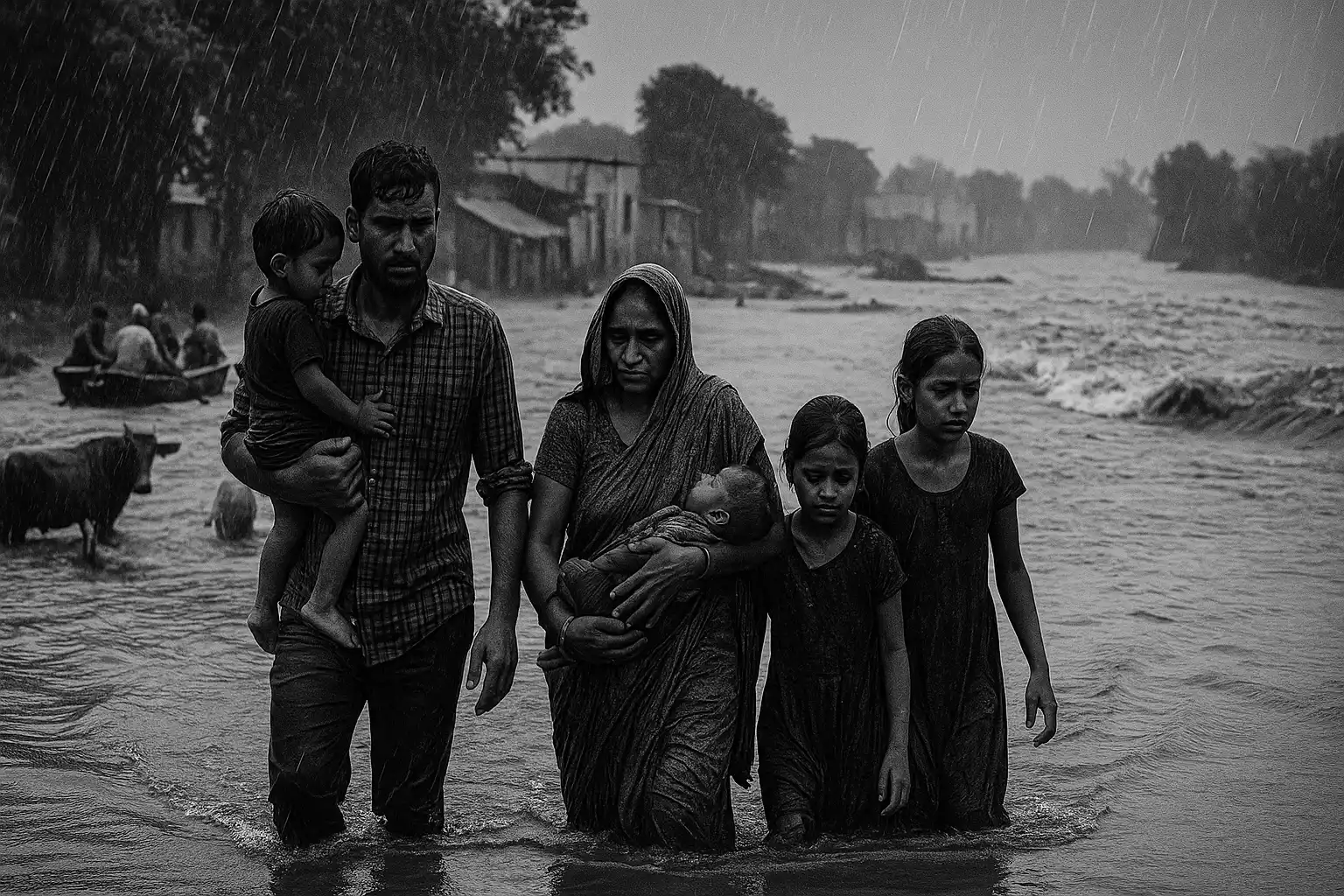
Recent studies underscore India’s growing vulnerability to climate hazards and flag urgent need for strengthened adaptation financing and resilience measures
Dateline: New Delhi | 05 November 2025
Summary: India is facing escalating climate impacts, with fresh data showing heavy losses from extreme weather, shifting rainfall patterns and rising heat-stress in vulnerable states. According to the latest indices and a major global adaptation report, the country must urgently boost adaptation finance, infrastructure resilience and planning to avoid mounting human and economic costs.
Climate Signals: Losses, Risks and Red Flags
Over the past decades, India has borne a disproportionate share of climate-related damage and fatalities. A recent piece highlights that India has suffered estimated losses of USD 180 billion (roughly ₹14-15 lakh crore) over the last 30 years due to floods, cyclones and droughts. This underscores the magnitude of the challenge. While exact numbers vary, the trend is clear: extreme weather events are becoming costlier and more frequent.
One of the most telling indicators is from the Adaptation Gap Report 2025, which warns that adaptation finance for developing nations falls significantly short of needs. It estimates that annual adaptation funding must rise to USD 310-365 billion by 2035 to meet the scale of risk. India, as a highly vulnerable country, therefore faces the dual burden of mitigating and adapting to climate change.
In the more immediate term, the Climate Risk Index 2025 shows how inaction has mounting consequences: more extreme weather events, larger losses and higher human tolls. India’s exposure is high due to its geography, population density and socio-economic vulnerabilities. State-Level Flashpoints: Gujarat and Beyond
The spotlight is on states like Gujarat, which have recently experienced rainfall patterns far outside their historical norms. In October, some districts recorded their highest ten-year rainfall averages in fewer days, leading to disruption of agriculture, transport and infrastructure. Environmental analysts see this as symptomatic of broader climate destabilisation.
According to the rainfall anomaly data, the volume of rain is increasingly concentrated in fewer heavy-storm days rather than spread more evenly. This drives flash-flooding, urban inundation and soil erosion—challenges for both rural and peri-urban communities. For example, in Gujarat, the shift is dramatic: total monsoon rainfall may not have increased significantly, but the intensity and concentration of downpour events has.
Urban Heat, Shifting Patterns and the “New Normal”
Climate change is manifesting not only in storms and floods but also in rising heat and changing seasonality. According to a nationally-representative survey, the average Indian is increasingly aware of climate change and its local effects. The survey, “Climate Change in the Indian Mind, Spring 2025”, found shifts in public perception, including willingness to join demonstrations and demand action, reflecting the growing immediacy of climate risk.
In urban areas, the “urban-heat-island” effect plus changing humidity and rainfall patterns is raising thermal stress, especially at night and in marginalised neighbourhoods. This has health implications, from increased heat-stroke risk to reduced sleep quality and higher burden on health systems. The intersection of climate, urbanisation and vulnerability is becoming critical.
Vulnerability of Agriculture and Rural Livelihoods
India’s agricultural sector remains highly exposed to climate shocks. A recent analysis suggests that with a 1–1.5 °C rise in mean temperatures, major grain yields could shrink by up to 10 % unless adaptation measures are strengthened.
Given that nearly half of India’s workforce is linked directly or indirectly to agriculture, such declines have multiplier effects — on employment, rural incomes, migration and food-price inflation. The adaptation challenge thus spans both climate science and socio-economic policy.
Finance and Policy: Adaptation Gap Widens
The Adaptation Gap Report 2025 finds that despite growing climate risk, adaptation finance flows remain very low in proportion to need. For India, this means the state-capacity to adapt (early-warning systems, resilient infrastructure, retrofitting, planning) needs acceleration.
One key dimension is the mismatch between adaptation demand and funding mechanisms. Many India-specific programmes focus on mitigation or generic disaster risk reduction rather than systemic climate-resilience investment. The implication: climate risk is baked into many sectors — from water management to urban planning — but may not be budgeted accordingly.
The policy challenge now: shift from reactive to proactive adaptation, embed climate-resilience in infrastructure planning, improve coordination between sectors (water, agriculture, urban development, health), and mobilise finance — domestic, multilateral and private. The clock is ticking.
Infrastructure, Urban Planning & Local Government Challenges
India’s infrastructure is increasingly exposed to climate hazards. Urban flood-risk, unstable slopes, drainage overloads, inadequate heat-mitigation (shaded areas, cooling systems), and failing urban-services in older townships all increase vulnerability.
Planning frameworks often lag: approvals for new neighbourhoods sometimes ignore climate-impact projections, retrofitting is expensive, and municipal budgets are hard-pressed. Many local governments lack capacity for integrated climate-resilience planning. This gap is now visible in the face of real-time climate stress.
Health, Equity and Human Dimensions
The human cost of climate change is not evenly distributed. Marginalised urban communities, rural farmers, informal-sector workers, older people and those with underlying health conditions face higher exposure and lower adaptive capacity.
For example, a district with poor drainage, inadequate healthcare access and dense informal housing is far more vulnerable to flooding + waterborne disease + heat-stress compared with a well-serviced suburban area. Climate change amplifies inequities. It is not just a technical challenge — it is a social-justice challenge.
What Should India Prioritise? A Strategic Response Framework
Given the data and trends, India must adopt a multi-layer strategy:
- Embed resilience in planning: Every major infrastructure project, township, irrigation scheme, transport corridor to include climate-impact assessment, scenario modelling and adaptive design.
- Scale up adaptation finance: Mobilise state, private and multilateral funding for climate-resilient infrastructure (dams, drainage, cooling shelters, flood defences), capacity building and technology deployment.
- Strengthen early-warning and response systems: Improve district-level climate-health data, expand alert coverage, integrate hazard-monitoring with local government action plans.
- Focus on vulnerable populations: Urban informal-settlement upgrades, rural livelihood diversification, targeted support for communities prone to vector-borne diseases, heat stress or floods.
- Link mitigation and adaptation: While India pursues long-term net-zero goals, the shorter-term adaptation agenda must not lag. Mechanisms such as nature-based solutions (mangrove restoration, urban green space), water-harvesting, sustainable agriculture and resilient infrastructure provide dual benefits.
- Enhance institutional coordination: Climate-resilience spans ministries (water, agriculture, health, urban housing, finance) and tiers (centre, state, district). Bridging silos is critical to avoid fragmented efforts.
Risk Scenarios: What Could Go Wrong—and What Could Be Gained
If adaptation is delayed or inadequate, India faces several risk trajectories:
- Increased frequency of heat-waves and related mortality; agricultural-productivity decline; food-price inflation and rural distress.
- Urban flood events, drainage failures and displacement of low-income communities; infrastructure damage and economic disruption in growth corridors.
- Accelerated migration from rural to urban areas, stressing city services, housing and social systems.
- Higher insurance-and-reconstruction costs, fiscal stress on states, delayed growth and reduced investment in vulnerable regions.
On the positive side, if adaptation investment is scaled and executed well, India can reduce disaster losses, protect livelihoods, improve liveability in cities and draw international climate-finance flows — positioning itself as a resilient growth-model rather than a vulnerable economy.
India’s Next Steps on the Global Stage
At upcoming global climate forums, India’s voice will be critical. As the COP-process moves from mitigation to adaptation, India must push for fair finance, technology transfer, capacity-building and equity in global climate architecture. The national agenda must align with global action, including the upcoming rounds of negotiations and financing frameworks.
Domestically, transparent tracking of adaptation outcomes, better data, public-engagement, and accountability mechanisms will build trust. The Indian public is increasingly aware of climate change and expects action — as the survey shows. Aligning policy with public sentiment is vital.
Conclusion: A Turning Point for India’s Climate Response
The evidence is mounting and the message is clear: India is no longer only confronting future climate risk—it is already living its consequences. From heavy floods and shifting rainfall patterns in Gujarat to the agricultural stress and urban heat challenges across multiple states, the impacts demand urgent, coordinated response.
Adaptation is no longer optional. It must be central to growth strategy, infrastructure planning and public-policy frameworks. The mobilisation of finance, institutional reform and integration of climate-resilience in all sectors will determine whether India becomes a resilient economy or remains vulnerable to climate shocks.
The path ahead is complex but actionable. India has strength—scale, diversity, innovation, public awareness. The challenge is aligning that strength with execution, financing and policy coherence. If done right, this moment can be a turning point—a pivot from coping with climate risk to mastering it.
As the world watches, India must act not only for itself but as a leader among developing nations: demonstrating that climate-resilience, sustainable growth and equity can go hand in hand. The next decade will be decisive.


+ There are no comments
Add yours