
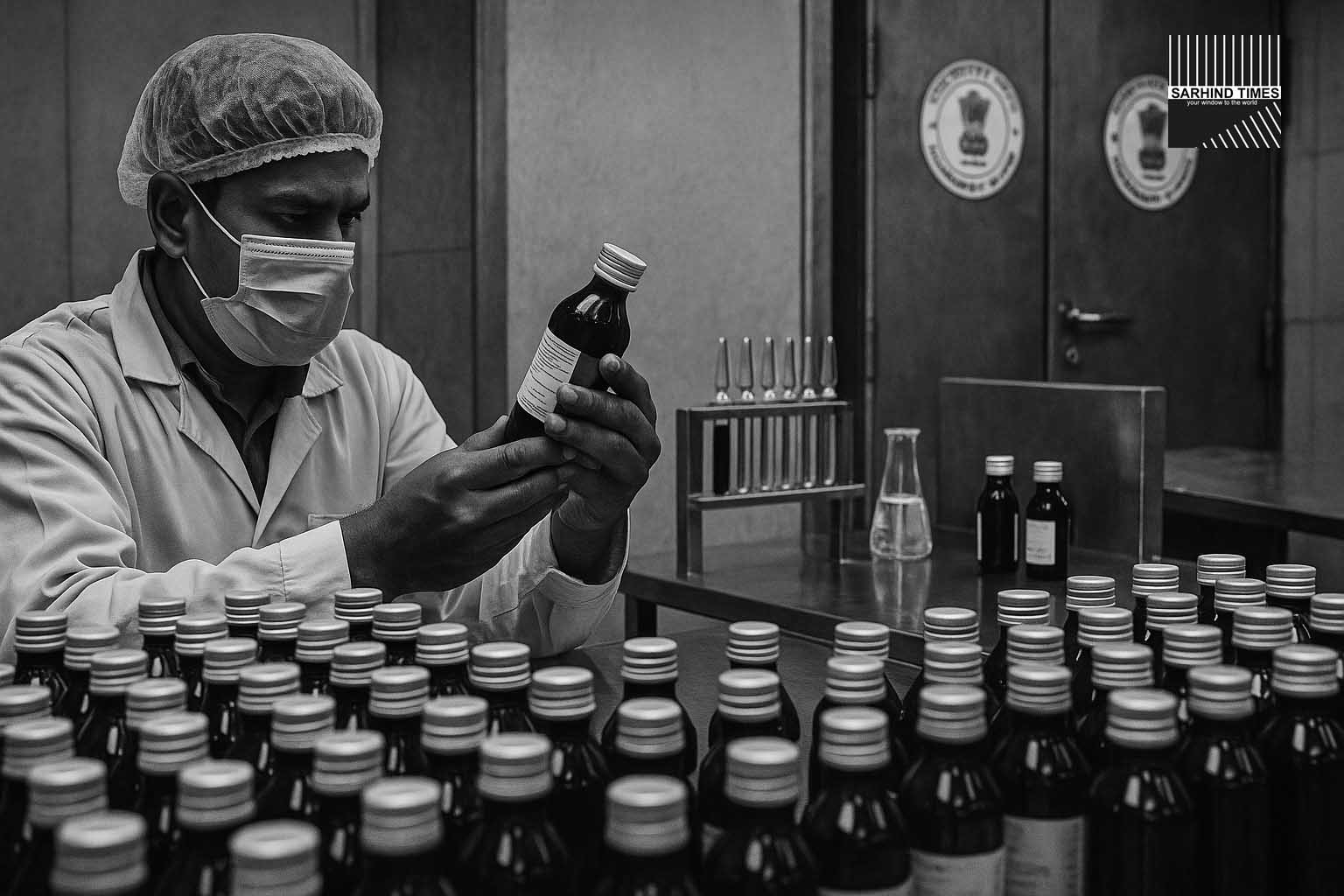
Government refuses extension for plant-upgrades after deadly contamination linked to children’s deaths
Dateline: New Delhi | 01 November 2025
Summary: In response to a recent tragedy in which dozens of children died after taking a contaminated cough syrup, the Indian government has taken a firm stand: it will not extend the deadline for small pharmaceutical manufacturers to upgrade their plants to meet global quality standards. The move marks a significant regulatory tightening and signals heightened scrutiny of India’s “pharmacy of the world” status.
The incident that triggered the crackdown
The government’s decision follows the investigation into the deaths of at least 24 children in India who consumed a cough syrup produced by a local manufacturer. Laboratory tests revealed extremely high levels of diethylene glycol (DEG) — a toxic industrial solvent — far exceeding permissible limits. The affected syrup, manufactured by a company that failed to upgrade its plant despite earlier warnings, became the focal point of a larger regulatory crisis. The Indian regulator decided in late October that no further extensions would be granted to small plants that had not yet complied with required upgrades.
Until now, India’s pharmaceutical-manufacturing sector has enjoyed a leading global position, supplying large volumes of generic medicines and export drugs. But repeated drug-safety scandals have cast a shadow: previous batches of contaminated syrups exported to Africa and Central Asia killed over 140 children in earlier incidents. Authorities say the latest crisis exposed domestic oversight gaps and triggered public anger, compelling swift regulatory action.
Regulatory context and the upgrade deadline
The flow-of events shows that in mid-2024, the government had set a deadline for drug-manufacturing plants to meet the World Health Organization (WHO)-recommended standards, following prior export-linked tragedies. Larger manufacturers met the deadline, but small and medium players sought more time. Some industry-sources said financial pressures, complexity of upgrades and disruptions in supply-chains made compliance difficult.
However, after the latest deaths were linked to the syrup made by Sresan Pharmaceuticals which reportedly contained nearly 48.6 % DEG — nearly 500-times the allowed limit — the government took a firm stand and refused extension requests. Sresan’s licence was revoked, its manufacturing facility sealed, and its founder arrested as the central regulator initiated prosecutions.
Implications for the pharmaceutical industry
The decision has wide-ranging implications. First, it signals that regulatory tolerance for non-compliance has reached a limit and that public-health concerns will override industry pleas. Second, smaller manufacturers now face an existential risk: either invest heavily in upgrades or exit the market. Many previously exporting under cost-pressure may face closure or consolidation.
Third, for India’s ambition as the “pharmacy of the world”, this crackdown introduces both risk and opportunity. Risk because supply disruptions may occur if plants shut down; opportunity because compliant manufacturers may gain competitive edge, both globally and domestically. The government has indicated that in the short term, larger compliant manufacturers will be asked to fill any supply gaps, especially in critical medicines.
Child-health, public trust and the safety deficit
The human cost of the contamination has added urgency. Children affected by the syrup unexpectedly developed acute kidney injury, vomiting, abdominal pain and subsequent multi-organ failure. By the time the contamination was flagged, many were critically ill across Madhya Pradesh and neighbouring states. The toll on families and communities has fuelled demands for accountability and stronger regulation.
For parents, the incident has eroded trust in domestic pharmaceutical products and in regulatory assurances. Stakeholders note that while India has globally competitive capacity, regulatory enforcement — zone-wise inspections, quality-control checks, supply-chain traceability — has been inconsistent. The government’s move, they argue, is as much about restoring trust as about technical compliance.
Policy action and government direction
The Ministry of Health and Family Welfare, working with the Central Drugs Standard Control Organisation (CDSCO), has issued fresh directives: any plant that has not completed the upgrade by the stipulated date will have its licence revoked, no further extension will be entertained, and all batches from non-compliant plants will be flagged for compulsory retesting before use in the supply-chain. Export-only plants will also face stricter audit, and distribution of suspect products domestically will be curtailed.
The government is also consulting with the taxation and manufacturing ministries to provide fiscal support — such as concessional loans, tax rebates or fast-track approvals — for compliant plants, though such support will only go to those within deadlines. For non-compliant units, closure or conversion is on the table. A separate task-force is mapping vulnerable segments of the industry and documenting potential supply disruptions, so as to pre-empt medicine-shortage risks.
Challenges and next-steps for public health safety
While the regulatory push is strong, implementation will not be easy. Upgrading a drug-manufacturing plant to WHO-Good Manufacturing Practice (GMP) involves large capital outlay, process re-engineering, quality system upgrades, traceability protocols and staff training. Many smaller manufacturers operate narrow-margin businesses, and the move may trigger consolidation, job-losses or market exit.
In parallel, the regulator must ensure continuity of supply for critical medicines. The government has confirmed that it will monitor stocks of essential medicines closely and may impose temporary import licences or invoke stock-piling to avoid disruption. The shift also raises concerns around pricing: if supply shrinks and competition drops, medicine costs may rise, affecting low-income patients. Balancing patient access and safety will be a key policy challenge.
Global outlook and India’s pharma export credibility
India exports medicines to over 200 countries and remains one of the largest producers of generic drugs. However, the recent crisis has tarnished that reputation in key export markets in Africa and Central Asia, where past syrup-poisoning incidents had already triggered large-scale recalls. To retain global export links, Indian manufacturers must meet international standards reliably. The government’s strong stance is therefore also a message to global buyers: “India will not compromise on quality.”
What this means for patients and healthcare providers
For patients and doctors, the crackdown means enhanced vigilance: hospitals and clinics are being asked to track adverse-events linked to cough syrups and share data with health-authorities. Suppliers of medicines have been instructed to provide batch-wise documentation of plant status. Patients are being advised to check for batch-recall alerts and prefer trusted brands. Meanwhile, the public-health community is ramping up monitoring of paediatric renal injury cases that could signal residual contamination events.
Conclusion
The Indian government’s decision to enforce plant-upgrades without further delays marks a watershed moment in the country’s pharmaceutical-regulation regime. Triggered by tragic child-fatalities, the move underscores that medicine-quality cannot be secondary to cost or speed. For the industry, the message is clear: adapt or exit. For patients, the hope is for safer medicines and rebuilt trust. The balance ahead between supply, safety and affordability will test not just regulators and manufacturers, but India’s broader commitment to healthcare for all.
“`
**Categories & Tags**
Categories: Health, India, National
Tags: cough syrup crisis India, pharmaceutical manufacturing reform India, child deaths India syrups, drug regulation India October 2025, CDSCO enforcement India
* [Reuters](https://www.reuters.com/sustainability/cop/us-will-not-send-officials-cop30-climate-talks-white-house-says-2025-10-31/?utm_source=chatgpt.com)
* [thetimes.com](https://www.thetimes.com/uk/environment/article/cop-30-climate-conference-brazil-belem-2025-k8pw3svwd?utm_source=chatgpt.com)
* [Reuters](https://www.reuters.com/sustainability/sustainable-switch-climate-focus-cop30-deadly-drug-crackdown-2025-11-01/?utm_source=chatgpt.com)



+ There are no comments
Add yours