
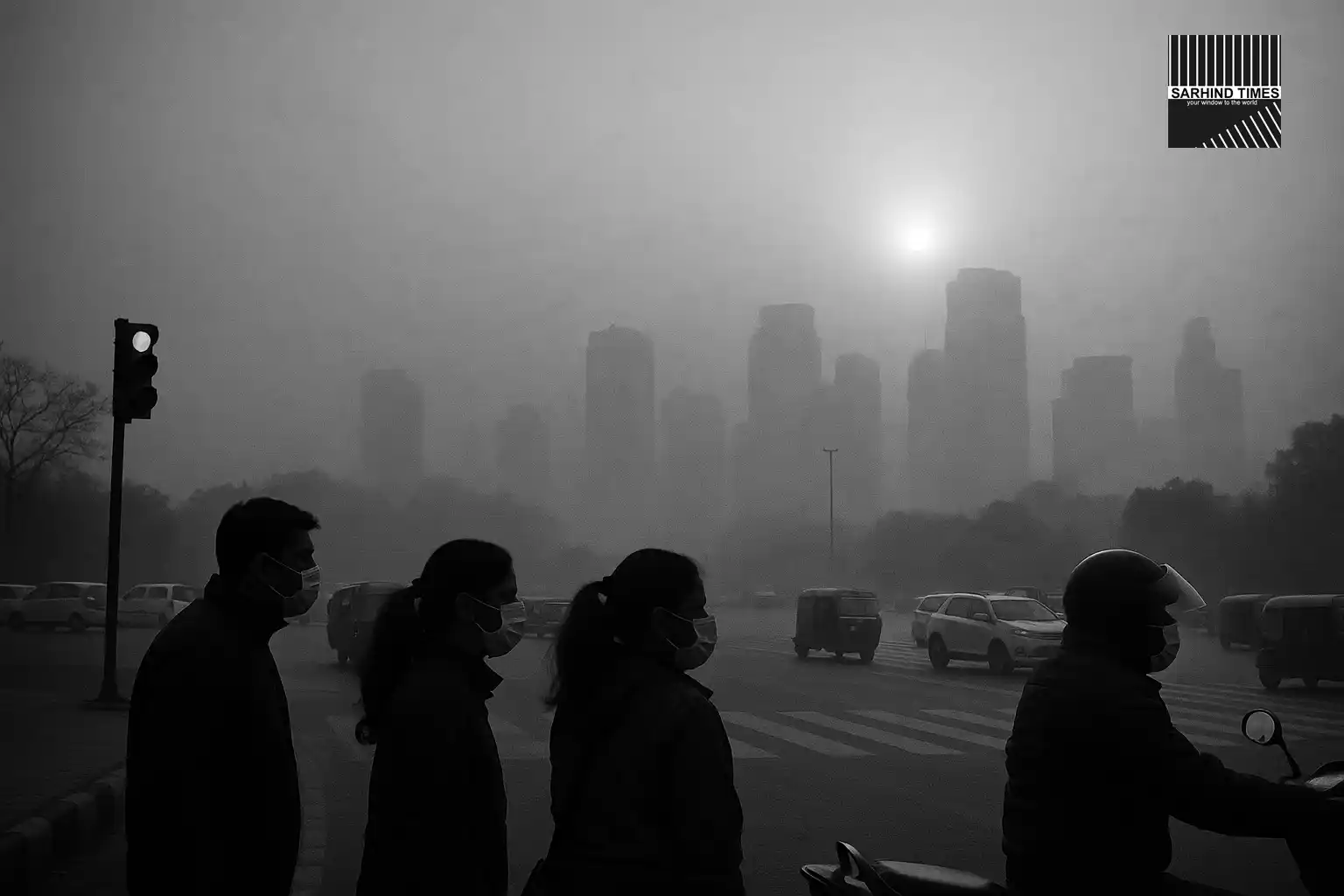
With air quality already “unhealthy” to “hazardous” across major urban areas, authorities and residents prepare for what could be a grimmer season than ever
Dateline: New Delhi | 8 November 2025, Asia/Kolkata
Summary: As winter sets in, India is witnessing a sharp rise in air pollution across its northern belt. Real-time readings show PM2.5 concentrations reaching hazardous levels in the National Capital Region and other major cities, prompting alerts from monitoring agencies. Experts warn that the combination of stalled wind, crop-residue burning and lingering festival emissions will test urban resilience and public health systems in the coming months.
1. The early warning signs: data and trends
Across northern India, evidence is mounting that the forthcoming winter pollution season may be more severe than prior years. For example, readings from Swiss-based monitoring service IQAir show that, as of 7 November, many Maharashtra, Delhi, Haryana, Uttar Pradesh and eastern cities are logging Air Quality Index (AQI) figures above 300 — the “unhealthy” category — with several crossing 500 or more. In the national capital, AQI levels topped 700 on multiple mornings, placing the city in the “hazardous” bracket and raising alarm among residents and officials.
Meanwhile, a recent country-wide report notes that all of India now lives in areas where annual average PM2.5 levels exceed even India’s own standard of 40 µg/m³ — according to the Air Quality Life Index 2025 update. Roughly 544 million people live in zones of chronically poor air quality, suggesting that the problem is systemic rather than episodic.
This early spike comes ahead of the full push of winter and standard pollution triggers — giving a lead-window for action, but also indicating greater risk.
2. What’s driving the spike: multiple sources converge
The factors behind this early surge are well-known, yet this year they appear to be converging with more intensity:
– **Crop-residue burning:** Fields in Punjab, Haryana and western Uttar Pradesh are undergoing post-harvest residue burning. Smoke plumes drift into the NCR and adjacent areas, raising particulate matter (PM) loads significantly.
– **Festive and fireworks emissions:** Recently concluded festivals such as Diwali added heavy bursts of particulate and gaseous pollutants. Even with “green” cracker restrictions in place, widespread violations occurred, and the post-festival spike lingers.
– **Stagnant weather and lower wind speeds:** With early onset of cooler air, inversion layers are forming. These trap pollution near the surface, preventing dispersion and exacerbating concentrations.
– **Vehicle, construction and industrial emissions:** In dense urban pockets, aging vehicles, heavy traffic, ongoing construction and industrial processes continue to contribute NOx, SO₂, PM and secondary pollutants like ground-level ozone. The Central Pollution Control Board recently reported that ozone pollution is high in the NCR and Mumbai, making the problem multidimensional.
– **Weak or reversed regulatory momentum:** Some older regulatory mandates, such as flue-gas desulphurisation (FGD) systems in coal plants beyond major cities, have been eased, raising concerns about longer-term emissions control.
The combination of these drivers means that even if one sector improves, the others may offset gains — making the winter smog surge likelihood high.
3. Regional focus: Delhi-NCR and its spill-zones
The National Capital Region remains uniquely vulnerable. Its geography, dense urbanisation, heavy traffic and multiple pollution sources combine with seasonal meteorology to create a recurring smog challenge. On 7 November the AQI in Delhi surged past 700, and nearby cities like Ghaziabad, Noida, Gurugram and Faridabad saw readings well-above 300.
The spill-zones — including parts of western Uttar Pradesh, Haryana, and Rajasthan — are also under pressure. In many of these locales the particulate concentrations are persistently high, and local health infrastructure is already preparing for increased load of respiratory and cardiovascular cases. The state governments of Delhi and Haryana have already restricted construction activities and diesel generator usage in some high-pollution days — but whether these measures will hold or be extended remains to be seen.
4. New tools and policy responses: cloud-seeding, alerts and more
The early surge has prompted authorities to explore novel interventions alongside traditional controls. Notably, Delhi’s regional government in collaboration with the Indian Institute of Technology Kanpur embarked on a cloud-seeding experiment in late October to trigger artificial rainfall and clear the air. While the operation received attention, experts called it a short-term fix that does little to address root causes.
At the institutional level, urban-air dashboards and early-warning systems are being activated more rapidly. Alerts advising citizens to limit outdoor exposure, close windows, use purifiers, and wear masks are being circulated across states. Some states are also bringing forward winter-smog action-plans that were usually in effect later in December.
On the regulatory front, the National Clean Air Programme (NCAP) continues to be the central framework, but critics say implementation gaps remain wide. With recent easing of sulphur-emission rules for many coal-based plants, some policy analysts warn that momentum may be waning just when stronger control is needed.
5. Health and socio-economic risks
The elevated pollution levels pose multiple risks: studied associations link PM2.5 exposure to respiratory illness, cardiovascular disease, adverse birth outcomes, and reduced life expectancy. In Indian cities, children, the elderly and outdoor workers (construction, roadside vendors) are particularly vulnerable.
Economically, higher pollution means increased healthcare burden, reduced productivity, more sick days, and greater strain on public services. In a city like Delhi where an AQI spike to 700+ occurred, the tangible cost to citizens and institutions becomes acute — from hospital surge to commuter exposure, and even tourism impact.
Socially, there is a growing divide: those with means may relocate or install air-purifiers; those without remain trapped in hazardous ambient conditions. The legal dimension is also growing: some activist groups are asking courts to treat clean air as a fundamental right — the approach that India’s Supreme Court affirmed earlier.
6. Systemic challenges and implementation gaps
Despite decades of policy frameworks, the recurring smog challenge highlights systemic deficits:
– **Poor data integration and monitoring**: While monitoring stations exist, real-time data sharing, local forecasts and release of maps remain inconsistent across states and cities.
– **Fragmented governance**: Urban air-quality management involves multiple agencies — traffic police, municipal corporations, state pollution control boards, environment ministry — with weak coordination and overlapping mandates.
– **Delayed enforcement**: Penalising crop-residue burning, industrial non-compliance, and vehicle-emission violations often remains slow and legally contested. Even when action is taken, effectiveness is limited.
– **Public awareness and behaviour**: In many areas, residents are unaware of pollutant sources or do not change behaviour early. For example, despite official alerting, large segments in NCR continue to rely on diesel generators or open biomass burning.
– **Infrastructure bottlenecks**: Public transport share remains low in peripheral urban zones; vehicles dominate. Green-belt buffers, efficient dust-management systems in construction sites, upgraded industrial filters and modern vehicle fleets are still aspirational in many cities.
In short, the underlying architecture for sustained air-quality improvement is still fragile — and may weaken further if economic trade-offs lead to regulatory rollback.
7. Looking ahead: what to watch this winter
As winter deepens, several turning-points and indicators will matter:
– **Frequency of high-AQI episodes**: If cities like Delhi or Gurugram repeatedly exceed AQI 400-500 levels over multiple days, the situation may require emergency interventions (school closures, traffic restrictions).
– **Crop-fire and residue-burning data**: Monitoring satellite fire-counts and ground-confirmation in Punjab, Haryana and western UP will reveal whether measures (alternative disposal subsidies, no-burn zones) are working.
– **Transport and traffic flows**: If public-transit and active-mobility measures are rolled out, they may reduce private-vehicle dependency and curb emissions.
– **Industrial emissions control**: Whether the recently relaxed FGD rules get re-assessed, or whether enforcement of industrial stack-emissions improves, will influence overall ambient levels.
– **Health-sector readiness**: Hospital admissions for respiratory issues, air-purifier sales, mask usage penetration and school-attendance disruptions may reflect the real-world toll.
– **Behavioural signals**: If citizens, schools, municipal bodies proactively implement advisory behaviour (reducing outdoor time, using masks and air-filters), the human-impact may moderate.
8. Opportunity for structural reform
While the focus is often on immediate episodes of smog, there is a structural opportunity embedded in the crisis:
– Strengthening public transport and reducing private-vehicle dominance in cities like Gurugram, Delhi and others will lower emissions and improve urban liveability.
– Investing in domestic renewable energy plants, phasing out older coal-based units and accelerating FGD and pollutant-capture technology can address industrial contributions.
– Agro-policy reform: incentivising alternatives to residue-burning, promoting mechanised collection, pelletising stubble and linking farmers into value-chains can shift agricultural emissions.
– Urban design: greening belts, low-emission zones, enforcing construction-dust norms and shifting to non-motorised transport will support ancillary reduction in exposure.
– Data and transparency: building real-time public dashboards, clear air-quality alerts, community-driven monitoring and integrating health-outcome data into policy loops will improve responsiveness.
This winter’s smog season could become a catalyst rather than just a recurring crisis — if states choose to act on structural levers rather than just episodic fixes.
9. Citizens’ checklist: actionable steps
For residents and urban-dwellers the following measures are advisable this season:
– Reduce outdoor exposure during high-AQI days — plan travel early, avoid peak traffic periods.
– Use good quality masks (KN95/FFP2) if outdoor time is needed.
– Install or use air-purifiers in key indoor areas, especially if you are in vulnerable health categories.
– Support local-community clean-air efforts: tree-planting, neighbourhood dust-management, reporting of illegal burning.
– Stay informed: subscribe to local air-quality alerts, check AQI levels and act proactively when thresholds are crossed.
– For households: avoid biomass or coal burning, ensure efficient cooking and heating, monitor ventilation and indoor air quality.
10. Conclusion: a critical juncture for India’s clean-air agenda
India enters this winter at a critical inflection point in its clean-air journey. The signs are clear: pollution levels are climbing earlier, the drivers remain complex and overlapping, the health stakes have never been higher. For policy-makers and city-leaders, the challenge is not just to manage episodic spikes but to shift into a regime of sustained cleaner air.
If India leans into its structural levers — transport reform, agricultural emissions control, industrial upgrades and transparent monitoring — this winter might mark the beginning of turning the smog cycle. If not, citizens may endure yet another harsh season, with long-term health and economic costs mounting. The window of opportunity is narrow, and the nation’s capacity for execution is about to be tested.



+ There are no comments
Add yours