
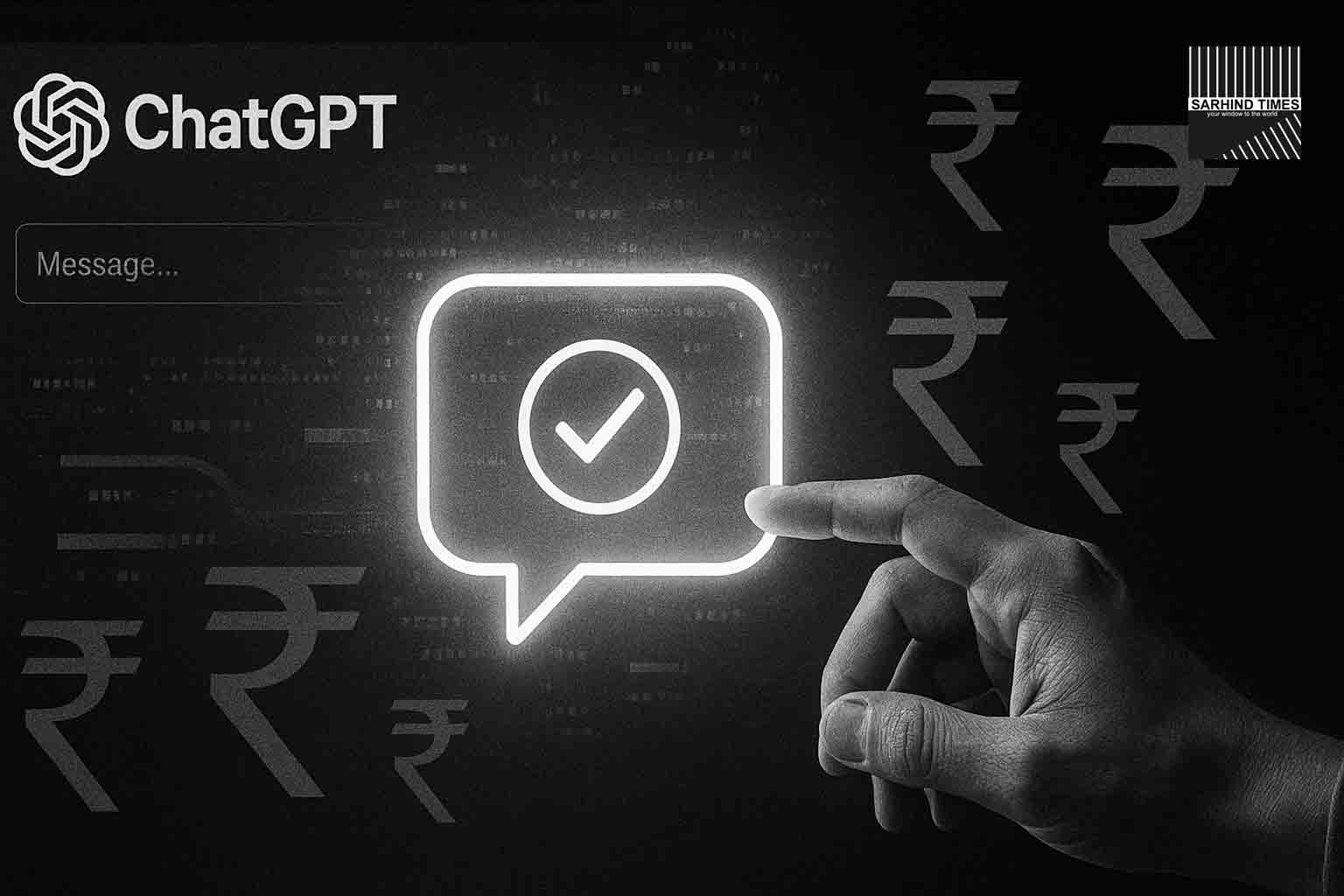
India takes a bold leap toward the future of “agentic commerce,” testing direct UPI payments within ChatGPT conversations. The pilot, involving NPCI, Razorpay, Axis Bank, Airtel Payments Bank, and Bigbasket, aims to redefine how Indians shop and pay online — seamlessly, securely, and intelligently.
By SarhindTimes Bureau
New Delhi, October 2025
India’s Conversation Turns into Commerce
India has long been at the forefront of digital payments. From the introduction of the Unified Payments Interface (UPI) in 2016 to the exponential adoption that followed, the country has become a global case study in how to democratize financial technology. Now, India is pushing the boundaries once again — this time, merging artificial intelligence with e-commerce.
In a world-first initiative, the National Payments Corporation of India (NPCI) has partnered with Razorpay, Axis Bank, Airtel Payments Bank, and Bigbasket to enable UPI payments directly through ChatGPT, the AI conversational platform by OpenAI.
This pilot allows users to chat, decide, and pay — all within one seamless interface. For the first time, an AI assistant can help users compare products, apply coupons, and complete checkouts through a secure, user-authorized UPI flow.
As per the collaboration framework, NPCI provides the payment backbone, Razorpay serves as the technology bridge integrating payment APIs with conversational flows, while participating banks manage transaction authorization. Bigbasket, India’s leading e-grocery platform, becomes the first pilot partner to test conversational commerce at scale.
A Step into “Agentic Commerce”
Industry insiders are calling this the dawn of agentic commerce — a paradigm where AI assistants don’t just help users think or search but act on their behalf.
Imagine saying:
“Hey ChatGPT, order my usual grocery basket from Bigbasket and apply any new offers.”
The AI confirms your order, shows the total, and requests your biometric or PIN confirmation via your linked UPI app — all without leaving the chat.
Once authorized, the payment is made instantly through UPI rails. The user gets a confirmation within ChatGPT, followed by standard UPI transaction notifications from their bank.
According to sources close to the project, each transaction must pass a two-step verification process — AI recommendation and user consent — to maintain transparency and regulatory compliance.
NPCI officials emphasize that the system will be fully auditable, featuring consent logs, time-stamped authorization records, and traceable digital footprints to safeguard against fraud or misuse.
Behind the Scenes: How It Works
- Discovery & Decision:
The user chats with ChatGPT about products or services, e.g., “Show me organic rice under ₹500.” - Recommendation Engine:
The AI cross-references multiple marketplaces and curates relevant options. - Checkout Trigger:
Once the user confirms, ChatGPT invokes the Razorpay–NPCI payment bridge to create a UPI intent. - User Authorization:
The user approves the payment via their linked bank app (BHIM, GPay, Paytm, PhonePe, etc.). - Payment Completion:
The system confirms success in-chat, while NPCI logs the transaction as a standard UPI event.
This seamless loop demonstrates what experts call “multi-agent cooperation” — where conversational AI, payment APIs, and financial institutions collaborate dynamically to complete a task.
NPCI’s Vision: “Conversational Payments” for All
A senior NPCI official stated anonymously:
“This is a natural next step for UPI. We’ve built the rails for instant, secure payments. Now we’re testing how these rails can empower new interfaces — whether that’s voice, chat, or AI.”
India’s digital payments infrastructure already handles over 20 billion transactions per month, processing trillions of rupees annually. Integrating AI interfaces like ChatGPT could unlock an entirely new front — AI-led financial inclusion.
The goal isn’t merely convenience; it’s about accessibility.
Rural users or first-time online shoppers could one day simply “talk” to an AI assistant in Hindi, Tamil, or Bengali and ask it to pay bills, recharge phones, or order essentials, all verified through voice authentication and UPI consent.
Security, Trust, and Regulation
With such innovation comes the question of safety.
The Reserve Bank of India (RBI) and NPCI have both clarified that no autonomous transaction will be permitted. Every payment will require explicit consent. Fraud detection algorithms are being trained to flag anomalies like repeated attempts, inconsistent geolocation, or mismatched device fingerprints.
Razorpay’s CTO, Shashank Kumar, told reporters:
“AI can improve user experience, but it cannot replace user control. In this pilot, every step is logged, every command traceable. The user remains the ultimate decision-maker.”
Cybersecurity experts echo the sentiment.
Dr. Aparna Iyer, an AI ethics researcher, explained:
“This model could revolutionize commerce, but it must adhere to three pillars — consent, context, and compliance. The AI should not infer transactions beyond user intent, nor should it store sensitive data.”
For regulators, the pilot is as much about data governance as it is about financial safety. It will inform future frameworks for AI in fintech, balancing innovation with accountability.
Banks Join the Conversation
Banks like Axis Bank and Airtel Payments Bank view this pilot as the beginning of a new era of “invisible banking.”
“Customers are already chatting with AI every day. If those conversations can also handle verified payments, we become part of their lifestyle, not just their wallet,” a senior Axis executive said.
Airtel Payments Bank, which has over 70 million active users, sees potential in micro-transactions and subscription management through ChatGPT.
Imagine ChatGPT automatically reminding you of your DTH recharge, asking permission, and completing it with one tap.
Bigbasket: The First Mover
Bigbasket, one of India’s largest online grocers, has long experimented with automation — from smart replenishment to predictive delivery. With this pilot, it becomes the first commerce partner to explore AI-led conversational checkout.
“We’re always looking for ways to make grocery shopping faster and smarter,” said Hari Menon, CEO of Bigbasket. “If customers can place orders and pay within a chat window, it’s a breakthrough in convenience.”
This could reduce cart abandonment rates, one of the biggest pain points in e-commerce, where nearly 70% of users drop off before completing a purchase.
The Broader Vision: From Chat to Wallet
The implications extend far beyond retail.
If successful, AI-led payments could soon power:
- Bill payments (electricity, gas, broadband)
- Travel bookings
- Insurance premium renewals
- Micro-loan applications and repayments
- Subscription services
A “smart wallet assistant” could eventually act as your financial concierge, reminding you of due dates, comparing interest rates, or negotiating discounts — all via secure AI-led interactions.
The Technology Backbone
The integration uses a secure NPCI sandbox, enabling real-time monitoring.
Each partner—Razorpay, Axis Bank, and Airtel Payments Bank—maintains individual audit logs and encryption keys.
Razorpay’s API layer plays the crucial role of bridge and validator, ensuring that data flowing between ChatGPT’s conversational interface and UPI servers remains encrypted and tamper-proof.
This model follows AI transparency standards being developed by the Bureau of Indian Standards (BIS) for financial systems involving generative AI.
Global Context: India Leading Again
Globally, fintech giants are closely watching India’s move.
While ChatGPT’s payment features have been explored with Stripe in the U.S., no country has yet allowed AI-led payments via a national real-time payment network like UPI.
That makes India’s initiative unprecedented.
World Bank analysts have repeatedly cited India’s UPI as the “gold standard of public digital infrastructure.” Integrating it with AI adds yet another dimension — from digital inclusion to cognitive inclusion.
Risks & Mitigations
No innovation is without risk. Key concerns include:
- AI Misinterpretation:
What if the chatbot misreads user intent? A wrong order could result in financial loss.
Solution: Double consent layer — textual confirmation followed by biometric approval. - Data Privacy:
ChatGPT operates on cloud servers; thus, Indian regulators will demand that sensitive data remain within NPCI’s jurisdiction.
Solution: Tokenization and localized data residency rules. - Fraudulent Prompts:
Phishing prompts could mimic legitimate AI interactions.
Solution: NPCI will roll out a “Verified AI Partner” badge, similar to UPI app verification marks. - System Downtime:
UPI currently boasts 99.99% uptime, but real-time AI handoffs introduce latency challenges.
Solution: The pilot is designed to stress-test response times under high load.
Expert Opinions
Ritesh Agarwal, fintech analyst at PwC, noted:
“This isn’t just about payments. It’s about redefining the user interface of money. When an AI becomes your shopping companion, India’s digital economy gets personal, conversational, and continuous.”
Dr. Arvind Sankaran, AI governance consultant, added:
“If India can manage this safely, it sets a global precedent for responsible AI-finance convergence.”
User Experience: A Glimpse of the Future
Test users participating in the pilot shared early impressions:
“I asked ChatGPT to reorder my weekly groceries. It showed me current discounts, let me modify quantities, and paid using my linked UPI ID — all within one minute,” said one participant in Bengaluru.
Another user appreciated the hands-free experience, saying:
“It’s like talking to your personal shopper. But I liked that it still asked for my fingerprint before paying.”
Such early feedback will shape how conversational commerce expands to millions.
Economic Significance
Digital payments already contribute to over 45% of India’s total transactions by value. Adding AI-assisted flows could bring in new users — particularly senior citizens or rural customers — who find chat-based interfaces more intuitive than app-based navigation.
Economists estimate that AI-led transactions could increase overall digital commerce volume by 8–10% annually, driving both merchant adoption and government revenue through traceable transactions.
What’s Next?
If the pilot proves safe and scalable, phase two may include:
- Integration with more merchants (Amazon India, Swiggy, MakeMyTrip)
- Regional language support (Hindi, Tamil, Bengali, Marathi, etc.)
- Voice-led commerce through India’s Bhashini AI initiative
- Integration with ONDC (Open Network for Digital Commerce)
NPCI officials hinted that ChatGPT-powered ONDC checkouts could be the next milestone, merging India’s open network with AI interfaces.
India’s Edge: Trust, Scale, and Talent
Unlike Western markets where private players dominate payments, India’s public digital infrastructure — Aadhaar, UPI, DigiLocker, and ONDC — enables experimentation at scale.
Combine that with India’s rapidly growing AI ecosystem, and it’s clear why the country is positioned to lead this next phase of fintech evolution.
Closing Thoughts
This pilot isn’t just another fintech experiment; it’s the blueprint for how AI, banking, and commerce can coexist responsibly.
By merging UPI’s reliability with ChatGPT’s intelligence, India could redefine how billions transact — making every conversation potentially actionable, every query monetizable, and every user empowered.
If successful, it will be remembered as the moment India turned AI from assistant to agent — and the chat window into a checkout counter.
#UPI #Fintech #AI #Payments #Ecommerce #NPCI #Razorpay #DigitalIndia #ChatGPT #AgenticCommerce #Innovation #Technology #Bigbasket #AxisBank #AirtelPaymentsBank



+ There are no comments
Add yours