

After Gurgaon and Delhi recorded “Severe+” air quality levels, India’s apex court takes suo motu cognisance and will examine state compliance with the Graded Response Action Plan (GRAP) and Centre’s accountability.
The Supreme Court of India will hold a special sitting next Monday to review the worsening air-pollution crisis across the National Capital Region. The bench led by Chief Justice D.Y. Chandrachud has summoned reports from the Commission for Air Quality Management (CAQM), the Centre, and all NCR states, calling pollution “a recurring constitutional failure that endangers the right to life.”
Why the Court Stepped In
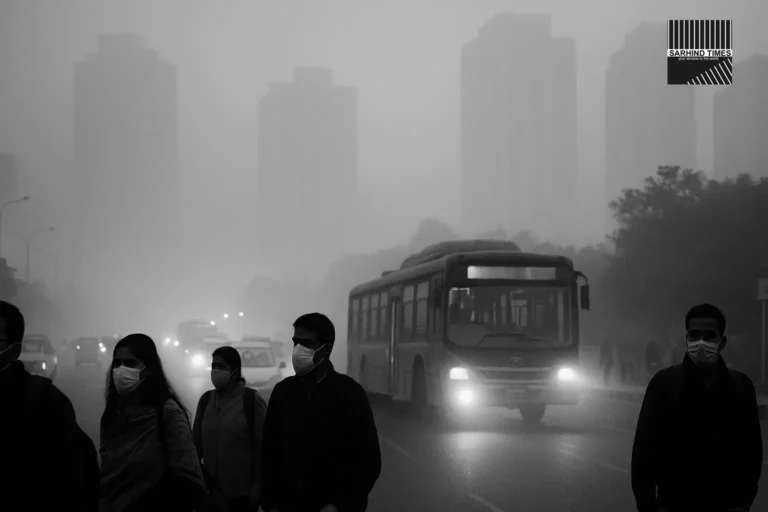
For the second consecutive winter, a thick grey pall has settled over Delhi-NCR, pushing daily life into a zone of caution and compromise. Schools have staggered hours, outpatient departments report spikes in breathlessness, and municipal bodies are back to sprinkling water on dusty corridors and crossroads. Against this backdrop, the Supreme Court has decided to step in — not as a seasonal firefighter, but as a constitutional sentinel seeking to address what it terms “a structural governance lapse.” The trigger, sources say, was a compilation of news reports and medical advisories flagged to the Registrar General, highlighting “Severe+” readings across Delhi and Gurgaon and a documented rise in emergency respiratory admissions.
Taking suo motu cognisance under Article 32, the bench has registered a public-interest matter and issued urgent notices to authorities responsible for air-quality management. The decision comes amid public unease with the stop-start rhythm of controls: bans on construction one week, partial reopenings the next, and traffic restrictions that often falter in enforcement. The court has signalled that this year’s scrutiny will focus as much on the architecture of accountability as on the immediate firefight.
“Clean air is not charity — it is a constitutional guarantee. Citizens cannot be condemned to breathe toxic air year after year while governments trade blame.” — Chief Justice D.Y. Chandrachud
The Bench and Monday’s Agenda
The matter will be heard by a bench led by the Chief Justice, with Justices J.B. Pardiwala and Manoj Mishra on the roster. The court has sought granular updates from CAQM, the Union Environment Ministry, the Delhi Government, and the governments of Haryana, Uttar Pradesh, and Rajasthan. It has also asked the Indian Meteorological Department (IMD) to file forecasting inputs that correlate wind patterns with pollution episodes, and the Central Pollution Control Board (CPCB) to submit data on compliance and penal actions taken in the current season.
- Assessment of GRAP Stage IV triggers and how quickly they were operationalised across Delhi, Gurgaon, Noida and Faridabad.
- Affidavits on enforcement staffing, inspection logs, challans issued, and prosecution status for repeat violators.
- Review of live AQI dashboards, satellite fire counts, and sensor-network reliability, including data validation methods.
- Consideration of a permanent Clean Air Commission for Delhi-NCR with statutory powers and an independent secretariat.
The hearing is scheduled for October 28 (Monday), with live streaming indicated to ensure transparency and public access. Observers expect a robust discussion on the limits of administrative discretion when fundamental rights are at stake and on whether extraordinary judicial remedies are warranted if coordination breaks down.
What Sparked the Suo Motu Review
The court’s move followed an internal note compiling press coverage of Gurgaon’s “Clean-Air Emergency” and reports that Delhi’s hourly AQI crossed the 500 mark in several neighbourhoods. The bench noted that while meteorology can intensify episodes, the persistence of intense smog indicates durable failures in dust control, industrial emissions, waste burning, and seasonal biomass fires. The court described the repeated crises as “not an act of nature but a planning and enforcement deficit,” adding that seasonal plans without off-season preparation amount to “governing by calendar rather than by outcomes.”
To that end, the bench has directed that all affidavits must not merely narrate steps taken but quantify outcomes: kilometres of road vacuumed, tonnes of construction debris contained, number of pollution hotspots abated, and the time lag between GRAP triggers and on-ground action.
Centre vs States: The Fault Lines
Solicitor General Tushar Mehta, for the Union Government, informed the court that the Centre has been coordinating satellite-based fire detection with advisories to agriculture departments. He acknowledged that residue burning remains a stubborn variable but argued that the combined effect of incentives and enforcement has reduced the window of fires. Punjab and Haryana, in their preliminary responses, have cited delays in subsidy disbursal and machinery supply, while pointing to ground-level capacity constraints at the block and panchayat levels.
“The court’s patience is not infinite. Excuses of machinery shortage cannot override citizens’ lungs.” — Justice J.B. Pardiwala
The Delhi Government, for its part, told the court that while local dust controls and road sweeping have scaled up, cross-border inflows — both from biomass fires and industrial plumes — erode gains. It has also flagged the need for a metropolitan-level clean air authority with binding coordination powers, arguing that “pollution ignores administrative borders; our institutions should not.”
The Constitutional Frame
At the heart of the matter lies Article 21 — the right to life — which India’s jurisprudence has repeatedly interpreted to include the right to a healthy environment. The bench also invoked Article 47, the Directive Principle that tasks the State with improving public health. The court hinted that if inter-agency coordination fails, it may consider exercising its Article 142 powers to craft binding, time-bound directions and to constitute a monitoring mechanism capable of cutting through bureaucratic drift.
“This is not just an environmental case but a fundamental rights case. The court must intervene where policy inaction costs lives.” — Meenakshi Arora, Senior Advocate
Data Snapshot: What the Numbers Say
Even as authorities debate causality and coordination, citizens experience air quality as a daily variable — a number flashing red on phone screens and school notices. While measurements vary by hour and location, broad indicators paint a consistent picture of distress in late October.
| Indicator | Recent Range (NCR) | Implication |
|---|---|---|
| AQI (24-hr) | Severe to Severe+ in several hotspots | Prolonged outdoor exposure unsafe; vulnerable groups at high risk |
| PM2.5 (µg/m³) | Frequently > 250 in peak hours | Acute respiratory effects; long-term cardiovascular risk |
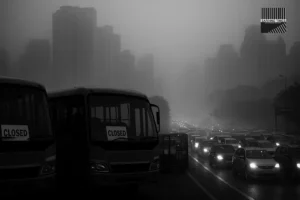
| Traffic Congestion | High; episodic gridlocks | Increased idling emissions; lost productivity |
GRAP Under the Microscope
The Graded Response Action Plan (GRAP) is designed as an escalator: as air quality worsens, progressively stricter measures kick in. Stage IV, the harshest tier, curtails most construction, intensifies mechanical sweeping, and advances traffic restrictions. The court will examine whether these triggers were applied promptly and uniformly across districts, and whether exemptions granted to priority projects diluted impact without adequate offsets.
- Were Stage III and IV actions activated at the right thresholds and communicated unambiguously to agencies and the public?
- Did enforcement squads have clear targets, sufficient staff, and night-shift coverage for compliance checks?
- Were violations escalated consistently from fines to sealing and prosecution for repeat offenders?
Children at the Bar: A First for the Season
In a poignant twist, five schoolchildren from Delhi and Gurgaon have filed an amicus brief through the NGO “Let Me Breathe,” arguing that toxic air violates their right to education and a dignified future. The bench has listed their submissions for Monday, a gesture that acknowledges the disproportionate burden borne by young lungs. Pediatric pulmonologists have long warned that childhood exposure to PM2.5 can stunt lung growth and predispose individuals to chronic disease — a trajectory that no economy can afford.
Public Mood: Anger, Anxiety, and a Demand for Clarity
Public sentiment is raw. Parents worry about outdoor sports and exam schedules, gig workers about cancelled deliveries, and small businesses about unpredictable curbs. On social media, the hashtag #RightToBreathe has trended alongside videos of low-visibility commutes and DIY air purifiers. Industry associations, meanwhile, seek predictability: if curbs are inevitable, they want them to be time-bound, data-driven, and announced with enough lead time to adjust shifts and logistics.
“We can’t survive without air — but we also can’t live without jobs. The solution has to protect both lungs and livelihoods.” — Vivek Goel, Industry Association Chair
Economics of Bad Air
Dirty air is expensive. Lost workdays, ER visits, cancelled flights, and diminished tourist footfall chip away at the region’s economic dynamism. Economists estimate that air pollution lops off a measurable slice of national output every year, with Delhi-NCR shouldering a sizable fraction of that burden. Small enterprises face a double bind: compliance costs without the cushion of scale, and demand shocks when citizens stay indoors. The court’s focus on outcome metrics may spur a better balance, ensuring that each rupee spent on mitigation yields demonstrable reductions in exposure.
“The economy cannot grow on a polluted lung.” — Dr Rathin Roy, Economist
Technology on Trial: From Satellites to Street Sensors
Policy attention is coalescing around technology that can shrink the response time from weeks to hours. ISRO’s satellite imagery already tracks fire counts; overlaying these with low-cost street sensors and mobile LIDAR vans can pinpoint plumes before they blanket entire districts. IIT-led pilots claim sub-2 km source attribution in urban canyons, enabling targeted crackdowns on illegal fuel use or midnight waste burning. The court has sought briefings on these tools and, crucially, on how they will be institutionalised rather than piloted and forgotten.
- Sensor fusion to triangulate emission hotspots and direct enforcement squads.
- Open APIs for public dashboards, enabling crowdsourced audits of action taken.
- Predictive traffic management to prevent idling-induced spikes at chokepoints.
Dust: The Underestimated Culprit
While stubble smoke commands headlines, road dust and construction debris contribute a steady, often under-policed share of particulate load. The court will probe whether municipal corporations met sweeping targets, whether water-sprinkling schedules matched meteorological advisories, and whether work sites complied with mandatory screens and on-site recycling of C&D waste. Experience suggests that disciplined dust control can bend the exposure curve even when regional inflows are unfavourable.
Healthcare Lens: Managing the Surge
Hospitals have reported seasonal surges in OPD footfalls for breathlessness, COPD exacerbations, and pediatric wheeze. Public-health experts argue for adaptive protocols: temporary triage counters for respiratory complaints, stockpiles of inhalers and N95 masks, and daily bulletins that translate AQI jargon into actionable guidance. The court is likely to ask state health departments for readiness plans, especially for vulnerable neighbourhoods abutting highways, industrial clusters, and landfill sites.
“Delhi’s rate of childhood asthma linked to PM2.5 is among the world’s highest. Prevention is cheaper — and kinder — than intensive care.” — Dr Arvind Kumar, Public-Health Researcher
Lessons from the Court’s Green Docket
India’s apex court has a long history of environmental interventions. Notable milestones include the 1998 conversion of Delhi’s bus fleet to CNG, judicial limits on firecrackers since 2016, and the affirmation in 2019 of a specialised air-quality body for NCR. Yet, the smog seasons have persisted, a reminder that judicial sparks need the oxygen of executive follow-through and civic cooperation. The present review, if it is to be different, will have to embed accountability at every link of the chain: from tendering street sweepers to prosecuting chronic violators and publishing neighbourhood-level scorecards.
| Year | Judicial Action | Intended Outcome |
|---|---|---|
| 1998 | CNG conversion for buses | Reduce vehicular particulates |
| 2016 | Restrictions on firecrackers | Lower festival spikes |
| 2019 | CAQM framework upheld | Dedicated NCR oversight |
International Parallels and Cautions
Delhi is not alone. Lahore’s High Court has experimented with a Smog Commission, and the EU’s top court has held governments liable for failing to meet air-quality targets. These precedents show that judicial nudges can catalyse policy, but they also caution against over-judicialisation that sidelines elected accountability. The sweet spot, experts argue, is a court-anchored timetable with clear deliverables and an empowered secretariat that outlasts news cycles.
What Might Monday Bring?
Based on the questions raised so far, legal experts outline several possibilities ranging from incremental to assertive:
- Constitution of a court-monitored task force with scientists, administrators, and civic representatives.
- Time-bound targets for stubble management, urban dust control, industrial fuel audits, and vehicle emission checks.
- Mandated monthly district-level dashboards that publish enforcement and exposure metrics in the public domain.
- Escalation protocols that automatically move serial violators from fines to sealing and prosecution.
Local Voices from the Ground
In Gurgaon’s construction corridors, site managers say they can comply if expectations are consistent. In East Delhi’s recycling belts, informal workers ask for safe zones and cleaner fuels rather than blanket crackdowns that erase livelihoods. In Noida’s schools, PT instructors hope for a predictable regimen of indoor alternatives when AQI crosses thresholds. These granular concerns must be stitched into any macro plan if compliance is to be durable and humane.
“The court’s intervention should not replace policy but reignite it. We need clean energy, not courtroom air.” — Vandana Menon, Environmental Activist
Risks, Trade-offs, and the Politics of Enforcement
Air, unlike water or land, is a shared and mobile resource — difficult to police and easy to politicise. Strict controls risk pushback from sectors already strained by erratic demand and high input costs. But laxity extracts a heavier, invisible tax paid in hospital queues and lost learning. The court appears intent on forcing political actors to choose outcomes over optics: if a restriction is necessary, justify it with data; if an exemption is granted, offset it with equivalent mitigation.
Proposed Timeline and Milestones
To avoid the annual ritual of frantic winter firefighting, experts propose a rolling calendar that front-loads prevention in spring and summer, stress-tests enforcement in autumn, and audits outcomes in winter. A sample pathway is outlined below.
| Phase | Date/Year | Milestone |
|---|---|---|
| I | Nov–Dec 2025 | Court-monitored action plan; district dashboards go live; peak-season enforcement surge |
| II | Jan–Jun 2026 | Off-season dust control upgrades; industrial fuel audits; sensor network expansion |
| III | Jul–Oct 2026 | Pre-winter stress tests; stubble management readiness; contingency plans refined |
Next Steps Before the Hearing
All agencies have been directed to file affidavits by Saturday evening. These must enumerate actions already taken, quantify outcomes, and outline barriers that require judicial or legislative fixes. The bench is expected to ask pointed questions on staffing, budgets, and inter-agency command structures. If a monitoring panel is constituted, it will likely be mandated through at least the 2025–26 winter to ensure continuity.
Bottom Line: Breathing Under Judicial Watch
Courtrooms cannot clear skies. But they can clear the fog of inaction. Monday’s review will test whether Delhi-NCR can move from ritual to regime — from emergency sprinklers to year-round systems, from ad-hoc bans to measurable exposure reductions. For millions in the region, it is not an abstract debate but a daily inhalation. The right to breathe has finally reached the bench; the verdict that matters most will be measured in micrograms per cubic metre, not just pages of orders.


+ There are no comments
Add yours