
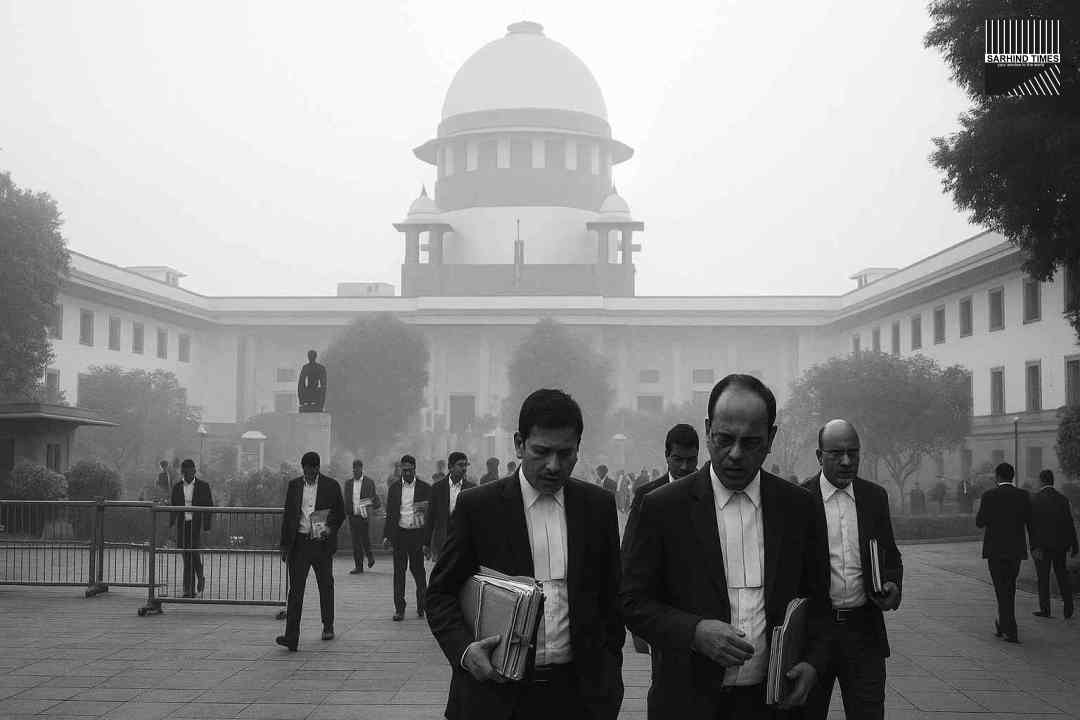
Top court examines 19-year delay in implementing mandatory reforms; seeks detailed affidavits on training gaps, torture prevention mechanisms, and accountability frameworks.
Dateline: New Delhi | 28 November 2025
Summary: In one of the most consequential hearings on police reforms in recent years, the Supreme Court sharply criticized the Centre and seven state governments for failing to implement the mandatory directives issued in the landmark Prakash Singh judgment nearly two decades ago. With custodial deaths rising across multiple states, the Court demanded time-bound action plans, strict documentation of police training reforms, independent complaint authorities, and real-time data-sharing systems. The hearing marks a pivotal moment in India’s push toward modern, accountable policing.
The Bench Signals Zero Tolerance for Further Delays
A three-judge bench of the Supreme Court convened on Thursday to hear a clutch of petitions concerning the non-implementation of police reforms mandated in its landmark 2006 Prakash Singh judgment. The Court expressed strong displeasure that after 19 years, “the foundational pillars of democratic policing” remain largely unimplemented in several states.
The petitioners — a combination of civil society organizations, retired police officials, and human rights lawyers — argued that systemic failures in police accountability frameworks have led to increased custodial violence, political interference, and erosion of public trust.
In a stern observation, the bench said, “The constitutional guarantee of life and liberty cannot be diluted by administrative lethargy. When custodial deaths are rising, reform is not an option — it is an obligation.”
States Summoned: Seven Governments Asked to Explain Non-Compliance
The Court directed seven states — Uttar Pradesh, Bihar, Tamil Nadu, West Bengal, Rajasthan, Maharashtra, and Assam — to file detailed compliance reports explaining why critical directives such as fixed tenure for police officers, separation of investigation from law-and-order duties, and establishment of independent complaint authorities remain stalled.
These states were asked to respond within two weeks, failing which the Court warned it may issue coercive directions including deployment of monitoring committees.
Senior advocates representing the petitioners emphasized that poor compliance has directly contributed to rising custodial fatalities, many of which remain uninvestigated or unresolved.
Custodial Death Statistics Raise Alarm
The bench cited recent data showing a sharp spike in custodial deaths across India, with several states recording double-digit increases over the past year. Petitioners argued that lack of independent oversight mechanisms is enabling police stations to operate with “opaque and unaccountable practices.”
A rights advocate told the Court, “When police investigate their own colleagues, outcomes are predetermined. Without external oversight, torture prevention is impossible.”
One of the state government counsels attempted to argue that deaths often occur due to “medical complications.” The bench promptly countered this claim, saying, “Medical complications do not explain broken ribs, burn marks, or evidence of blunt force trauma.”
The Core Reforms Still Pending Since 2006
In the Prakash Singh judgment, the Supreme Court mandated a series of reforms aimed at creating a professional, depoliticized, and citizen-centric police force. Nearly 19 years later, many remain partially implemented or ignored.
The Court listed the mandatory reforms and asked states to indicate precise compliance timelines:
1. Fixed Tenure for DGPs and Key Officers
The Court noted that frequent transfers erode administrative continuity and increase political control. Several states continue to bypass tenure norms.
2. Separation of Investigation and Law-and-Order Functions
Only a handful of states have implemented structural separation. Most still use the same officers for both functions, leading to compromised investigations.
3. Police Establishment Boards
Boards meant to oversee transfers and promotions exist only on paper in many states.
4. State Security Commissions
The Court highlighted that several states formed commissions but diluted their independence by appointing ruling-party functionaries.
5. Independent Police Complaints Authorities
These remain the most neglected directive. In most states, authorities are either non-functional or lack investigative powers.
6. Transparent Appointment of DGPs
The Court asked the Centre to explain why DGP appointments continue without following UPSC guidelines.
7. Constitution of Human Rights Training Units
Many states lack structured training modules on custodial behavior, rights enforcement, and use-of-force standards.
“Your compliance charts are full of half-measures,” the bench remarked while reviewing state affidavits.
Petitioners Demand Real-Time Digital Tracking of Police Misconduct
During the hearing, petitioners urged the Court to direct states to implement digital oversight mechanisms that track custodial violence complaints, FIR filing delays, charge-sheet timelines, and internal disciplinary actions.
They argued that analog record-keeping enables tampering, delays, and manipulation.
A former IPS officer appearing as an intervener said, “Technology can transform accountability. The question is whether states are willing to expose real data.”
Centre Acknowledges Gaps, Proposes New Framework
The Centre admitted that despite multiple advisories, compliance remains inconsistent. It proposed a central monitoring portal where states would upload quarterly data on:
- Suspect interrogation hours
- Custodial injuries
- Complaint disposal rates
- Investigation quality audits
- Training completion rates
The Court responded cautiously, asking the Centre to ensure the portal is not “another bureaucratic dashboard that collects dust.”
Judges Stress Need for Scientific Investigation Techniques
The bench emphasized replacing outdated investigative practices with modern forensic tools. It noted that reliance on confessions — often extracted under duress — reflects structural weaknesses in policing.
The judges cited the need for:
- Advanced forensic labs
- Digital evidence training
- Crime-scene preservation units
- Body-worn cameras
“We cannot expect 21st-century policing from 20th-century systems,” the bench noted.
States Defend Delays, Blame Funding and Administrative Hurdles
State counsels blamed resource constraints, saying police reforms require structural reorganization, recruitment, training, and new infrastructure.
Some states argued that funding shortfalls hindered implementation of separation-of-powers directives.
The Court responded sharply: “If you can find funds for grand events, you can find funds for protecting basic rights.”
Custodial Violence Victims’ Families Attend the Hearing
Several family members of custodial violence victims were present in court. Their silent presence underscored the human cost of systemic delays.
One petitioner cited recent incidents in Tamil Nadu, Uttar Pradesh, and Rajasthan, where victims died within hours of being taken into custody. Many families allege that FIRs were not filed, CCTV cameras “malfunctioned,” and post-mortem reports were delayed.
The Court said it would examine whether CCTV coverage of police stations is functioning, stored securely, and accessible to investigators.
Human Rights Groups Demand Independent Oversight
Human rights organizations reiterated their long-standing demand for independent district-level police complaints authorities headed by retired judges.
They argue that without independence, these bodies cannot effectively investigate misconduct.
One advocate said, “Internal disciplinary inquiries almost always exonerate officers, regardless of evidence.”
Supreme Court May Issue New Monitoring Roadmap
The bench hinted at issuing a new monitoring mechanism to ensure time-bound compliance, including:
- State-wise compliance scorecards
- Quarterly reporting deadlines
- Public disclosure of reform progress
- Appointment of an independent monitoring committee
The bench added that it may also define minimum standards for police training.
Forensic Gaps Emerge as a Key Barrier to Justice
Petitioners highlighted that India has a severe shortage of forensic experts, often forcing police to rely on confessions rather than scientific evidence. Many states have pending vacancies in forensic laboratories, with delays stretching months.
The Court said it would consider issuing directions to fill vacancies and ensure timely forensic analysis.
Senior Lawyers Warn Against Cosmetic Compliance
Several senior advocates cautioned against “paper compliance” — a practice where states create institutions without giving them staff, funds, or enforcement powers.
The bench agreed, saying, “We want functional reforms, not ornamental ones.”
Public Expectations Rising as Court Tightens Scrutiny
The case has drawn widespread public interest as incidents of custodial violence have been highlighted more frequently in the media. Civil society groups say the hearing offers a rare opportunity to overhaul policing practices.
Social media platforms saw an outpouring of support for mandatory reforms, with several users sharing personal experiences with police misconduct.
The Road Ahead: What Happens Next?
The Supreme Court will reconvene in three weeks to review state affidavits and finalize a roadmap for enforcement. Judicial observers say the Court’s tone suggests it is prepared to impose strict timelines and consequences for non-compliance.
Legal analysts believe this hearing could become a defining moment for India’s criminal justice system — potentially leading to standardized policing practices, better accountability mechanisms, and a rights-based approach to law enforcement.
Conclusion: A Historic Turning Point for India’s Policing System?
The Supreme Court’s intervention marks a critical juncture in India’s push for modern, transparent, and accountable policing. With custodial deaths rising and political interference still pervasive, the Court’s insistence on strict compliance may finally force long-overdue structural reforms.
The coming weeks will determine whether India embarks on a transformative path — or continues to grapple with the chronic challenges that have plagued its policing system for decades.



+ There are no comments
Add yours