
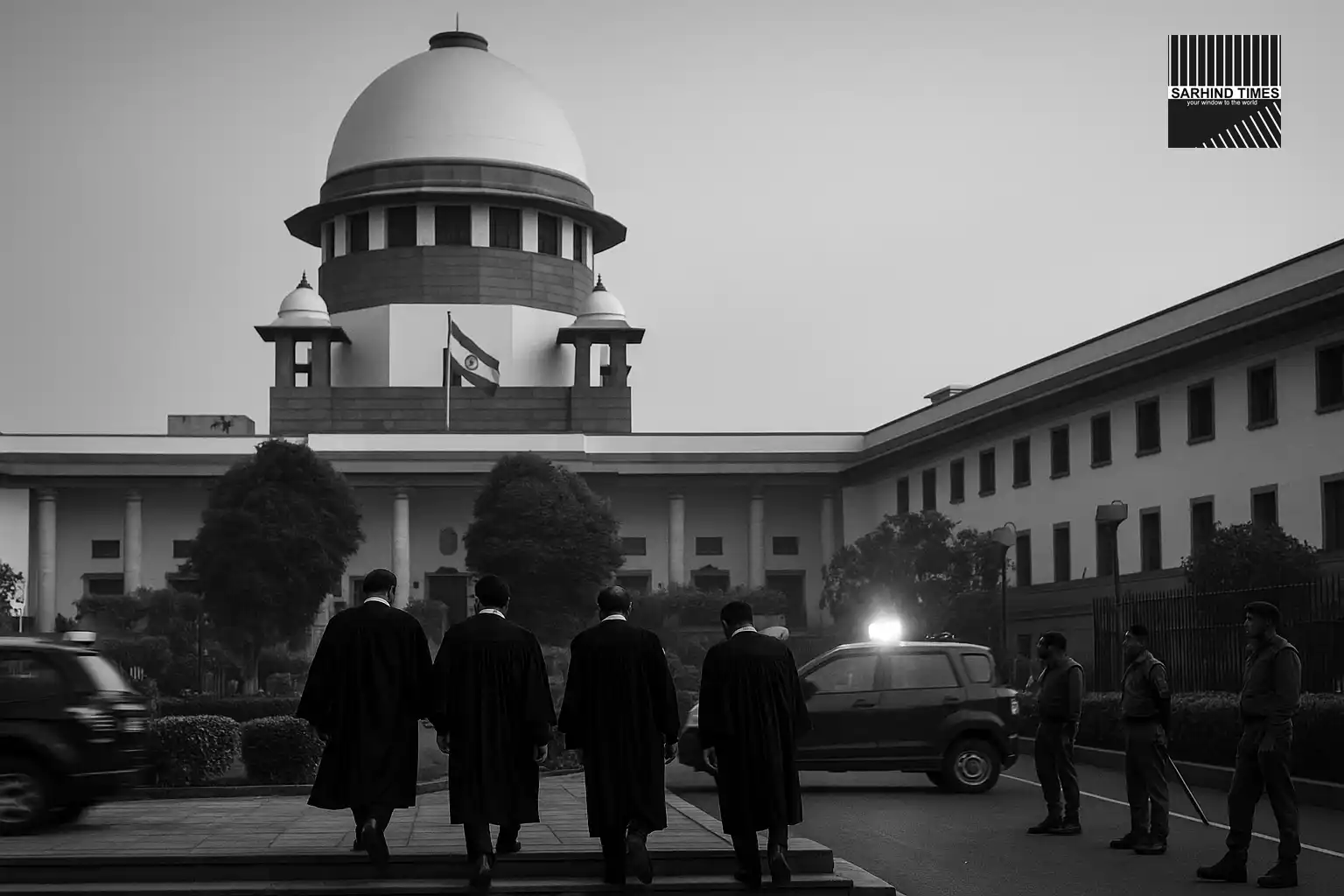
Landmark ruling strengthens lawyer-client confidentiality and signals a corrective to agency overreach
Dateline: New Delhi | 05 November 2025
Summary: The Supreme Court of India has issued a firm directive that investigative agencies must not routinely summon lawyers for the advice they provide to clients unless circumstances are rare and specifically justified. The decision seeks to safeguard the integrity of legal representation and reaffirm the professional privilege accorded to legal counsel.
Background and Context
The relationship between lawyer, client and state investigative agencies is a foundational component of the justice system. Legal counsel play a central role in protecting the rights of individuals, ensuring fair process, advising on law, and upholding constitutional guarantees. Against this backdrop, concerns had grown that agencies were summoning lawyers in investigations merely because of their role as counsel to suspect clients, rather than for their own active role in wrongdoing.
On 31 October 2025, the Supreme Court took up a case in which a lawyer was summoned by a central investigation agency to appear and explain advice he had given to a client suspected in a criminal case. The bench examining the matter observed that while agencies must have powers to probe and gather evidence, the freedom of legal counsel to advise clients confidentially is equally essential for the rule of law. The Court emphasised that lawyer-client privilege extends beyond formal communications and includes the freedom of counsel to operate independently and without fear of undue interference.
The Judgment: Key Directives and Legal Principles
In its ruling, the Supreme Court laid down several key principles:
- Investigative agencies cannot routinely summon or question lawyers solely because they have provided legal advice to accused persons.
- Any summons or interrogation of a lawyer must be in **rare, exceptional circumstances**, justified by material showing the lawyer was actively involved in criminal activity beyond representation. Merely being counsel is not sufficient basis.
- The lawyer-client relationship and confidence in representation are constitutional values underpinning Article 14 (equality before law), Article 21 (right to life and personal liberty) and statutory rights under Code of Criminal Procedure and Evidence Act.
- Agencies must ensure that any interference with legal practice and advice is proportionate, necessary and subject to procedural safeguards, including notifying the lawyer of the reasons for summons and allowing representation or independent counsel where appropriate.
- The directive explicitly warns agencies that flouting these principles undermines not only individual rights but the entire legal system’s confidence and credibility.
Why the Ruling Matters
This ruling holds significance on multiple fronts.
1. Protection of Legal Representation: Lawyers perform an essential public interest role and must be able to provide advice without fear of harassment or arbitrary summons. The decision helps reinforce that role and protect professional autonomy.
2. Enforcement Balance: Investigative agencies have broad powers in the interests of public safety and crime-control. But the Court is signalling that enforcement must respect foundational rights and that no competence should trump the rule of law.
3. Confidence in the Justice System: When counsel feel under threat, clients may hesitate to seek advice, undermining access to justice. By setting clearer boundaries, the Court strengthens confidence in the system for suspects, defendants and their advocates.
4. Precedent for Future Cases: The directive will shape how summons and questioning of lawyers are handled across the country, clarifying grey areas and providing a template for courts to assess challenges.
Interpretation and Practical Implications
In practical terms, the decision means the following changes will likely ripple through investigative and legal practice environments:
- Agencies will need to justify summoning a lawyer more rigorously—investigative records, communications, nexus to alleged wrongdoing must be demonstrable.
- Lawyers will gain a clearer legal shield, enabling them to function with greater assurance in advising clients, including those under investigation.
- Defence lawyers and rights organisations now have jurisprudence to challenge agency actions if lawyers are being called simply because they represent clients.
- Agencies themselves may adjust internal policies, training and supervisory systems to ensure summons of counsel are not routine and are subject to oversight.
Reactions from Legal Community and Enforcement Agencies
Within the legal community there has been welcome relief and optimism. Several bar associations described the ruling as restoring balance and protecting the core function of advocacy. They noted that in recent years lawyers acting for clients under investigation felt vulnerable to summons, questioning and even surveillance simply because of their professional role.
Investigative agencies, for their part, expressed a mixed response. While accepting the need to respect the rule of law and rights of counsel, some senior agency officials cautioned that serious investigations often require questioning of lawyers—when evidence suggests complicity in criminal acts or misuse of legal advice for criminal ends. The Court’s caveat that only in “rare, exceptional cases” summons of counsel are permissible is therefore likely welcomed but also raises concerns over definitional scope and operational flexibility.
Challenges and Open Questions
Even as the ruling clarifies broad principles, numerous practical and legal questions remain:
Defining “exceptional” circumstances: What precisely constitutes sufficient material to justify summons of a lawyer? Will each agency develop internal criteria or will this continue to be litigated case by case? The Court’s directive provides a framework, but operational guidelines are still needed.
Implementation oversight: Will agencies document and justify decisions to summon lawyers? Will courts monitor or audit such use? Ensuring that agencies comply rather than bypass the directive remains a challenge.
Inter-agency variations: Agencies with overlapping or competing jurisdictions might interpret the ruling differently. Harmonising approach across central and state investigative bodies will be important.
Impact on investigations: Some investigations may be delayed or complicated if lawyers feel empowered to resist summons more strongly. Agencies will need to refine their procedures and documentation before approaching lawyers.
Training and awareness: Both lawyers and agency officers will need sensitisation. Lawyers must understand when the protection applies, and agencies must train staff to adopt more discriminating practices.
Broader Legal and Governance Implications
The ruling is part of a broader pattern in recent years where courts in India have reinforced professional and institutional safeguards—for lawyers, judges, civil servants and regulatory agencies. This is consistent with the constitutional governance paradigm where independent institutions and rights of representation matter.
By reinforcing this aspect of law-enforcement procedure, the Supreme Court is sending a message about the importance of process, fairness and institutional integrity. In a rapidly modernising India, where investigations increasingly involve complex financial, cyber- and trans-national crime, the role of legal counsel and rights protections become even more critical.
Implications for Stakeholders
For defence lawyers the ruling is a protective milestone: an affirmation that legal advice to clients, in itself, does not make one a suspect. The need for independent representation remains vital.
For clients facing investigation it means stronger confidence that their legal counsel will not be subject to arbitrary investigation simply by virtue of advising them.
For investigative agencies it introduces a procedural adjustment: summons of counsel must be carefully justified and likely documented, with internal protocols refined to align with the judgment.
For policymakers and legislators the judgment underlines the need to develop clear legislative or regulatory frameworks governing investigation of lawyers / legal professionals, possibly filling the gap between the directive and operational practice.
Looking Ahead: What to Watch
Several developments can be tracked to assess how the judgement effects real-world practice:
- Investigations and agency records where lawyers are questioned — will there be fewer such summons, or better justification provided? Case-tracking will matter.
- Legal challenge filings by lawyers alleging harassment or improper summons based on the new precedent — these could shape further jurisprudence.
- Amendments or orders in central/state investigation agencies aligning rules on summoning lawyers with the Court’s directive.
- Training programmes, advisories and internal protocols adopted by enforcement agencies indicating a shift in approach to counsel-summons.
- Feedback from the bar and legal service organisations on whether the protection has practical impact or remains theoretical in practice.
Conclusion
The Supreme Court’s directive that investigative agencies can summon lawyers only in rare, exceptional circumstances marks a significant reinforcement of lawyer-client confidentiality, professional independence and institutional fairness in India’s criminal justice system. At a time when investigations grow more complex and enforcement more assertive, such a judgment is a balancing act: preserving the rights of counsel, without unduly curtailing legitimate investigatory powers.
For the justice ecosystem—lawyers, clients, agencies, courts—the ruling provides clarity, but also responsibility. The responsibility for agencies is to act with restraint and justification; for legal counsel, to maintain professionalism and independence; and for courts, to monitor adherence to this framework. If implemented in good faith, this decision can enhance both fairness and efficiency in legal processes.
In essence, the ruling reminds us that the strength of a legal system lies not merely in its power to investigate, but in its ability to protect the rights of all participants—including those whose role is to challenge power on behalf of others. That protection is not optional in a constitutional democracy—it is central to the rule of law.



+ There are no comments
Add yours