
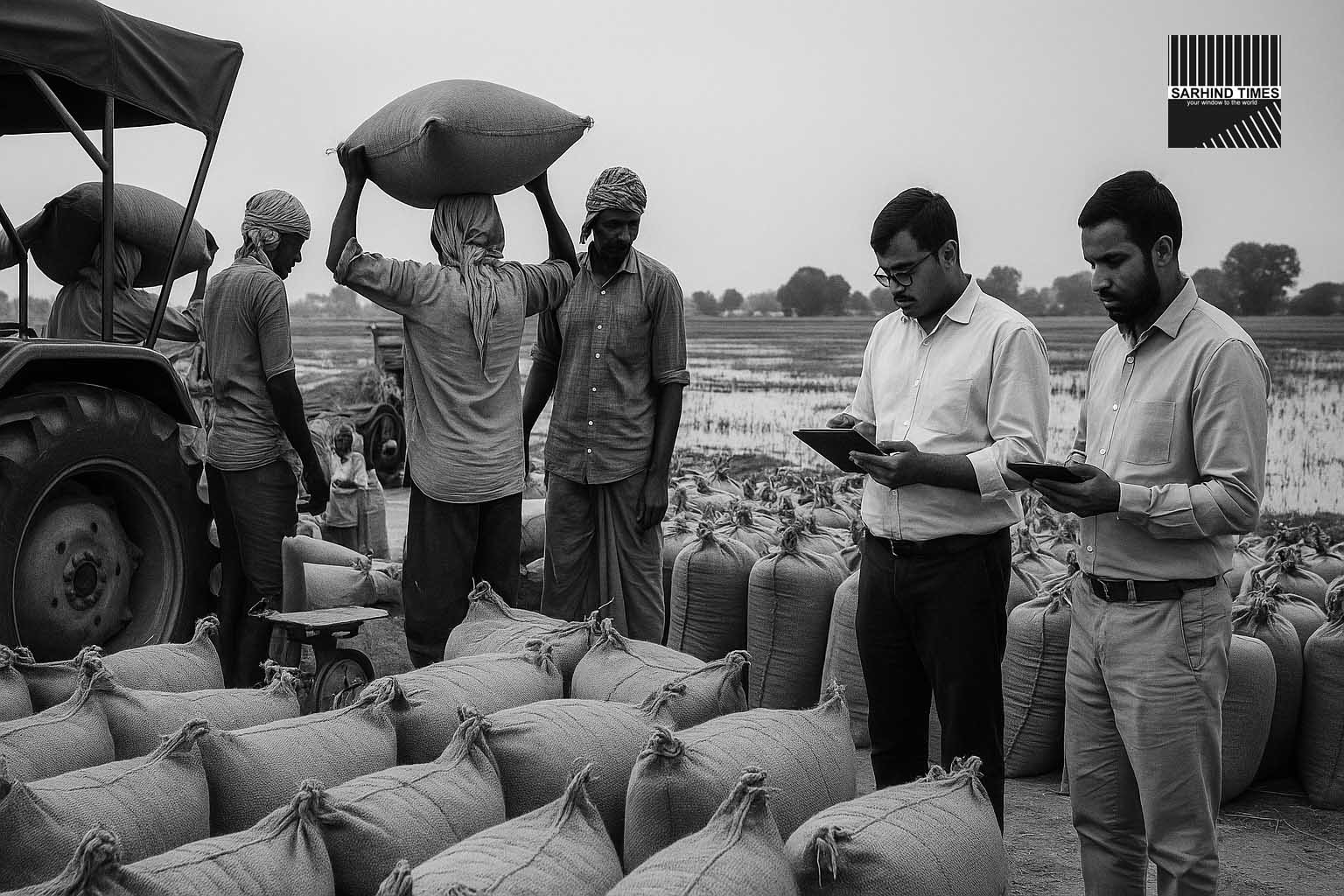
State says ₹9,000 crore transferred to farmers for 48 lakh tonnes of paddy — trade body alleges large-scale mis-procurement and diversion of funds amid flood-hit crop damage
Dateline: Gurugram/Chandigarh | 24 November 2025, Asia/Kolkata
Summary: The government of Haryana has announced that during the Kharif 2025-26 season, it procured about 48.44 lakh metric tonnes (LMT) of paddy at the Minimum Support Price (MSP) and transferred over ₹9,029 crore directly to farmers’ accounts. Meanwhile, a prominent trade-body has accused officials of orchestrating a procurement scam—alleging the purchase of cheap paddy from other states for re-sale at MSP and under-payment of local farmers amid heavy flood losses across 14.74 lakh acres. The dual narrative exposes both the scale of procurement operations and the underlying vulnerabilities in the state’s procurement framework.
State’s procurement claim: numbers and execution
The state government, through its Department of Food, Civil Supplies and Consumer Affairs, reported a total of 48.44 LMT of paddy procured from 2,52,693 farmers via its “Meri Fasal Mera Byora” portal during the Kharif season. Payments amounting to ₹9,029.39 crore were transferred directly into farmers’ bank accounts, the state claims. Reportedly 40.22 LMT had already been lifted from the markets at that time. The official MSP for paddy is ₹2,389 per quintal.
Procurement commenced early—from 22 September instead of the usual 1 October—on account of heavy rainfall risk and stubble-burning concerns, according to state officials. Mandis were instructed to ensure farmer convenience, with advance warnings of gate-passes via SMS and digital documentation.
Allegations of irregularity: trade-body raises alarm
In parallel, the provincial body Haryana Vyapar Mandal claimed the actual crop damage due to floods spanned much larger area—approximately 30 lakh acres—contrary to the official 14.74 lakh acres figure cited by the government. Despite this, procurement figures exceeded the target of 54 LMT and last year’s 53.98 LMT—reaching about 62 LMT according to one claim.
The trade-body alleges that procurement agencies purchased paddy from neighbouring states at Rs 1,500–1,600 per quintal and sold it to the Haryana state procurement system at MSP (~Rs 2,389), thus creating a financial loss for the state and unfair disadvantage to local farmers. Moreover, they say many local farmers were paid between Rs 200 to Rs 700 less than MSP under moisture content or other pretexts and that crops such as millet and cotton were similarly mishandled.
Stakeholder views and reactions
From the farmers’ side, there is a sense of relief at the scale of procurement and timely payments—especially given weather-related risk. Early procurement start and digital payment are positive signals. On the other hand, trade-representatives and farmer-organisations view the allegations as serious, hinting at misuse of procurement system and diversion of benefits.
The government has responded by reaffirming its commitment to MSP procurement. Ministers have directed that no farmer should face inconvenience and that procurement officials ensure full adherence. Yet, the presence of contradictory narratives means the issue has entered a contested zone.
Why Haryana’s procurement matters
Haryana is a major national contributor in wheat and paddy output; its procurement policies influence national food-security calculations and market signalling. Effective MSP procurement boosts farmer income, supports domestic buffer stocks and strengthens farm-economy trust. Conversely, irregularities can undermine market confidence, inflate fiscal burden and stall farm investment decisions.
Operational challenges in the season
The Kharif 2025 season faced weather adversity—rains, floods and stubble-burning risks were major headwinds. The early start of procurement was designed to mitigate this. Still, handling large volumes, ensuring accurate moisture tests, avoiding contamination and ensuring logistics posed large operational demands. The government apparently instructed mandis to implement safeguards, e.g., tarpaulin covers for produce and rapid procurement arrangements.
The reliance on vast digital platforms (Meri Fasal Mera Byora) and direct payments is positive, but there are questions about whether ground-level monitoring, moisture-check accuracy and geographic equity have held up across all districts.
Fiscal and budgetary implications
The transfer of approximately ₹9,000 crore in payments to farmers is significant—implying a heavy fiscal commitment by the state. If the procurement numbers (48–62 LMT) are accurate, the cost to the exchequer is substantial. Any procurement of out-state paddy at MSP or inflated quantities could strain the budget and affect other agriculture-subsidy schemes.
Should there be mis-procurement or diversion of payments, the state may face pressure to correct the system, recover funds, and potentially face legal actions, which could shift future budgetary allocations and priorities in the farm-sector.
Policy and governance issues raised
Key governance questions have emerged:
- **Verification of farmer registration and crop origin**: Ensuring that only local produce from registered farmers is procured and that records accurately reflect quantity and quality.
- **Moisture testing and quality control**: Over-moisture produce often leads to discounts from MSP; whether lab facilities and standardisation were uniformly applied remains contested.
- **Accounting for procurement vs target**: The gap between official crop-damage estimates and procurement numbers has led to questions about scale-accuracy and authenticity.
- **State-vs-trade-body trust deficit**: The state’s claim of full MSP procurement conflicts with trade-body allegations; independent scrutiny or audit mechanisms may be required.
- **Impact on farmer income and cropping decisions**: If procurement remains inconsistent or delayed, farmers may shift cropping pattern or reduce investments—affecting long-term sustainability.
Outlook and what to monitor going forward
Several indicators will determine whether this procurement season becomes a meaningful success or a governance setback:
- Whether the trade-body’s allegations trigger a judicial or independent inquiry and what the findings reveal about procurement origins and volumes.
- Completion of lifting of procured stocks and transparency of warehousing, transportation and payment batches.
- Whether MSP procurement for crops beyond paddy—for example millet, cotton, mustards—is executed as per announcements and whether farmer grievances drop.
- State-level data release on number of farmers covered, district-wise variation in procurement volumes, amounts paid and delayed payments, if any.
- Budget realignment in upcoming financial years—whether the state maintains procurement commitment without undue fiscal stress.
Conclusion
The state of Haryana stands at a critical point in its agricultural procurement story. On one hand, the early and large-scale procurement of paddy and the direct transfer of payments represent operational success and signal strong policy intent. On the other, the conflicting narrative of trade-body allegations of a procurement scam raises worrying governance shadow-lines and the risk of farmer distrust.
For the state’s agrarian economy, the key will be trust—trust of farmers in the procurement system, trust of trade-actors in fairness and trust of the public in accountability. If that trust holds, the procurement season could strengthen Haryana’s farm sector. If it frays, the fallout may echo for years in cropping decisions, fiscal planning and rural livelihoods.
In short: big numbers, big commitments—but bigger questions. The next moves on audit, transparency and delivery will shape whether this becomes a procurement milestone or a missed opportunity.



+ There are no comments
Add yours