
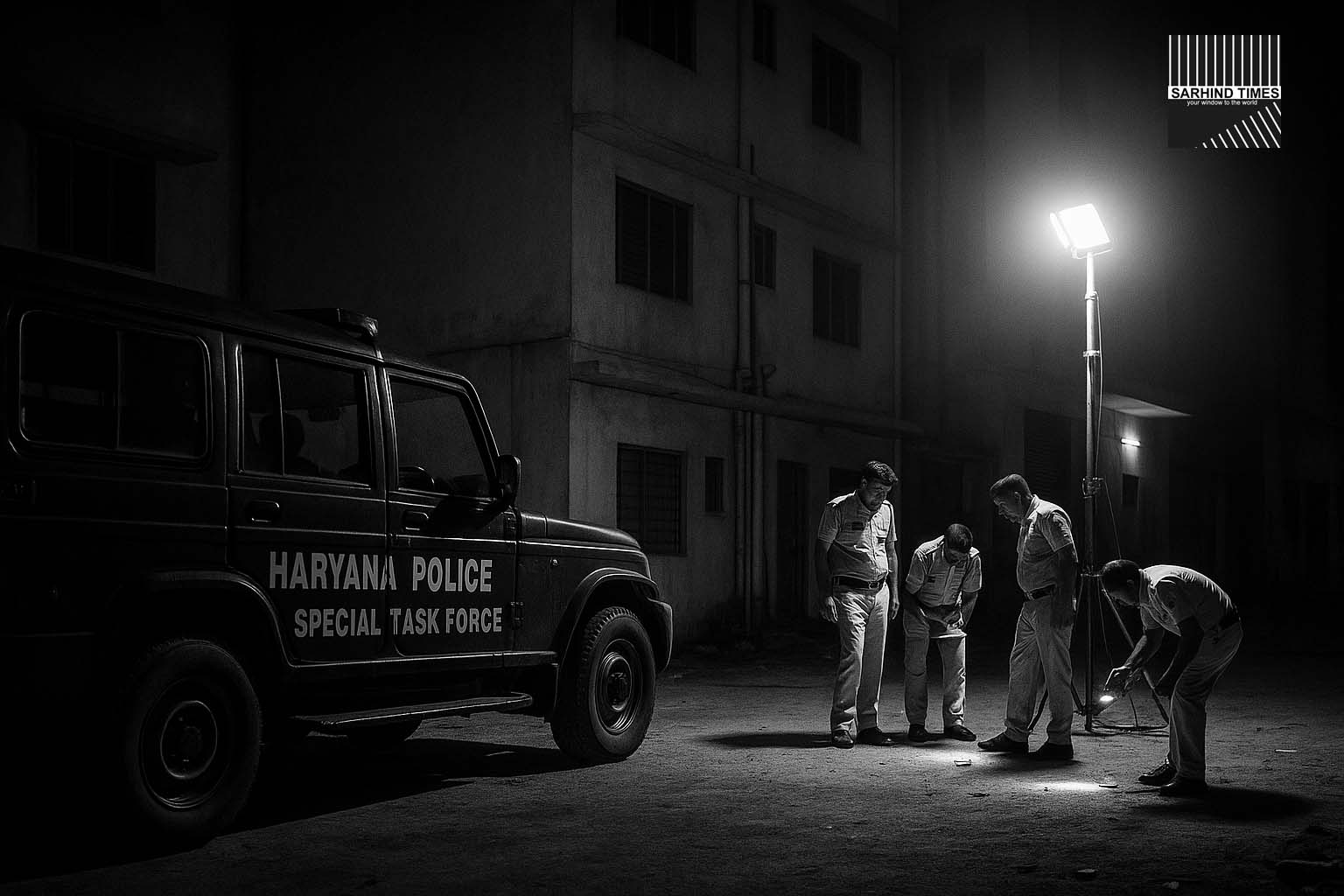
Intensive state-wide drive kicks off from 5 November, with focus on fugitives, arms seizure and organisational crime networks
Dateline: Gurugram | 10 November 2025, Asia/Kolkata
Summary: The Haryana Police has initiated “Operation Trackdown”, a 16-day targeted campaign (5–20 Nov) to apprehend fugitive offenders linked to gun-related crimes and dismantle associated networks. The drive imposes structured accountability across hierarchy, involves cross-border coordination and seeks to curb the recent rise in firearms offences.
Background: Rising Gun Violence and Fugitive Challenge
Over recent months, Haryana has witnessed a marked uptick in offences involving firearms, ranging from illegal possession, shootings and reckless driving with arms to unresolved fugitive lists operating across districts. The police leadership has flagged the accumulation of “old cases” where offenders remained at large, creating a persistent threat to public safety.
In response, the state’s top police command charted a new approach: rather than isolated raids, a **time-bound, target-driven campaign** involving all squads and police units. The concept of Operation Trackdown emerged: a 16-day mission with defined lists (worst-5 at station level; worst-10 at zonal; worst-20 statewide) aimed at delivering tangible results rather than symbolic action.
The timing of the launch is strategic — as the year moves into higher travel, festival, and public-activity phases, law-enforcement seeks to pre-empt a spike in organised crime, arms misuse and cross-border movement of fugitive offenders.
Structure of the Operation
Operation Trackdown has been laid out with a clear command-and-control framework:
– At each police station the SHO has been tasked to compile a **“worst 5” list** of offenders (gun-related, fugitive, repeat) and aim for their arrest or status change within the 16-day window.
– At the district/zone level, SPs and DCPs are responsible for a **“worst 10” list** each, to synchronise local progress and resources.
– At the state level, the Special Task Force (STF) under IG (Crime) has a **“worst 20” list**, targeting high-profile offenders who have either evaded arrest repeatedly or are heads of networks.
– A central command cell under the DGP is monitoring daily progress metrics: arrests made, bails cancelled, assets seized, FIRs registered for organised crime, cross-state coordination logged.
The operation explicitly calls for swift legal action: reversal of bail for flagged offenders, asset-seizure of criminal gains, rigorous FIRs under UAPA/POCSO/Arms Act as applicable. Additionally, it mandates coordination with neighbouring jurisdictions (Delhi, Punjab, Rajasthan, Chandigarh UT) to hunt fugitives who may have crossed borders.
The language from the top leadership is unambiguous: this is not a PR exercise. The mandate emphasises **“operational deliverables in the next sixteen days”**, with accountability cascading down to beat-officer level. While long-term crime reduction remains the goal, the chosen 16-day burst is designed for visible action and deterrence.
Scope and Focus Areas
The campaign covers multiple crime-modalities:
– **Illegal firearms and ammunition**: Many incidents have involved licensed weapons being mis-used, as well as smuggled or un-licensed guns in the state’s fast-growing urban pockets. The operation sets out to identify storage points, disrupt arms supply chains and arrest both users and facilitators.
– **Fugitive offenders**: By compiling the worst-lists, the police aim to bring down the backlog of cases where accused remain at large for months or years. Tackling fugitive status reduces the impunity that fuels repeat crime.
– **Organised networks**: Beyond single-incident shooters, the campaign targets enablers: landlords harbouring offenders, financiers, logistics helpers, cross-state gang links. The asset-seizure component signals the shift toward disrupting the criminal value-chain.
– **Inter-state cooperation**: Recognising that fugitives often cross into Delhi, Punjab, Rajasthan or Chandigarh UT, the operation explicitly includes liaison with other state/UT police forces, airlines, vehicle-movement-tracking units, and border patrols.
Why Gurugram Matters in This Context
The city of Gurugram plays a vital role in this state-wide drive. As one of the fastest-growing urban centres, with corporate parks, gated housing colonies and a large transient worker population, it offers both opportunity and risk for crime.
– The scale and density of high-value properties, serviced apartments and corporate zones means that crimes such as illegal firearm-storage, rent-by-week end dwellings or un-monitored guest rooms can create conducive conditions for offences.
– Fugitive shelters or hide-outs may be easier in urban clusters where verification is complex, traffic is high, and surveillance may be weaker despite security infrastructure.
– Law-enforcement stresses that in Gurugram and surrounding districts, the tempo of arms misuse (shootings of youth, licensed-gun thefts, motorcycle-firing incidents) has been concerning. Hence, Gurugram has been given **priority focus within the operation**: additional manpower, surveillance, intelligence sharing, and local‐police “hot-lists”.
For the residents and businesses of Gurugram, this has important implications. While a crackdown may temporarily add traffic or enforcement presence, the long-term benefit is improved perception of safety, fewer random incidents of gun-violence, and a less-risky environment for investment, real-estate, commerce and high-net‐worth mobility.
Current Progress & Early Indicators
Although the operation is in its early phase, initial indicators are promising:
– Police have reportedly seized multiple licensed weapons whose storage was deemed careless, and initiated proceedings to suspend or review the licence-holders.
– Arrests of at least a dozen fugitives have been reported across districts in the first few days, according to police briefings.
– Asset-seizure notices have been served in several high-value cases tied to arms rackets and vehicle-based fleeing networks.
– Surveillance has been ramped up on guest-houses, rental flats and lodging facilities in Gurugram’s urban fringes; traffic room units are coordinating with camera feeds and intel.
The DGP’s office emphasises that these early wins are important for inculcating confidence within the force and in public perception. However, they also caution that measurable impact—such as reduction in incidents of gun-firing or arms‐theft—will begin to emerge only after the full 16-day cycle and beyond.
Legal and Regulatory Angles
The operation not only focuses on enforcement but also raises questions around regulatory gaps:
– Licensed arms: Many firearms held by private individuals appear to be stored without rigorous oversight. The operation is highlighting that licence-holders must ensure safe-storage, regular verification, and keep report of minor’s access. Failure could bring suspensions or revocations under the Arms Rules 2016.
– Rental housing and guest-density zones: Urban rental flats in sectors such as 48, 57 in Gurugram often change hands quickly. The operation’s success will depend on landlords maintaining records, cooperating with police and installing surveillance. The regulation of guest-houses, lodges and private apartments is under review.
– Bail and legal delays: One element of the operation is targeted revocation of bail for repeat offenders. This indicates a more assertive judicial enforcement cooperation and may shape how courts respond to arms-repeat cases in Haryana.
– Cross-state vehicle/arms movement: Recognising that fugitives and arms often move across state lines, the operation will test inter-state protocols, fast-track notices (ECIR/Public ICAR alerts), and checkpoint monitoring at state borders and transit hubs.
The regulatory dimension suggests that the campaign is not purely tactical—rather it is part of a broader shift in how Haryana seeks to manage arms-related crime and fugitive accountability. If the guidelines and enforcement mechanisms launched now prove robust, they could serve as a model for other states.
Community, Residents and Business Impact</
For citizens of Gurugram and broader Haryana, the operational thrust has direct implications:
– **Residential password**: Gated communities, high-rise apartments and serviced housing in Gurugram have often relied on static security and entry-logs. With increased police visibility and intelligence sharing, residents may notice more guest-checks, surveillance, and co-ordination between society security teams and local police.
– **Business and real-estate environment**: A decline in arm‐related crime improves investor confidence. For companies located in Gurugram who worry about employee safety, asset security and reputational risk, the operation underscores the state’s willingness to act.
– **Youth and rental zones**: Many young employees in corporate hubs live on rents, shift often, and may use guest rooms or shared flats. Operation Trackdown heightens the importance of landlord compliance, guest-register maintenance, and adherence to safety norms.
– **Law-abiding public reassured**: For citizens who abide by rules, the message is that police forces are aligning resources proactively—this may build public trust, increase cooperation (with witness statements, tip-lines) and generate a virtuous cycle of enforcement and deterrence.
But there are also potential stress-points: over-surveillance, socio-economic profiling, and the risk of policing pressure on legitimate tenants or small landlords. The challenge will be to calibrate enforcement without eroding civil‐liberties or creating mistrust.
What’s At Stake: Measuring Success
The operational framework clearly outlines metrics:
– Number of fugitives arrested from the worst-lists within the 16 days.
– Number of licensed arms seized or seized from storage-violations.
– Number of FI Rs filed under organised crime or arms-trafficking, beyond individual incident cases.
– Verified reduction in gun-firing incidents in urban zones during and immediately after the campaign.
– Cross-border coordination outcomes: successful arrests of cross-state fugitives, vehicles/arms intercepted at border-checkpoints.
Longer-term, success will mean fewer repeat offenders, improved clearance rates for arms and gun-cases, more rigorous storage compliance among private gun-holders, and stronger public perception of safety in Gurugram and Haryana.
Challenges and Caveats
While the plan is ambitious, real-world execution will face hurdles:
– **Resource intensity**: A sustained blitz across all districts may stretch manpower, especially if simultaneous investigations and raids are underway.
– **Legal sustainability**: Arrests make headlines, but unless backed by strong prosecutions, asset seizure and judicial convictions, the deterrent value could be short-lived.
– **Intelligence dependence**: Success hinges on accurate data—worst-lists, fugitive tracking, cross-state intelligence. Any gaps in information may hamper results.
– **Community cooperation**: Guest-houses, flats and landlords may resist extra police scrutiny. Without community buy-in, enforcement alone may not suffice.
– **Risk of displacement**: Offenders may shift to neighbouring states or use non-traditional channels, leading to displacement rather than elimination of threat.
The police acknowledge these risks and appear to have built in review mechanisms (daily monitoring, escalation to DGP office, adjustment of strategy) to address them proactively.
What to Watch Over Next Few Weeks
Several indicators will determine whether Operation Trackdown delivers:
– Daily bulletin of arrests & seizures from Haryana Police: upward trajectory expected.
– Any major fugitive captures in Gurugram region that were previously at large for months.
– Tracking guest-house/flat oversight in Gurugram’s sectors: Are security logs being tightened? Are landlords cooperating?
– Monitoring of firearm licence suspensions or revocations following discovery of storage-violations.
– Any statement from courts or state government on asset seizures, bail-cancellations or cross-state enforcement results.
If after the 16 days there is minimal visible outcome, critics may argue it was a short-term PR exercise rather than structural reform. But if outcomes are strong and sustained, this campaign could set a new baseline for crime-control strategy in urban Haryana.
Implications for Wider Haryana Crime Ecosystem
The implications extend beyond the immediate crackdown:
– Other states may look to replicate this time-bound target model for fugitive and gun-crime control.
– The shift toward *both* enforcement (arrests) and *prevention* (storage-regulation, community liaison) may mark an evolving mindset in police governance.
– For gun-holders and property owners in Haryana, the message is clear: licensed or not, safe-storage and accountability are non-negotiable. This could lead to more stringent licensing audits, periodic inspections and civil-liability awareness among civilians.
– For urban residents and businesses, the improved security image may translate into higher investor confidence, better talent retention and stronger reputation for Gurugram as a safe corporate hub.
In effect, if Operation Trackdown shows tangible results, it may become one of the hallmark law-enforcement initiatives of the year in Haryana.
Conclusion
In a state where rapid urbanisation, high-income enclaves, transient populations and industrial growth often correlate with complex crime-dynamics, the Haryana Police’s launch of Operation Trackdown represents a deliberate shift: from scattered interventions to structured, timeline-driven enforcement of arms-and-fugitive crime. The early indicators suggest momentum is building, but the real test will be whether arrests, prosecutions, asset seizures and gun-incident reductions become sustained and measurable. For the residents, businesses and communities of Gurugram and wider Haryana, this operation offers hope of a safer environment; but this hope will only translate into reality if the follow-through matches the ambition.



+ There are no comments
Add yours