
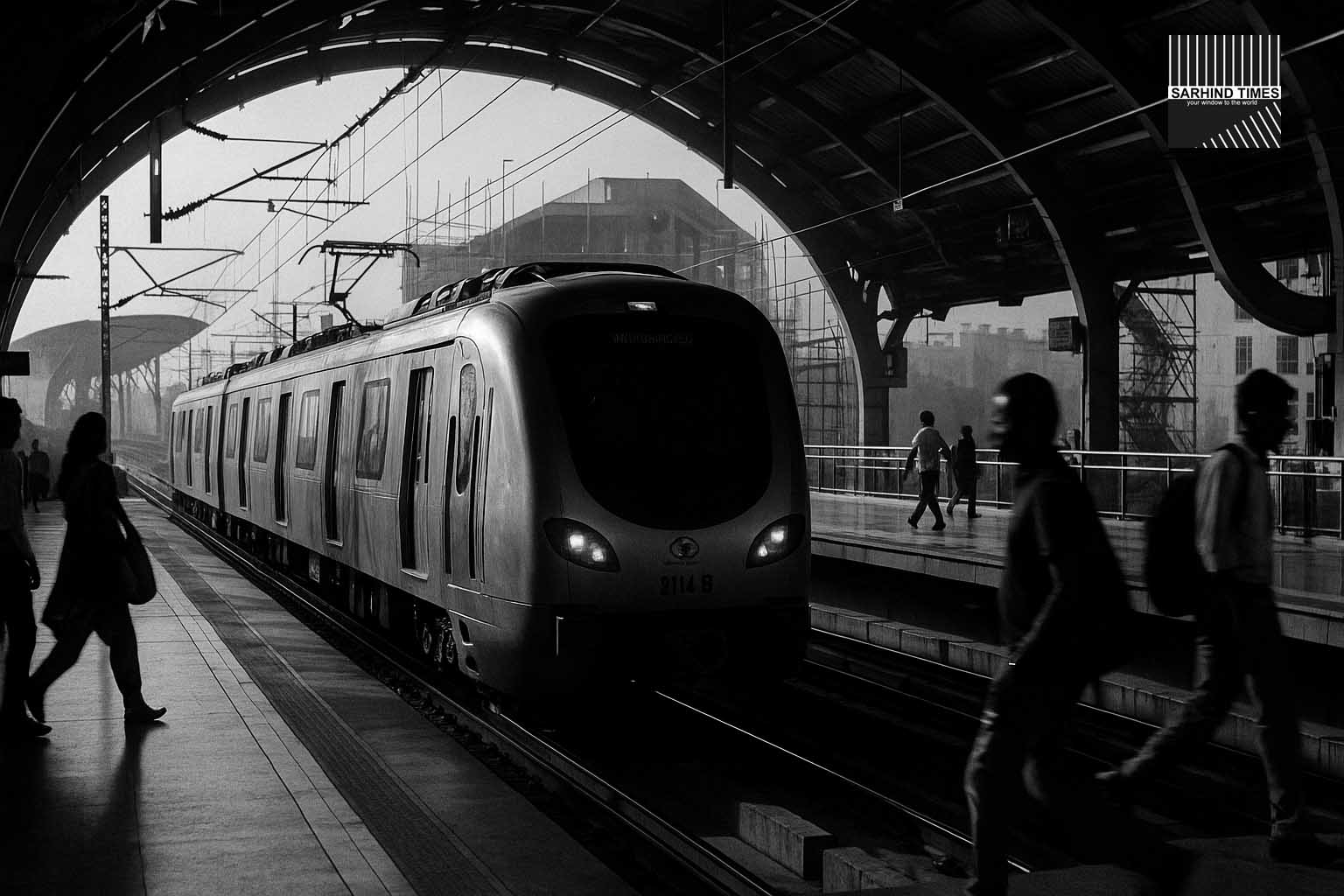
Over 300 km of new metro corridors planned, signalling a transformative shift for India’s most congested urban region
Dateline: Mumbai | November 12, 2025
Summary: The Mumbai Metropolitan Region Development Authority (MMRDA) has released its comprehensive mega-plan to expand the metro network in the Mumbai Metropolitan Region (MMR) through 2030. The plan earmarks more than ₹2.4 lakh crore for construction of over 300 km of new corridors, upgrades of existing lines, and modernisation efforts aimed at reducing travel time, de-congesting roads and supporting Mumbai’s growth as a global city.
“`
Why the push now?
Mumbai and its suburbs form India’s largest and most congested urban agglomeration, with the region’s transport infrastructure under significant strain. Rapid population growth, commuter influx from peripheral zones such as Navi Mumbai, Thane and Palghar, and increasing economic activity have placed pressure on roads, suburban rail and public transit systems. To keep pace with growth and maintain competitiveness, the MMRDA says the metro expansion is essential.
The decision comes against a backdrop of rising public-anger over daily commute times, soaring road congestion and mounting emissions in the region. Businesses cite transport delays as a key drag on productivity. Government sources say past incremental approaches to transit expansion—such as piecemeal metro corridors or bus-priority lanes—are no longer sufficient. The new plan, therefore, marks a shift to large-scale, integrated investment, consolidating future metro lines, depots, interchange hubs and last-mile connectivity in one roadmap.
What the plan entails
Under the Mumbai Metro 2030 plan, the MMRDA has proposed the following key elements:
- Over 300 km of new metro corridors—More than a dozen new lines are slated, covering emerging growth zones: Navi Mumbai-Panvel extensions, Andheri-Ghatkopar-Metro 9 northwards, Thane-Kasauli north corridor, and east-west linkages such as Kurla-Ulwe-CBD-Mumbra.
- Upgrades to existing lines—Modernising the current operational lines with platform-screen doors, automatic train control systems (CBTC), increased frequency, longer trains (six-to eight-car sets), faster headways and enhanced passenger amenities.
- Large-scale investment—The total estimated spend is **₹2.4 lakhcrore** (approximately US $29 billion) through to the year 2030, covering civil works, rolling stock, signalling, depots, land acquisition and associated infrastructure (interchanges, park-and-rides, feeder shuttles).
“` - Focus on suburban integration—The plan emphasises linking metro corridors with suburban rail lines (such as the Mumbai Suburban Railway network), bus rapid transit (BRT) and non-motorised transport networks. Island-style interchange hubs will enable smoother transfers and reduce commute times by up to 25 per cent, according to estimates by MMRDA.
- Support for outer growth areas—Corridors reaching Navi Mumbai, Panvel, Kalyan-Dombivli, Thane West, Mira-Bhayandar and the upcoming Navi Mumbai International Airport zone are part of the newer lines, ensuring emerging suburban clusters are embedded in the urban transit grid.
- Last-mile and sustainability features—The plan includes 100 electric-shuttle buses, over 200 multi-modal mobility hubs (bike-share, e-rickshaw parking), solar-roofed stations, rain-water harvesting in stations and planned interoperability with the upcoming inter-state bus-terminal in Navi Mumbai.
“`
Financing and funding model
The scale of the project necessitates a mix of funding sources: central-government grants, state-budget allocations, public-private partnerships (PPP) for station-commercialisation, and land-value capture mechanisms around key nodes. The MMRDA plans to issue metro revenue-bonds, leverage station-mall-office complexes (Transit-Oriented Development, TOD) and monetise air-rights above metro corridors. In addition, part of the budget includes proceeds from elevated station-land leases and commercial retail integration.
Officials say that around ₹45,000 crore will be raised through market borrowing and TOD projects by 2028, with the remainder drawn from government-funded infrastructure outlays.
Expected benefits and urban impact
The new metro plan is poised to benefit multiple stakeholder groups:
- Commuters: If implemented on schedule, many current 90–120 minute suburban commutes could drop to under 45 minutes on key stretches. Reduced wait-times, air-conditioned trains, frequent service and better station access will improve daily life.
“` - Environment: With many of the new lines expected to operate in electric traction and serve high-density corridors, the shift away from cars and motorcycles is expected to reduce carbon emissions by an estimated 2.1 million tonnes of CO₂ annually by 2030 and reduce traffic congestion by up to 30 per cent in key radial corridors.
- Regional economy: Improved connectivity is seen as critical to unlock the suburban potential of the Mumbai-Navi Mumbai region, enable faster movement of workforce, bolster logistics, support real-estate investment in growth zones and attract corporate campuses beyond central Mumbai.
- Land-value capture and development: Stations along the new metro lines are likely to see commercial up-lift, generating TOD zones, mixed-use hubs and retail ecosystems. The MMRDA estimates this could create 120,000 new jobs by 2030 in station-adjacent zones.
“`
Challenges and risk factors
Despite the positive outlook, implementation will need to overcome several challenges:
- Land acquisition and delays: Previous metro projects in the region have faced land-acquisition resistance, relocation objections, utility-diversion delays and legal challenges. The new plan must accelerate those processes and build public consensus.
“` - Cost escalations and schedule risks: Complex urban construction—elevated viaducts, underground tunnels, station integration—often leads to cost overruns. Delays inflate interest overhead and reduce economic benefits.
- Inter-agency coordination: Many agencies are involved: MMRDA, Indian Railways, state transport, municipal corporations, utilities. Conflicting priorities or siloed working could hamper integrated progress.
- Operational readiness and workforce: Metro-systems require skilled maintenance teams, signalling-experts and safety staff. Rapid scaling may strain human-resource supply and lead to service-quality issues if not planned proactively.
- Ridership and financial viability: While demand is expected to grow, some corridors may initially under-perform. Reliance on land-value capture means commercial market cycles also matter. Sensitivity to ridership, fare-policy, operating subsidy and maintenance cost must be managed.
“`
Comparative perspective: How Mumbai stacks up globally
Globally, metro systems in mega-cities such as London, New York, Shanghai, Seoul and Delhi have long invested in mass-transit networks to reduce urban congestion and carrier growth. Mumbai’s plan of 300 km plus by 2030 places it in a competitive class of developing-city networks—as opposed to being constrained by geography or legacy systems alone. The move signals that Mumbai is evolving from legacy rail and road dependence to a future-ready multimodal city.
From a public-policy viewpoint, this aligns with ambitions in “India vs Cities” infrastructure race—mega-urban regions must shift from incremental add-ons to systems-thinking. The Mumbai Metro 2030 plan places the region firmly in that paradigm.
Timeline and next-steps
The MMRDA has outlined key milestones up to 2030:
- By 2026: Finalisation of alignment, land-acquisition permissions and financing for the first six new corridors.
“` - By 2027: Ground-breaking of corridors totalling 120 km, commencement of construction, procurement of first-batch of rolling-stock, mobilising finance for TOD nodes.
- By 2029: Achieving 250 km of corridor under advanced stage (50-70 % completion) and launching initial passenger operations on selected new segments.
- By 2030: More than 300 km in new-corridor length plus full upgrades of existing lines and interchange nodes.
The MMRDA emphasises that while 2030 is target year, many lines may open earlier, and partial operations could begin by 2028-29 in some clusters.
“`
Relevance for residents, developers and content-ecosystem
For Mumbai-area residents, the plan offers hope of a shift in commuting life. Reduced travel times, less congestion and improved access to suburbs may support relocation choices, housing decisions and career mobility.
For real-estate and infrastructure investors, the corridors define future value-zones. Developers working on project management, digital twin modelling, alignment-simulation, metro‐station commercialisation, last-mile micromobility can view the roadmap as a platform for growth.
For content-creators and automation-based businesses—especially those in urban-mobility, smart-city, traffic-analytics, artificial-intelligence based operations and real-estates—this large-scale transit upgrade provides data, infrastructure and demand signals you can leverage in building smarter mobility applications, digital-twins, city-analytics models and localisation services for commuters.
In short, the metro-expansion is not just transit-growth—it’s a city-scale transformation that ripples across mobility, economics, real-estate, data-services and daily-life.
Conclusion
The Mumbai Metro 2030 plan transforms talk into scale. With more than ₹2.4 lakh crore and over 300 km of new corridors, it marks the beginning of Mumbai’s transition from legacy infrastructure to future-ready transit. Commuters, investors and policy-makers all have much to gain. However, success will depend on execution—land, funding, coordination and human-resource readiness. If Mumbai can deliver on this scale, it may chart a template for other Indian mega-cities. The next few years will be the test-bed; from 2030 the payoff must be visible in fewer hours on roads, smoother journeys and a stronger urban economy.}



+ There are no comments
Add yours