
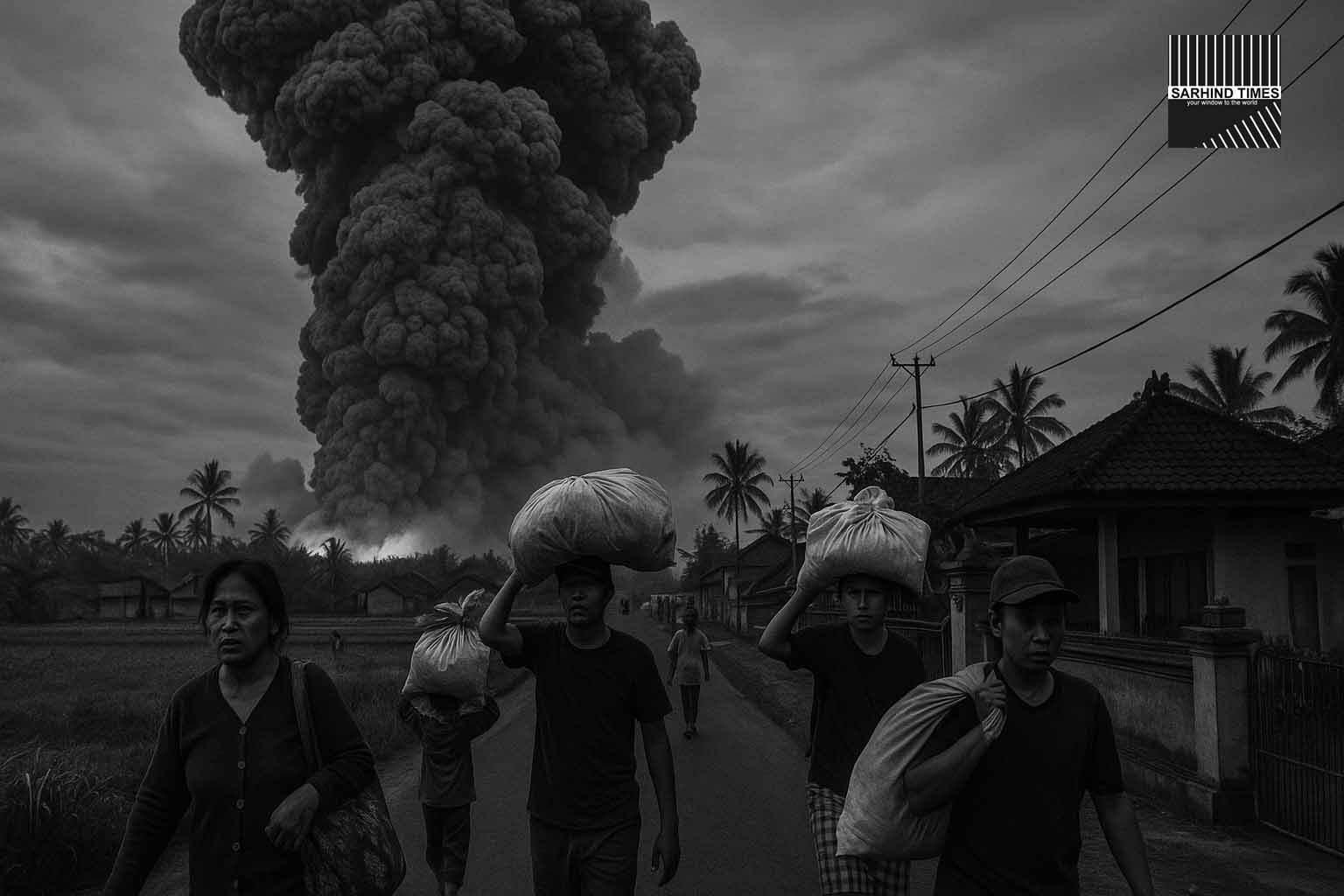
Authorities evacuate 300,000 residents as ash cloud reaches 18 km; aviation routes across Asia-Pacific forced to reroute
Dateline: Jakarta | November 29, 2025
Summary: Indonesia’s Mount Karabu erupted violently on Friday, sending a colossal ash column into the atmosphere and forcing over 300,000 people to evacuate. The eruption disrupted flight routes across Asia-Pacific, triggered tsunami warnings, and renewed fears of heightened seismic activity along the Pacific Ring of Fire.
A sudden and powerful eruption
One of Indonesia’s most volatile volcanoes, Mount Karabu, erupted explosively early Friday morning, unleashing ash clouds that towered nearly 18 kilometres into the sky. The Indonesian National Disaster Mitigation Agency (BNPB) immediately raised the alert level to its highest category, ordering mass evacuations and deploying emergency response teams across affected districts.
Villages surrounding the volcano were blanketed by thick ash within minutes, and pyroclastic flows — fast-moving currents of hot gas and volcanic debris — were reported descending the southeastern slopes.
Evacuation of 300,000 people underway
Authorities confirmed that over 300,000 residents living within a 15–25 km radius of the volcano have been evacuated to shelters and temporary camps. Emergency workers, military units, and volunteer groups are coordinating evacuation routes amidst falling ash, low visibility, and hazardous air quality.
Indonesian officials warned that additional eruptions remain likely, urging residents to avoid riverbanks due to the risk of volcanic mudflows (lahars).
Sky turns dark as ash cloud spreads over multiple provinces
Satellite imagery from the region showed a massive plume drifting westward, covering several Indonesian provinces and causing darkness in broad daylight. Residents described the sky turning “midnight black” as volcanic particles fell like “powdered cement.”
Schools, markets, and government offices have shut down in affected regions. The health ministry distributed masks and emergency kits to help residents cope with ash inhalation risks.
Global aviation routes disrupted
The eruption led to immediate disruptions across major Asia-Pacific flight corridors. Volcanic ash, which can severely damage aircraft engines, forced aviation authorities to issue urgent directives rerouting or cancelling dozens of international flights connecting Southeast Asia, Australia, and East Asia.
Several airports — including those in Jakarta, Surabaya, Kuala Lumpur, and Singapore — issued advisories warning of delays and potential cancellations throughout the weekend.
Australian carriers temporarily suspended routes passing through affected airspace, while Japanese and Korean airlines announced re-evaluation of long-haul flight paths.
Tsunami warnings briefly issued
The massive eruption triggered seismic tremors that prompted Indonesia’s meteorological agency to issue short-lived tsunami advisories along the southwestern coastline. Although no large waves were reported, coastal villages were temporarily evacuated as a precaution.
Global scientific community on alert
Volcanologists across the world have been monitoring Mount Karabu closely. The volcano had shown increasing activity over the past four months, including heightened tremors, sulphur emissions, and crater glow — signs of rising magma movement.
Scientists warn that the scale of the current eruption is similar to other historically impactful events in the region. A senior volcanologist noted that Mount Karabu’s magma chamber appears large and highly pressurised, increasing the possibility of sustained eruptive phases.
Health risks rise as ash affects millions
Hospitals across Java and Sumatra treated a growing number of patients suffering from breathing difficulties, eye irritation, and skin sensitivity caused by volcanic ash exposure. Authorities urged people to stay indoors, avoid contaminated water sources, and use N95 masks when venturing outside.
Health experts warn that ash inhalation can cause long-term respiratory issues, particularly for children, pregnant women, and the elderly.
Transport, power, and agriculture suffer major disruption
Roadways in several districts were covered in thick ash layers, reducing traffic speed to a crawl. Visibility dropped to less than 10 metres in some areas, complicating rescue and evacuation efforts.
Power outages were reported as ash settled on transmission lines. Farmlands near the volcano suffered severe damage, with ash destroying rice fields, banana farms, and vegetable crops.
Indonesia’s agricultural ministry warned that food supply disruptions are possible if the eruption continues.
Impact felt beyond Indonesia
Nations across the Southeast Asian region issued air-quality warnings. Malaysia, Singapore, and Brunei reported mild ash haze, prompting health advisories for those with respiratory issues.
Australia observed fluctuations in western airspace conditions as the ash plume drifted across maritime routes.
Emergency aid begins arriving
International agencies, including the Red Cross, UN humanitarian teams, and multiple NGOs, began mobilising support shipments containing tents, water purifiers, medical kits, and emergency food supplies.
Neighbouring countries offered assistance, including helicopters, water-tanker aircraft, and volcanic monitoring equipment.
Indonesia activates national disaster response strategy
The Indonesian President chaired a crisis meeting in Jakarta, authorising the deployment of national disaster response units, military engineering corps, and additional medical teams to affected provinces.
Authorities announced designated “clean air zones” equipped with filtration systems for vulnerable populations.
Historical context: Indonesia sits on the volatile Ring of Fire
Indonesia has more than 120 active volcanoes — the highest number in the world. Located on the Pacific Ring of Fire, the nation experiences frequent seismic and volcanic events. Past eruptions, including those of Mount Merapi and Krakatoa, resulted in significant casualties and environmental upheaval.
Volcanologists warn that climate patterns can influence eruption intensity by altering groundwater pressure and atmospheric conditions.
Economic impact: billions at risk
Indonesia’s tourism, aviation, agriculture, and trade sectors face major disruptions. Economists estimate that prolonged eruptions could cost billions in lost productivity and damaged infrastructure.
The global aviation industry also faces significant operational losses due to rerouted flights and increased fuel consumption.
People recount chaotic evacuation scenes
Evacuees described chaotic conditions as roads filled with vehicles carrying families, livestock, and belongings. Many travelled through thick ash clouds with headlights on full beam. Volunteers distributed masks and water as shelters filled rapidly.
A mother from a nearby village told reporters, “The sky went dark. We grabbed our children and ran. We didn’t have time to collect anything.”
Social media filled with dramatic visuals
Videos circulating online showed glowing lava fountains, lightning streaking through ash clouds, and rooftops blanketed in grey layers. Social media platforms were flooded with warnings, safety tips, and calls for support.
Next 48 hours crucial
Scientists warn that the next 48 hours will determine the direction of the eruption cycle. If magma continues rising, larger explosions could follow. If activity stabilises, ash dispersion may slow, allowing emergency teams to expand operations.
Authorities remain on high alert, with evacuation zones likely to expand.
Conclusion: Indonesia faces one of its biggest natural disasters in years
The Mount Karabu eruption marks one of the most significant natural disasters Indonesia has faced in recent history. With hundreds of thousands displaced, air travel disrupted across continents, and global attention focused on the region, the coming weeks will test the country’s resilience and emergency preparedness.
As the ash cloud continues to spread, governments worldwide are closely monitoring the evolving situation, aware that major volcanic eruptions can have far-reaching climatic and economic consequences.



+ There are no comments
Add yours