
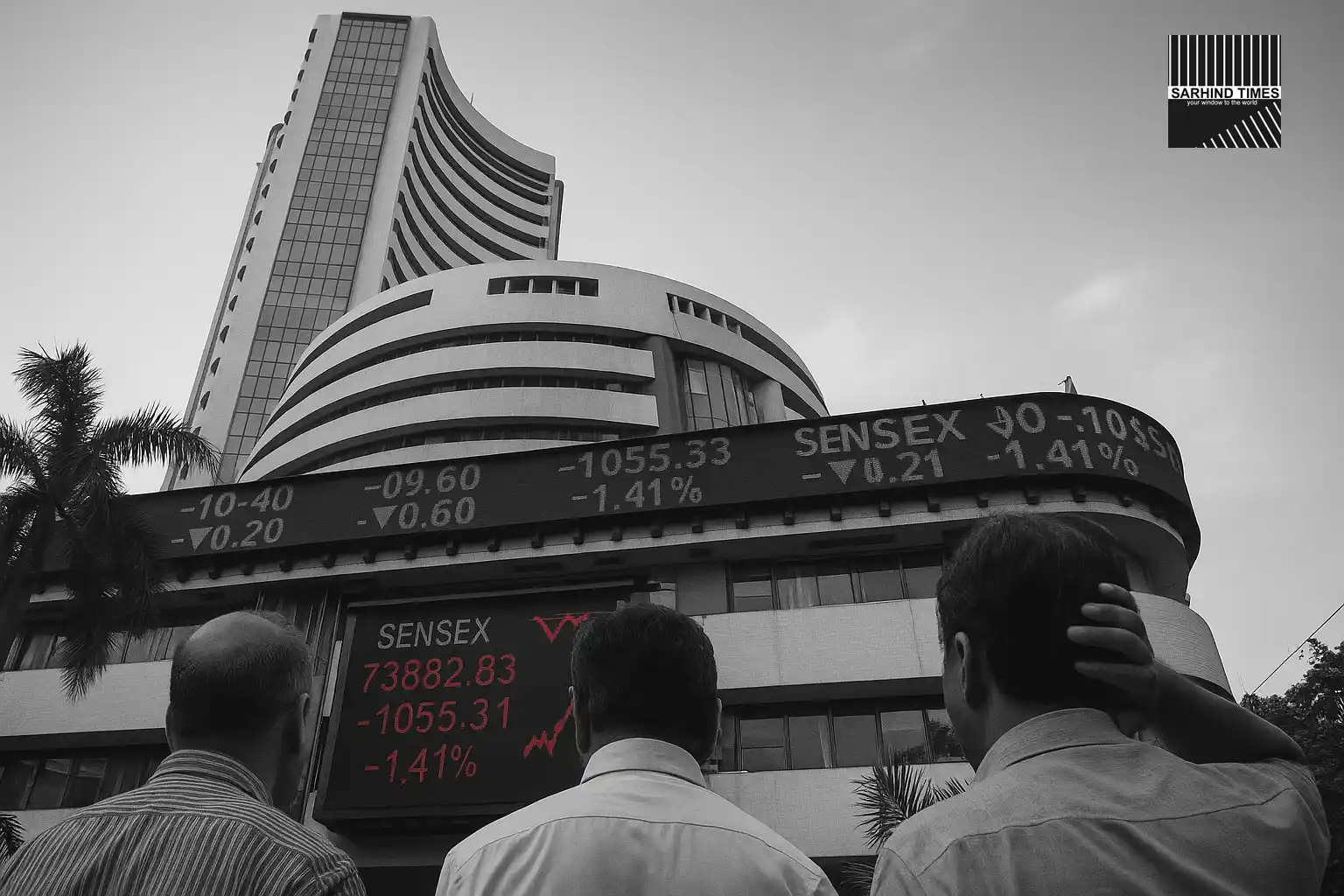
Investors turn cautious ahead of key earnings and U.S. Federal Reserve decision; IT and banking stocks lead the fall
Dateline: Mumbai | 28 October 2025
Summary: Indian equities closed sharply lower on Monday, tracking weak global cues and sustained profit booking in heavyweight stocks. The BSE Sensex plunged over 750 points to close below 78,000, while the Nifty50 slipped under 23,700 as investors awaited corporate earnings and U.S. Fed signals. Banking, IT, and metal indices bore the brunt of selling pressure, while defensive stocks offered minor relief.
Sharp sell-off led by global uncertainty
Indian markets opened weak and extended losses through the session as Asian and European peers traded in the red following renewed concerns over inflation and higher-for-longer interest rates. The Sensex slipped 757 points to end at 77,945, while the Nifty dropped 228 points to 23,681. Broader indices also mirrored the fall, with midcaps down 1.1% and smallcaps losing nearly 1.4% by the closing bell.
Market analysts cited global headwinds, including soft corporate guidance from major U.S. tech firms and cautious sentiment ahead of the Federal Reserve’s upcoming policy meeting. The dollar index firmed up, pressuring emerging-market currencies, including the Indian rupee, which closed at ₹83.49 per U.S. dollar.
IT, banking, and metal stocks lead declines
Among sectoral indices, IT and banking were the biggest drags. Nifty IT fell 2.3% as investors booked profits in heavyweights like Infosys, TCS, and HCL Technologies following a muted Q2 earnings outlook. Financial stocks also corrected sharply amid rising U.S. bond yields and weak credit growth expectations.
Axis Bank, HDFC Bank, and ICICI Bank collectively contributed over 250 points to the Sensex’s fall. Meanwhile, metal stocks slid amid a drop in global commodity prices and subdued demand from China. Tata Steel, Hindalco, and JSW Steel fell between 1.5% and 2%.
Energy and FMCG stocks offer mild support
Energy and FMCG counters offered some cushion as investors rotated into defensive plays. Reliance Industries managed to stay marginally positive after reports suggested that its retail arm is in advanced talks to acquire a leading digital payments platform. FMCG majors like HUL and ITC gained marginally on expectations of stable rural demand amid falling commodity costs.
However, the overall sentiment remained weak with selling visible across 36 of the 50 Nifty components. Market breadth on the BSE remained negative with 2,456 stocks declining against 1,102 gainers.
Foreign investors turn net sellers
Foreign institutional investors (FIIs) offloaded shares worth ₹2,980 crore, marking their fifth consecutive session of net outflows. Domestic institutional investors (DIIs), on the other hand, provided partial support by purchasing equities worth ₹2,142 crore.
Analysts attribute FII outflows to global portfolio realignments as U.S. yields remain elevated and concerns rise over geopolitical tensions in the Middle East. The 10-year U.S. Treasury yield climbed to 4.92%, its highest in two months, sparking risk aversion in emerging markets.
Corporate earnings under lens
With India Inc’s Q3 results season approaching, investors have turned selective. While the overall corporate earnings outlook remains stable, analysts expect margin pressure in export-oriented sectors such as IT, pharma, and chemicals due to global demand softening and a stronger rupee.
Brokerage firm Motilal Oswal noted, “While headline earnings growth looks resilient, pockets of stress are emerging in mid-tier IT and consumer discretionary companies. Investors are likely to focus on management commentary for FY26 rather than backward-looking numbers.”
Rupee under pressure, bond yields firm up
The Indian rupee extended its losing streak, falling 8 paise to close at ₹83.49 per dollar, tracking the broader emerging-market weakness. The Reserve Bank of India (RBI) was seen intervening intermittently to curb volatility. Bond yields edged higher, with the benchmark 10-year yield rising to 7.27% amid persistent inflation concerns and a strong U.S. dollar.
Traders expect the rupee to remain range-bound in the near term, with RBI’s intervention keeping volatility under check. However, if global risk aversion intensifies, the currency could retest record lows near ₹83.60.
Global markets add to pressure
Asian equities were broadly weak. Japan’s Nikkei fell 1.8%, Hong Kong’s Hang Seng dropped 2.4%, and South Korea’s Kospi lost 1.9% as investors weighed weak corporate results and inflation data. European bourses followed suit, with Germany’s DAX slipping 0.9% and London’s FTSE 100 down 0.8% during Indian market hours.
U.S. futures pointed to a weak Wall Street open, adding to investor caution. Analysts say that until clarity emerges from the Fed’s upcoming meeting, global risk appetite may stay subdued.
Technical view and outlook
Technical analysts see immediate support for the Nifty near 23,600 and resistance around 23,950. A breach below support may trigger further downside toward 23,400. For the Sensex, the next key support lies near 77,700.
“We may see short-term weakness continue as global sentiment remains risk-averse. Traders should stay cautious and avoid aggressive long positions until we see signs of stability,” said Rupesh Jain, equity strategist at LKP Securities.
What investors should watch ahead
All eyes are now on the Federal Reserve’s policy meeting, scheduled later this week, and the RBI’s commentary on inflation trends in its upcoming bulletin. Corporate results from heavyweights such as Reliance, Infosys, and HDFC Bank will also influence market direction.
Analysts recommend focusing on defensives such as FMCG, healthcare, and power, while staying cautious in IT and financials. For long-term investors, corrections like these can offer selective buying opportunities, particularly in high-quality large-cap names with strong balance sheets.
Conclusion
The market’s correction reflects a healthy reset amid high valuations and global macro uncertainty. With foreign investors trimming exposure and domestic earnings under scrutiny, volatility may persist in the near term. However, India’s structural growth story remains intact, supported by robust domestic demand, policy stability, and infrastructure expansion.
As global markets realign post-Fed and corporate results season, the Indian market’s resilience will depend on local fundamentals and continued retail participation. For now, patience and discipline remain the key virtues for investors navigating this volatile phase.



+ There are no comments
Add yours