
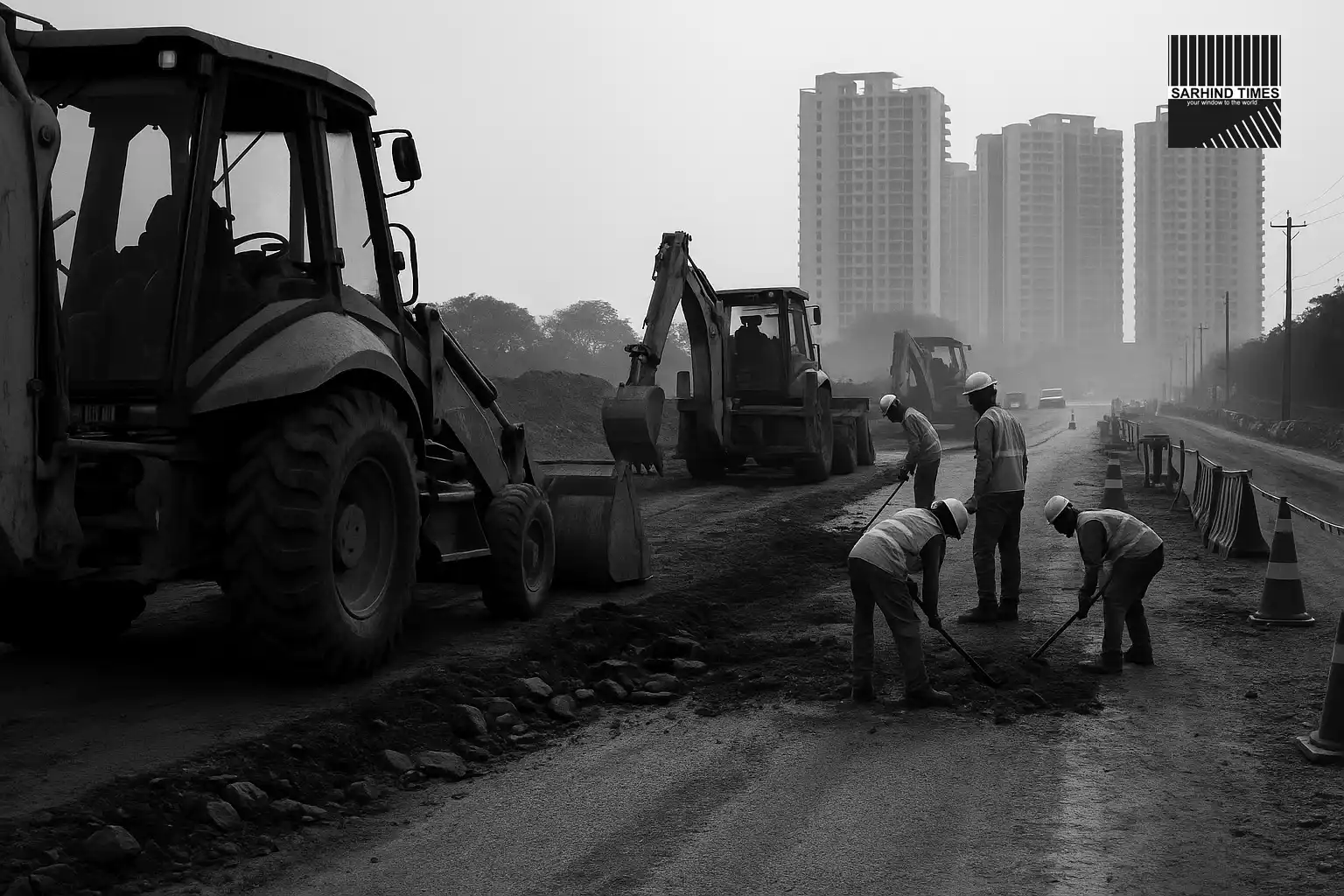
4-km corridor near the Dwarka Expressway will be fully reconstructed over 15 months under the Haryana State Industrial and Infrastructure Development Corporation’s urban access initiative
Dateline: Gurugram | 6 November 2025
Summary: The Haryana State Industrial and Infrastructure Development Corporation (HSIIDC) has announced a 4-kilometre reconstruction of Pataudi Road between Umang Bhardwaj Chowk and the new Global City township near the Dwarka Expressway. The 15-month project aims to tackle chronic road damage, water-logging and sewage overflow, and to establish a vital access corridor to the emerging mixed-use mega-development in Gurugram.
The project genesis and strategic importance
Stretch of Pataudi Road connecting the Umang Bhardwaj Chowk junction to the boundary of the upcoming Global City township in Gurugram has long been flagged by residents and commuters as one of the more vulnerable links in the city’s western corridor. With its location just off the Dwarka Expressway, the route serves as a critical connector from Delhi-Gurugram highway infrastructure into one of the largest industrial-residential developments planned by HSIIDC. The decision to reconstruct this 4-km corridor marks a decisive move by the Haryana government and HSIIDC to strengthen access infrastructure and manage the anticipated surge in traffic, population and investment around Global City. According to HSIIDC officials, the road “is in multiple states of disrepair — with deep potholes, occasional sewage overflows, heavy water-logging during the monsoon and sections that lack proper sub-base and drainage”. They confirmed that the new project will span approximately 4 kilometres from Umang Bhardwaj Chowk to the Global City interface, and is expected to be completed within 15 months of start-work. The formal announcement came on Wednesday, where HSIIDC outlined the scope, schedule and expectations for local municipal coordination. The Global City – a 1,000-acre mixed-use development in Sectors 36, 36B, 37 and 37B – is being developed as a high-density combination of residential towers, corporate offices, retail, green zones and social infrastructure. The new road will offer direct connectivity to the Dwarka Expressway and to the Delhi-Jaipur highway axis, positioning it as a strategic ingress for commuters, business visitors, residents and logistics flows. For the city of Gurugram and the broader National Capital Region, strengthening such linkages is vital. As the traffic load on the existing Delhi-Gurugram corridor intensifies, access roads like Pataudi Road serve as release valves. Well-executed reconstruction here not only ensures smoother local mobility but also supports larger township growth, investment inflows and real-estate activity. In this sense, the project signals the state’s preparedness to support large-scale urban infrastructure beyond the core city centre.
What the reconstruction will involve
The detailed plans laid out by HSIIDC include:
– Full road-bed excavation and removal of the existing pavement along the identified stretch.
– Installation of a new sub-base and concrete (or high-quality bitumen) overlay with proper compaction to support heavy traffic and reduce future maintenance.
– Upgraded storm-water drainage system including new side-drains, new manholes, channeling of overflow water, and replacing ageing or blocked pipelines where sewage and storm-water had been co-mingled.
– Sewage-overflow mitigation: In identified locations where untreated sewage was escaping onto the road surface, HSIIDC plans new conveyance piping and connection to the municipal system.
– Lighting and pedestrian frontage improvements: Given the high-density township context, the road will feature LED street-lighting, pedestrian walkways, cycle lanes and proper footpaths with tactile paving in key locations.
– Traffic mitigation and access management during construction: The agency has stated it will maintain one lane open at all times and deploy temporary diversion signage, a dedicated traffic-management office and coordination with the Municipal Corporation of Gurugram (MCG).
– Environmental safeguards: Given the proximity to residential zones and the scope of construction, construction-activity noise monitoring, dust suppression measures and tree-transplantation (where required) have been factored in.
HSIIDC officials noted that the project is planned to begin within the next few weeks—land-survey, utility-shift and contractor mobilisation are underway—and a mobilisation notice will be issued shortly. The estimated cost has not been publicly disclosed beyond “state-funded within HSIIDC’s infrastructure budget” but is understood to run into tens of crores.
Resident views and local concerns
Locals along the corridor, particularly in Sector 37, Sector 36B and adjacent areas, welcomed the announcement. Many noted that the road had deteriorated rapidly in recent years. One resident spoke of “monsoon evenings when the water would sit for hours on the road, vehicles would dodge potholes and sewage-overflow smell would spread”. The lack of proper pavement structure meant frequent repairs by individual residents or maintenance by resident-welfare-associations (RWAs). The road also served as a major feeder for employees commuting to the industrial and office parks in this catchment.
Some residents cautioned that the construction period could cause short-term inconvenience: “The mobilising of machines, diversion of traffic, noise and dust are inevitable,” said a local RWA president. “We hope the traffic management plan is robust, and that there is real coordination rather than ad-hoc closures.” The RWAs have been assured multiple stakeholder-meetings by HSIIDC and the MCG and have asked for frequent updates on timeline and access during construction.
In conversations with local shop-owners and service-providers, the expectation is that the improved road will enhance business activity. A café owner near Umang Bhardwaj said: “Customers often avoid this stretch during the rainy season due to puddles and blocked drains. If the road improves traffic and walking access, business will pick up.” For ride-hailing drivers and delivery personnel, smoother surface and fewer diversions will translate into lower vehicle-maintenance costs and faster routes – a direct benefit to the local economy.
Municipal and governance coordination
The project will require close coordination between HSIIDC and the MCG. Given that the corridor passes through a mix of industrial, commercial and residential land-uses, responsibilities include utility shifting (sewage, water, power, telecom), grievance-redress mechanisms, traffic diversions and ensuring minimal disruption to public services. MCG has committed to weekly coordination meetings with HSIIDC and has dedicated a helpline number for the project area.
Furthermore, the district administration has emphasised that construction contractors are required to maintain site-safety protocols, around-the-clock site lighting, designated pedestrian pathways during diversions, and a performance-linked penalty clause for delays or safety lapses. The plan also includes a resident-monitoring cell and online dashboard showing progress, expected milestones and photographs of the site.
Investment climate and link to Global City township
From the investment-attraction angle, this reconstruction could become a catalyst. The Global City township being developed by HSIIDC and other participating firms spans over 1,000 acres and is envisioned to host corporate offices, residential high-rises, retail hubs and recreational amenities. The enhanced access via the improved Pataudi Road will improve real-estate valuations, reduce commuting times, and make the location more appealing to institutional investors and expatriate professionals.
Nine Japanese companies have already signed MoUs involving around ₹5,000 crore of potential investment into the Global City and related industrial/residential campuses. These investments emphasise the need for accompanying infrastructure to support the township’s scale. By announcing the road upgrade now, the state is signalling that its infrastructure programme is aligned with the investment programme.
This alignment matters: poorly functioning access roads can erode the viability of large-scale developments, increase logistics costs, diminish commuter experience, and delay occupancies. By contrast, visible infrastructure delivery strengthens investor confidence, enables marketing of the township, and supports rental/lease yields for commercial tenants.
Traffic, mobility and connectivity effects
The existing stretch currently suffers from high vehicle wear and tear due to uneven surface, significant delays during monsoon due to pooling, recurring utility-cuts for emergency repairs (because of absence of structured sub-base), and rising complaints of minor accidents. With the upgrade, officials project a reduction in travel time along the corridor by 15-20 minutes during peak hours, and a reduction in minor accidents by up to 30 %. The smoother surface will also allow ride-hailing apps to price the route more competitively and improve service availability.
The road is also expected to ease pressure on the Dwarka Expressway and the Delhi-Gurugram highway network by offering a viable alternate feeder link for residents of western Gurugram and employees of the industrial parks. Over time, this may reduce congestion on major arteries, lower emissions, and improve last-mile access to the township and office zones.
Budget, timeline and risk factors
While the official cost of the project has not been publicly disclosed, HSIIDC indicates the timeline: Earth-moving and utility-shift will begin within one month; full mobilisation of construction equipment is expected within two months; main pavement works will start in three months; and final surface-repaving and finishing works will be executed in the final six months leading up to completion within 15 months. HSIIDC has indicated that it will monitor contractor performance via fortnightly reports and citizen-feedback surveys.
Nonetheless, some risk factors remain:
– Utility-shifting delays: In heavily built-up sections, shifting of old sewage/water lines could delay the pavement start.
– Rain-season disruptions: Although the majority of heavy works are planned post-monsoon, residual storms may still cause delay.
– Land acquisition or right-of-way clarifications: While the route is mostly land-acquired, pockets of informal encroachment or temporary vendor set-ups may slow progress.
– Traffic diversion management: If clean diversion is not managed well, commuter frustration may rise, and that could affect public perception of the project.
– Cost escalation: Unexpected subsurface conditions, inflation in material costs or contractor attrition could raise costs or stretch the timeline.
HSIIDC officials said they have built these risks into their plan and hold contingency buffers. They have also issued a strict no-excuse clause: if the contractor does not meet milestones, a penalty of up to 5 % of contract value may be applied.
Implications for wider urban development
While this project is primarily about one road corridor, the deeper significance lies in how infrastructure investment is being sequenced, how access roads are being prioritised ahead of full township occupation, and how industrial/development infrastructure is being aligned with residential and mobility needs. Gurugram’s rapid expansion has often outpaced auxiliary infrastructure; this time, the state and its agencies appear to be consciously reversing that pattern.
The upgraded corridor may serve as a model for other access-roads around expansion townships and industrial clusters in Haryana. It reinforces the idea that beyond highways and expressways, “last-mile connectors” — smaller but critical roads that plug into major infrastructure — demand equal emphasis.
For commuters, residents and investors alike, the improvement is likely to enhance quality of life, increase property attractiveness, lower vehicle-maintenance costs, and reduce travel stress. For the city’s governance ecosystem, it signals that infrastructure execution is becoming more advanced, with monitoring systems, transparent dashboards and citizen-friendly oversight.
Conclusion – A strategic hinge for Gurugram’s future
The reconstruction of this 4-km stretch of Pataudi Road in Gurugram may look modest in scale compared to massive expressways, but its strategic importance is disproportionate. It sits at the junction of urban growth, mobility demand, township development and investment flows. By moving now, the state and its agencies are demonstrating a shift in infrastructure mindset—from reactive fixes to proactive enabling.
As the road work commences, the coming months will test the robustness of planning, coordination, execution and citizen-interface. If successful, the Pataudi Road corridor may emerge as a micro-cosm of how rapidly growing urban regions like Gurugram can integrate development, mobility and quality of life. For this city, poised on the cusp of major change, such “small” projects may in fact define the lived experience of millions in the years to come.


+ There are no comments
Add yours