
Mid-night dispute escalates into fatal assault outside corporate premises in Gurugram’s IMT Manesar area
Dateline: Gurugram | 31 October 2025
Summary: In a shocking incident in the IMT Manesar area of Gurugram, a 34-year-old labourer allegedly struck a company clerk on the head with a crutch after a routine roadside argument, leading to the clerk’s death. The accused has since been arrested and investigators are probing the sequence of events and underlying tensions.
Late-night disturbance turns deadly
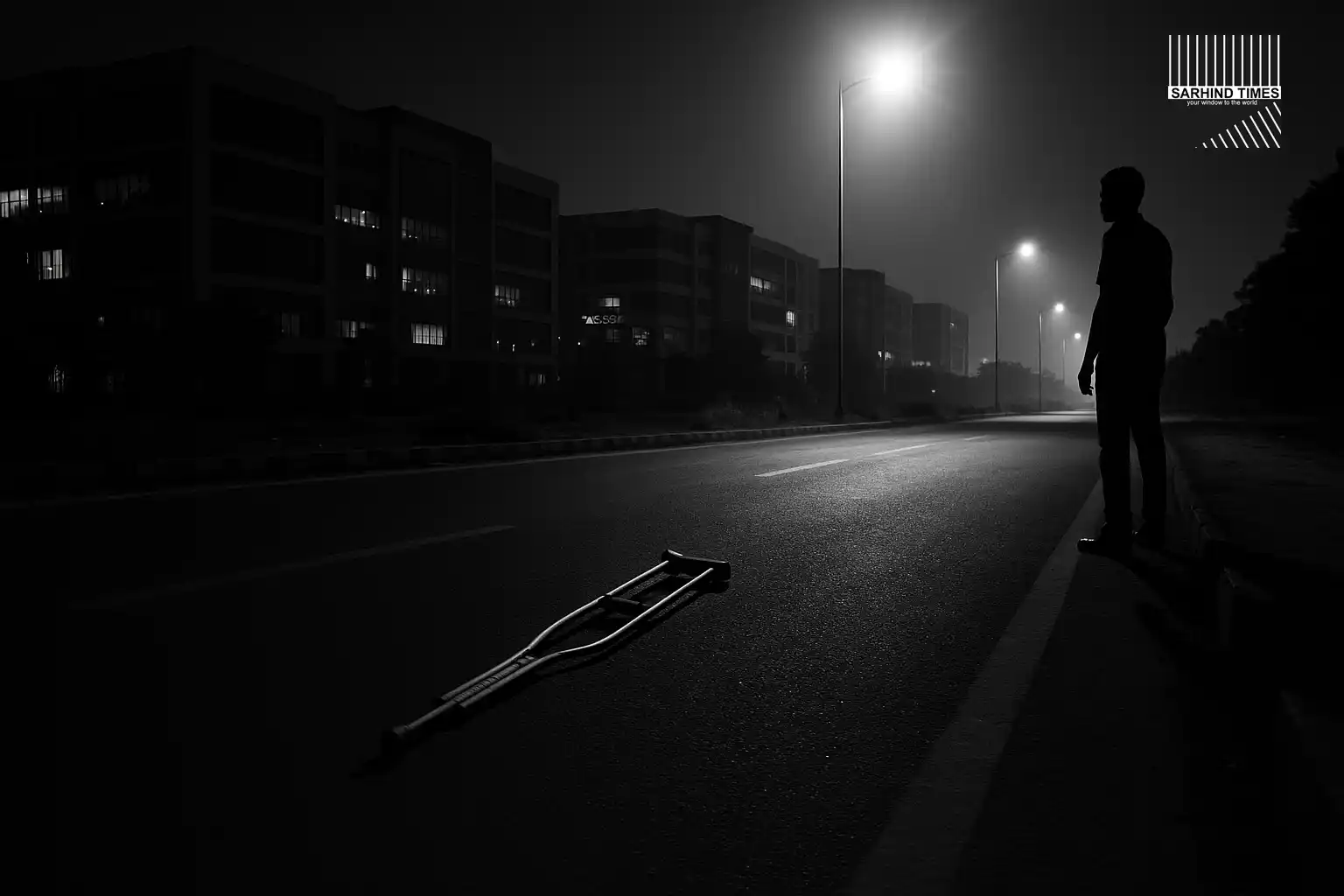
The city of Gurugram is reeling from yet another brutal act of violence. On the night of 21 October, at the Outer Road in Sector 7, IMT Manesar, a seemingly routine verbal spat between two men escalated into a fatal assault. According to police sources, the victim, 28-year-old clerk Kumar Gaurav Singh, was seated by the roadside when the accused labourer, identified as Ajay alias Bhuwani (34), approached him. Eyewitnesses say the argument quickly turned physical, and Ajay brandished a crutch, striking Gaurav on the head with force. Gaurav collapsed and died; his body was located later on 22 October and an official case was filed once the family identified the body on 24 October.
The investigation was carried out jointly by the Crime Branch, Manesar, and the Sector 7 police station. They swiftly tracked Ajay to a hide-out near the Kakrola-Bhangrola cut and effected his arrest. During interrogation, Ajay reportedly confessed to the killing and later to fleeing with Gaurav’s wallet and mobile phone.
For a city already grappling with rising concerns around corporate-area violence and labour-employer tensions, this incident raises fresh questions about urban law and order, worker rights, corporate campus perimeters, and policing hotspots.
What triggered the altercation?
Police records reveal that the confrontation began when Kumar Gaurav, a clerk at a local firm based in IMT Manesar, confronted Ajay for loitering near the Roadside access area around 10:00 pm. Gaurav reportedly asked Ajay, “Where are you heading? Why sitting here after hours?” – an ordinary question which turned into a fuse for violence.
According to the FIR and preliminary statements, Ajay responded angrily, citing frustrations over his own shift, low wages and lack of formal documentation. Gaurav persisted, prompting the labourer to pick up a crutch – commonly used by daily-wage workers for walking homewards – and strike Gaurav on the head. The knife-sharp blow fractured the skull and proved fatal.
Ajay then fled with Gaurav’s mobile phone and wallet, authorities say, before disposing of the crutch and altering his clothing at a roadside wash-area. The body was found in the early hours of 22 October by a security-patrol team, triggering the autopsy and identification process.
The arrest and investigation
The Manesar Crime Branch sprang into action once the family filed the missing person complaint on 24 October and identified the body. Using CCTV from the Outer Road stretch, they traced the movements of Ajay, identified his hide-out near Kakrola-Bhangrola cut and detained him on 26 October. Under interrogation, Ajay admitted the killing and described the sequence of events and his flight. He claimed to have hidden the mobile phone and wallet in his home in Manesar and urged investigators to recover them.
Investigators are analysing whether the motive extended beyond the verbal confrontation – whether it involved deeper workplace resentment, non-payment of wages, informal labour status, or personal animus. Meanwhile, the crutch used in the assault is being forensically examined, and Gaurav’s mobile phone data is slated to be extracted to confirm the timeline and any messages preceding the confrontation.
Gurugram police officials say that although this kind of fatal labour-employer dispute is rare in corporate parks, the rapid arrest indicates improved policing effectiveness in Manesar’s industrial corridor.
Corporate campus security and worker dynamics in Manesar
The IMT Manesar area, once a rural belt, is now a major industrial and corporate zone offering thousands of jobs to daily-wage workers, contract labourers, clerical staff and management executives alike. But this urban-industrial interface is also marked by socioeconomic tensions: workers often live in peripheral accommodation, commute late hours, operate under informal contracts and may lack access to mechanisms for grievance redressal.
In recent years, multiple incidents of conflict—though mostly non-fatal—have occurred on the Outer Road, within factory zones and in adjoining residential pockets. This incident highlights that what may begin as a routine ask from a clerk can spiral into fatality when life-stress, informal labour status, poor worker support and ambiguous corporate boundaries collide.
Companies in the zone often rely on subcontractors for labour supply, whose oversight and welfare mechanisms may be weak. Security at the peripheral roads is variable; many companies contract private guards, but the roads between factories are open public stretches. Late-night workers returning carry fatigue and stress; conflicts with local residents or security personnel can flare into violent episodes.
As one Manesar trade-union activist put it in a recent interview: “Many contract workers feel they are at the mercy of informal employers; two months’ wage delay or job insecurity can brew resentment. When a clerk or security guard questions them, it may trigger more than just a punch.” Although the quote is off-record, it reflects a broader tension between formal salaried employees and informal labourers in industrial clusters like Manesar.


+ There are no comments
Add yours