
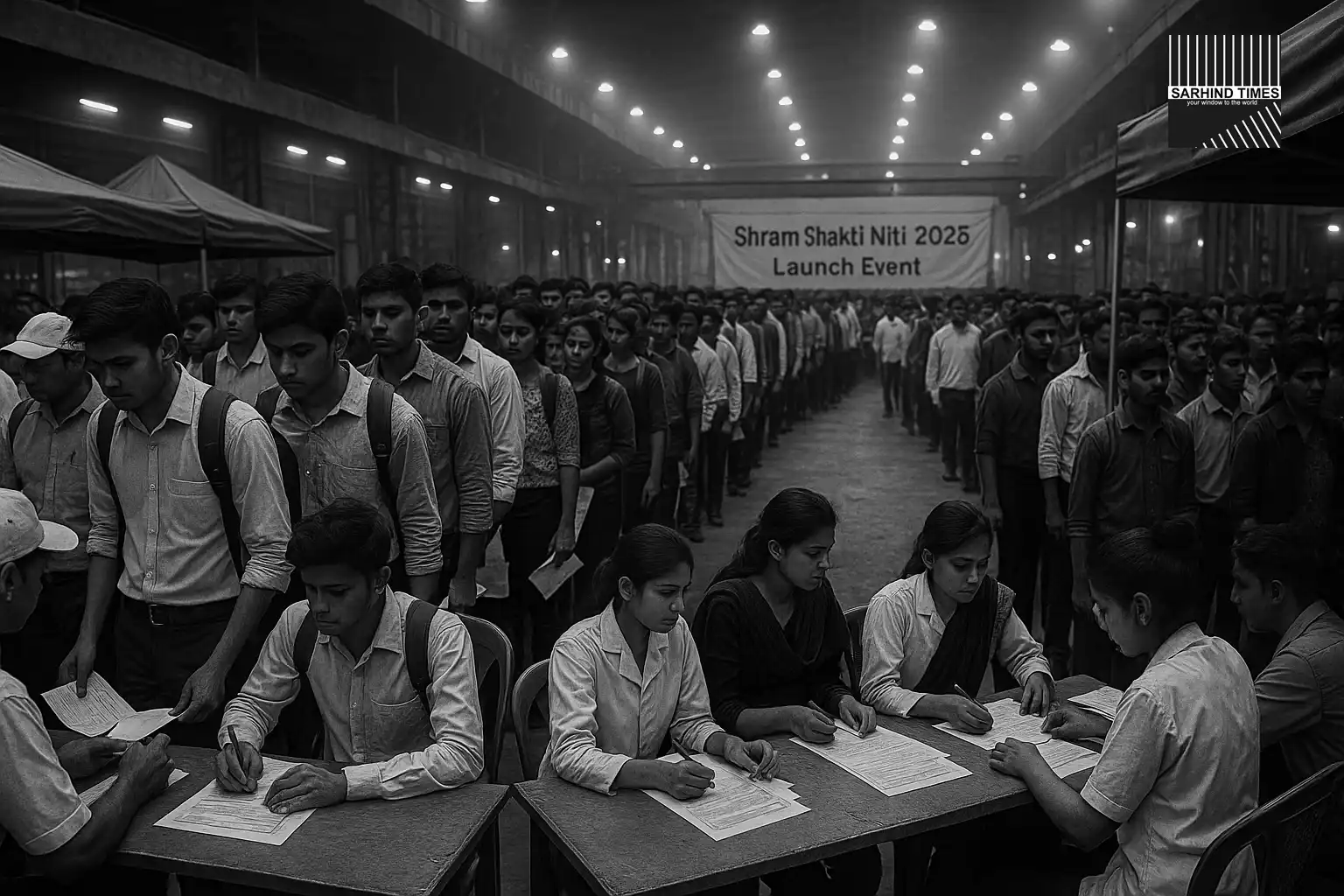
Comprehensive reform blueprint seeks universal social security, digital compliance streamlining and stronger inclusion of women and youth in the labour ecosystem
Dateline: New Delhi | 6 November 2025
Summary: The Shram Shakti Niti 2025 – a draft national labour and employment policy released by the Ministry of Labour & Employment – marks a major step in India’s labour-law and workforce governance overhaul. Its key pillars include universal social-security coverage, digital compliance frameworks, women-and-youth workforce empowerment and formalisation of the informal sector. The policy sets out a long-term vision for a fair, inclusive, and future-ready labour ecosystem in India.
Context and genesis of the reform
India’s labour-law architecture has been in transition for several years. With the consolidation of 29 central laws into four Labour Codes, as well as rising attention on workplace safety and rights, the reform narrative is gaining momentum. The draft Shram Shakti Niti 2025 is aimed at articulating a comprehensive “labour-and-employment policy” that aligns with India’s vision of building a modern workforce for a rapidly changing economy.
The build-out of this policy comes at a time when technological shifts, growth of gig work, digital platforms, changes in manufacturing and formalisation pressures are all reshaping what the “worker” means in India. The policy draft signals the Ministry of Labour & Employment’s recognition that governance must adapt from narrow regulation of specific industries to a more expansive and facilitative employment ecosystem.
According to the draft policy’s framing document, labour and employment are to be viewed not only through the lens of compliance but as economic-and-social pillars of a “Viksit Bharat 2047” agenda. The policy builds on prior inputs (such as studies on informal sector, women’s workforce participation, youth employment and digital labour platforms) and looks ahead to institutionalising systems that can respond to future shocks, tech disruptions and evolving job-markets.
Key pillars of Shram Shakti Niti 2025
The draft policy outlines seven strategic priorities and multiple enabling measures. They are summarised here:
– **Universal social-security coverage**: The policy proposes extending social-security benefits (health-insurance, pension, maternity, unemployment support) to all workers including those in informal or platform-based work, moving beyond the current segmented model.
– **Digital compliance and unified labour-stack**: A major theme is a “digital labour-stack” — unified registration, standardized data-systems, online inspections, e-certificates and reduced duplication across labour-regulators. The objective is to simplify formalisation for employers and workers alike.
– **Women and youth workforce empowerment**: Recognising persistent gender gaps and youth unemployment risks, the policy emphasises flexible work-arrangements, skills-upskilling, safe work environments, childcare/parental support mechanisms and preferential measures to integrate women and young adults into formal employment.
– **Formalisation of the informal sector and platform work**: The policy acknowledges the vast informal-sector labour and gig-economy workforce in India. It intends to bring in mechanisms for registration, rights protection, minimum-wage enforcement, social security linkage and dispute-redress for platform workers.
– **Occupational health, safety and decent work standards**: Strengthening workplace safety, health-monitoring, industrial-hazard management and compliance mechanisms is a key objective, in response to recent industrial accidents and workplace fatalities.
– **Labour-market mobility and career pathways**: The policy aims to enable easier job-mobility across sectors and regions, portable social benefits, recognition of certifications, skills-registry linking to employment, and better transparency for workers.
– **Inclusive governance and stakeholder participation**: The draft emphasises multi-stakeholder governance – inclusion of worker-unions, employer-bodies, state governments, civil-society, legal-aid mechanisms and technology platforms in policy implementation and monitoring.
Implementation structure and timelines
The policy sets out time-bound steps:
– Short-term (within 12 months): setting up a National Labour and Employment Council, launching the unified labour-stack portal, initial pilot of social-security extension to select informal-worker cohorts, awareness campaigns on digital registration, and state-level consultations.
– Medium-term (1-3 years): scaling up social-security coverage, formalising gig-and-platform-workers, linking skills-certification with employment registries, upgrading inspection frameworks, and institutionalising data-analytics for labour-markets.
– Long-term (3-5 years): achieving measurable reductions in informal employment share, increasing women’s labour-force participation substantially, dynamic labour-market regulation aligned with tech disruption and future-of-work challenges.
The policy underscores that the labour ministry will operate in coordination with state governments (as labour is a concurrent subject) and existing sectoral regulators (factories, mines, shops & establishments, gig-platform oversight). The national framework is intended as a guiding template; states will adapt rules, compliance tools and monitoring frameworks accordingly.
Why the reform is significant
This draft policy is significant for several reasons:
– It marks a shift in philosophy—from labour-law primarily being about “regulation of employers” to a model where the state acts as enabler of workforce outcomes, social-security extension and job-mobility.
– For India’s large informal sector (estimated over 90 % of workforce), the proposed push to register, protect and formalise many of these workers represents one of the largest tasks of social-policy engineering in decades.
– Given the demographic dividend and youth bulge, integrating young adults and especially women into productive employment is vital for growth, productivity and social cohesion.
– Digital-stacking of labour-compliance may help reduce regulatory burden on businesses, improve transparency, reduce corruption and improve data-driven policy-making—thus aligning with India’s digital-governance ambitions.
Challenges and risk factors
While the draft policy is ambitious, multiple challenges stand in the way:
– **States’ role and heterogeneity**: Labour is a concurrent subject; states may adopt rules at different rates, leading to uneven implementation across India.
– **Formalisation fatigue and cost**: Employers in informal sectors may resist increased registration, social-security linkage and compliance overhead. Unless incentives are aligned, the adoption may lag.
– **Digital-divide and capacity constraints**: Many workers in rural, informal or platform-work contexts may lack digital literacy, access or trust; achieving registration and linkage may require more ground-outreach.
– **Financial sustainability**: Extending universal social security entails substantial fiscal commitment — the financing model (central-state sharing, employer-employee contributions, general taxation) needs clarity.
– **Enforcement and inspection gaps**: Past reforms have often faced enforcement deficit; scaling inspection, monitoring and grievance-redress for widespread informal workers remains a major undertaking.
– **Transition risk and business-uncertainty**: Employers operating in informal sectors may view new regulation as pressure, potentially reducing hiring, increasing automation, or shifting to unregulated models unless managed carefully.
In effect, the policy’s success depends less on what is written and more on execution, resourcing, state-level adaptation and stakeholder buy-in.
Impact for workers, businesses and citizens
– For **workers**, the policy’s frame promises expanded access to rights, protections, portable social-security, and registration in digital stacks that could ease mobility, tracking and grievance-redress. Young women, platform-workers, informal-sector workers stand to benefit most, if delivery is strong.
– For **businesses**, especially medium and small enterprises, the policy signals that compliance, digital registration and simplified frameworks will be in focus. While this means adjustment-costs, it also aims for clearer rules, less fragmentation, and better predictability across states.
– For **citizens and society**, the policy addresses broader outcomes: improved labour-market inclusivity, better formal-jobs creation, alignment of workforce with future-of-work challenges and stronger social-safety-nets — all of which contribute to growth, equity and resilience.
Relation to other reforms and global context
India’s labour-policy reform aligns with global trends: countries are increasingly focusing on gig-economy regulation, universal social-security, digital-labour-market infrastructure and worker-mobility in a globalised environment. The draft policy also builds on India’s prior legislation (Labour Codes) and digital-public-infrastructure ambitions (for example, digital identity, employment-services portals). From the global investor angle, clearer labour-frameworks reduce regulatory uncertainty and strengthen India’s attractiveness as a destination for next-gen manufacturing, services and platform-enterprises.
Next steps and what to watch
Several developments will be critical in the coming months:
– Finalisation of the policy following public‐consultation and state-government inputs, including feedback cycles, industry/unions consultation and stakeholder workshops.
– Launch of the unified labour-stack portal and initial registration of informal-workers and platform-workers.
– State-level rule-notifications that align with the policy, especially for social-security extension, registration and inspection regimes.
– Budgets and financing decisions: how social-security coverage will be funded, cost-sharing models, employer-contributions and fiscal allocations.
– Monitoring metrics: key outcomes such as increase in formal employment, improved women’s participation, reduced informal share, increased registration of gig-workers, uptake of social security and responsiveness of grievance systems.
Conclusion
The Shram Shakti Niti 2025 draft policy represents a major inflection point in India’s labour governance — signalling ambition to build a modern, inclusive, digitally-enabled workforce aligned with national growth imperatives. The shift from regulation to facilitation, from fragmentation to unified frameworks, and from blue-collar focus to holistic workforce considerations underlines the change in mindset. The road ahead, however, is long and success will depend on implementation, resourcing, state-and-local alignment, and the ability to bring informal and vulnerable workers into the policy perimeter. For India’s growth-story and its workforce-transition, this policy may well become a cornerstone framework.



+ There are no comments
Add yours