
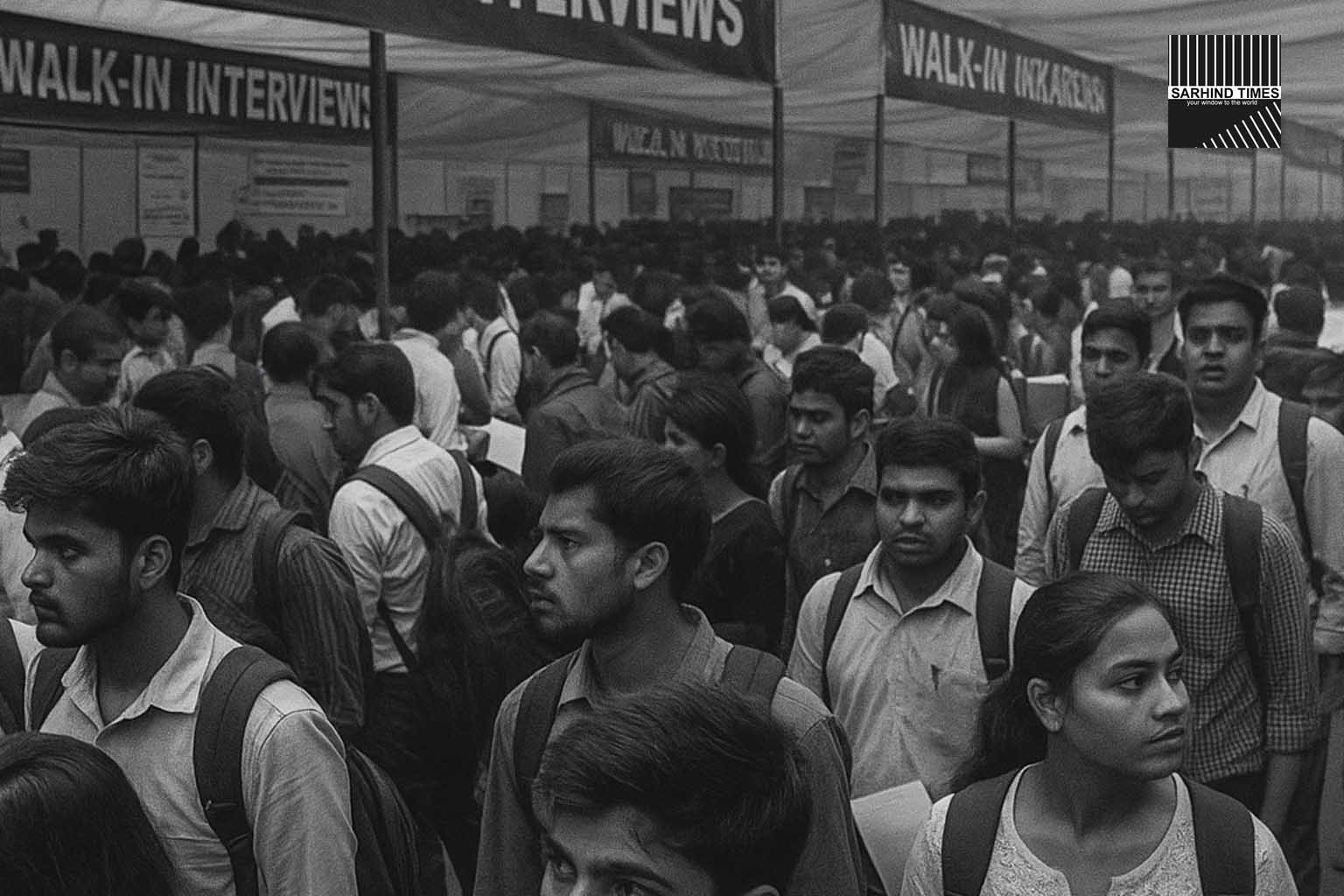
Improvement in rural employment and rising female participation drive headline gains amid rising urban youth job-loss pressure
Dateline: New Delhi | November 12, 2025
Summary: According to the latest quarterly bulletin of the Ministry of Statistics and Programme Implementation (MoSPI) covering July–September 2025, India’s overall unemployment rate for persons aged 15 and above has fallen to **5.2 per cent**, down from 5.4 per cent in the previous quarter. While this suggests some positive momentum, deeper data reveal growing urban joblessness, particularly among young people, and a labour-force participation rate that remains modest—posing challenges to policymakers and businesses alike.
Key figures and disaggregated trends
The July–September 2025 quarter (Q2 of FY 2025-26) data show the following headline and sub-trends:
- Overall unemployment rate (UR) among persons aged 15 and above: **5.2 %**, down from 5.4 %.
- Rural UR: **4.4 %**, lower than the previous quarter’s 4.8 %.
- Urban UR: **6.9 %**, slightly higher than the previous quarter’s 6.8 % — indicating joblessness remains more acute in urban zones.
- Labour Force Participation Rate (LFPR) remained largely stable at **55.1 %** for persons aged 15 +. Rural LFPR: ~57.2 %; Urban ~50.7 %.
- Female LFPR rose to **33.7 %** (from 33.4 %). Female Workforce Population Ratio (WPR) increased to 32.0 %.
- Youth unemployment (age 15-29) climbed to **14.8 %**, up from 14.6 % in the previous quarter.
These numbers paint a mixed picture: while the headline unemployment rate has improved driven largely by rural labour absorption (particularly in agriculture during the Kharif season), structural challenges remain especially in urban employment and the youth segment.
Drivers of the improvement
The contraction in rural unemployment is mainly attributed to seasonal agricultural operations, which typically expand employment during the July-September period (the Kharif harvest cycle). The share of rural workers in agriculture rose from 53.5 % to 57.7 % in this period.
At the same time, female participation in the workforce has inched up, contributing modestly to the WPR rise. For businesses, this suggests that despite broader concerns, labour supply head-winds are not as acute in many rural areas.
On the demand side, growth in the services sector, infrastructure push and government employment programmes appear to have helped absorb labour in some regions—but the gains are uneven.
Remaining concerns: Urban weakness and youth joblessness
Despite the overall improvement, the data raise several caution flags:
- Urban unemployment rising: The uptick to 6.9 % in urban areas suggests urban labour markets are under more pressure. Many metro and tier-1 cities, which rely on services, IT, manufacturing and construction, may be facing transition stress, slower hiring or adjustment to supply-chain shifts.
- Youth unemployment high at 14.8 %: This is nearly three times the national average UR and highlights the inability of labour markets to rapidly absorb younger entrants. The mismatch between skill-supply and job-opportunity remains visible.
- LFPR and WPR remain modest: A participation rate of 55.1 % means nearly 45 % of the working-age population is not engaged in work or seeking it—whether due to discouragement, household responsibilities, education or other reasons. Female participation at 33.7 % remains especially low compared to global peers.
- Rural resilience may mask vulnerability: While agriculture absorption boosted rural employment this quarter, such gains may be cyclical rather than structural. If industrial or services jobs do not expand commensurately, rural employment quality and earnings may deteriorate later.
Implications for policy-makers and business strategy
For policy-makers the results suggest both relief and urgency. The falling UR is a positive signal—but the high youth UR and urban stress demand targeted interventions. Key policy responses include:
- Focus on urban job creation and services-manufacturing link-ups. Strengthening industrial investment in suburban growth zones, upgrading workforce skills for digital and emerging domains and boosting mid-sized firms that can absorb urban labour.
- Skill-mismatch correction. Given youth joblessness remains high, aligning vocational education, industry internships and job-readiness programmes to market needs becomes critical.
- Female labour-force integration. With female participation still low, targeted schemes—for example flexible work arrangements, child-care support, improved access in urban service-jobs—can unlock a large latent workforce pool.
- Monitoring quality of jobs. As rural employment rises via agriculture or informal work, ensuring transitions to better jobs with security, regular wages and upward mobility remains key. Structural reforms in labour-law, ease-of-doing-business and MSME growth are relevant.
Business and investor take-aways
For firms, particularly those in content-creation, digital platforms, workforce services and automation (which align with your domain of interest), the labour-market dynamics present both challenges and opportunities:
- Urban workforce constraints: With urban unemployment and participation rates under pressure, firms may face higher wage inflation, skill shortages or turnover in cities—especially for mid-skilled or service-roles. Strategic location decisions and workforce planning become more important.
- Emerging across rural and semi-urban zones: Staffing models may increasingly look beyond metropolises; companies might tap semi-urban centres and smaller cities where labour-costs are lower, participation is rising, but infrastructure gaps may exist.
- Automation and up-skilling imperative: Continued high youth joblessness and skill-mismatch mean firms that invest in worker training, modular up-skilling, internal talent pipelines may gain competitive advantage in labour-scarce urban markets.
- Content and platform-play advantage: With rising female participation and youth in the labour-force, sectors such as digital content, online education, AI-tools, multilingual services and creator-economy stand to benefit from a more available yet under-leveraged workforce. You may consider how your content-creation business could leverage this demographic shift.
What to watch in coming months
Key indicators to monitor include:
- The quarterly unemployment and labour-force participation data for the period October–December 2025 and whether rural employment remains supportive or weakens post Kharif season.
- The breakdown of employment by type: regular wage/salaried, casual, self-employed; this will show job-quality changes rather than just headline employment improvement. For example, salaried employment in urban areas rose modestly this quarter to 49.8 %.
- State-level unemployment variations and how growth regions (such as NCR, Bengaluru, Pune) perform relative to weaker regions—this will affect localisation strategies for firms.
- Sector-wise employment—whether services, manufacturing, agriculture maintain growth or decelerate; shifts may identify which sectors create scalable jobs.
- Female labour-force participation and youth employment trends: if women’s participation rises substantially and youth jobless rate falls, the structural improvement claim gets stronger.
-
Conclusion
The India labour-market data for July–September 2025 offers a cautiously positive narrative: the overall unemployment rate has fallen to 5.2 per cent, rural employment conditions improved and female participation nudged upward. Yet the more critical story is that job creation, especially for urban youth and women, remains uneven and under pressure. For managers, creators and entrepreneurs, the take-away is clear: labour-market dynamics are shifting—costs, talent availability and regional workforce-mix all matter more than ever.
In the context of the broader economic and innovation agenda, India’s challenge is no longer just to reduce joblessness—but to raise job-quality, broaden participation and align workforce-skills for a more complex, digital-and-services-led economy. The next few quarters will be decisive in determining whether the current improvement becomes sustainable or remains cyclical.



+ There are no comments
Add yours