
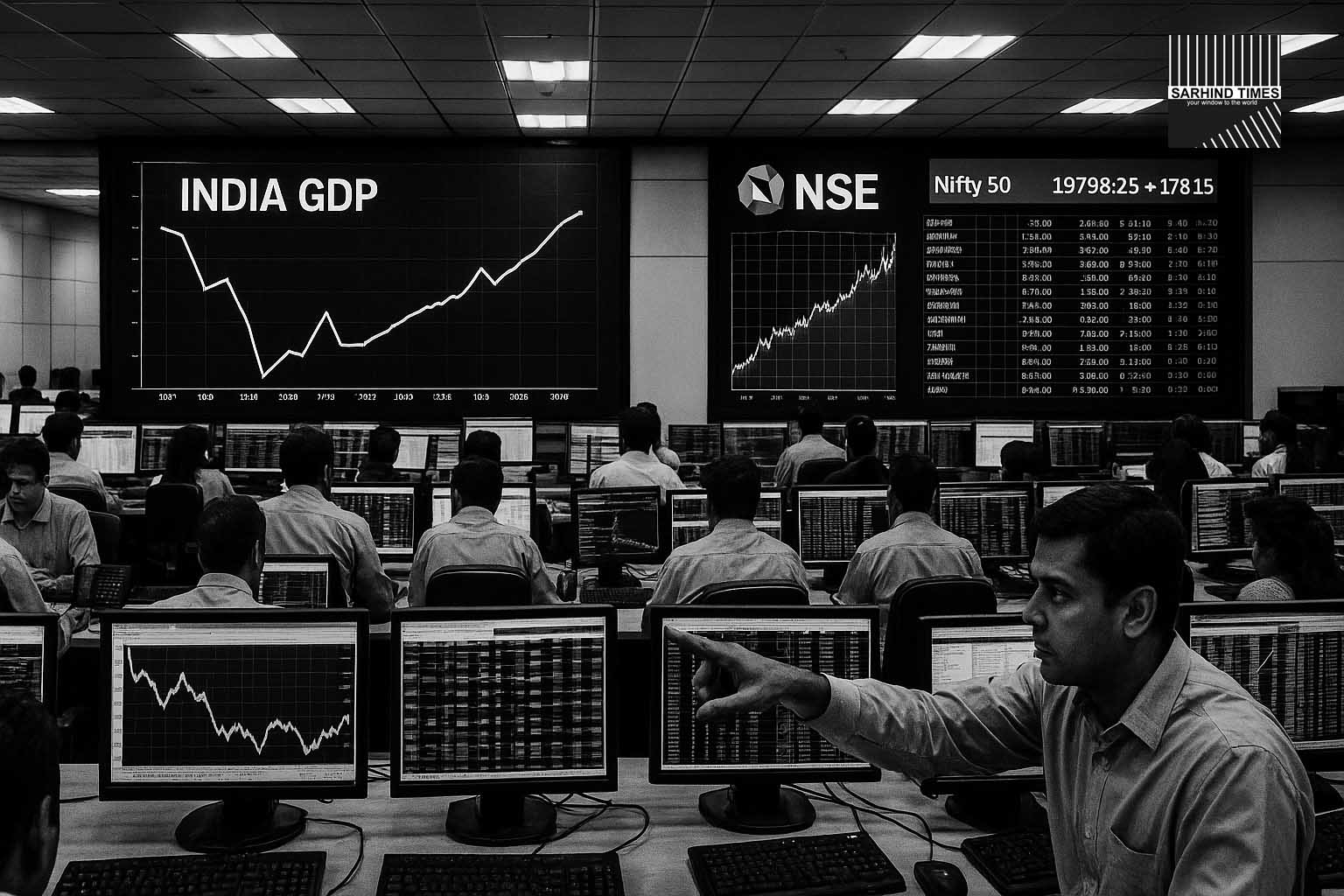
Robust consumption and fiscal thrust drive momentum, while business-investment recovery and global shocks remain the missing link
Dateline: New Delhi | 01 November 2025
Summary: India’s economy is poised for a strong performance this fiscal year, with the Reserve Bank of India (RBI) projecting growth at 6.8 % while inflation dips to an eight-year low. Despite these favourable dynamics, key domestic challenges — most notably weak private investment and uncertain export momentum — underscore that sustaining the expansion will require broader structural turns.
Growth drivers and inflation backdrop
India’s recent inflation print of 1.54 % for September represents the lowest rate since June 2017, cushioning the economy from price pressures and offering policy space. [The CPI inflation rate for September 2025 fell to 1.54 % from 2.07 % in August.]
According to the RBI’s October meeting, inflation for 2025-26 (FY26) has been revised downward to 2.6 %, while GDP growth for the same fiscal year is forecast at 6.8 %.
The underlying drivers of the growth surge include sustained private consumption, elevated government capital-spending, a rebound in services, and stable commodity/input costs. With inflation well below the central bank’s tolerance band of 2-6 %, borrowing costs are moderate and households retain spending power.
Consumption and fiscal thrust lead the recovery
Household demand remains strong–rural demand has firmed up thanks to better monsoons, good harvests and rising rural incomes, while urban consumption continues to be buoyed by services, discretionary spending and rising employment in organised sectors.
On the fiscal side, the Union and state governments continue to front-load infrastructure and capital-expenditure programmes. This fiscal thrust is further magnified by policy-announcements aimed at supporting manufacturing, logistics, digital infrastructure and health-care investment. These direct and indirect effects are sustaining demand-momentum even as private-investment lags.
Investment and export drag-factors remain prominent
While consumption and fiscal activity are strong, the investment side of the equation has not picked up as robustly. Corporate-capex announcements are up, but actual project-execution remains behind schedule; many firms remain cautious amid global demand-weakness, supply-chain disruptions and elevated financing costs earlier in the cycle. This lag in fixed-investment could cap the breadth of the economic up-turn.
On the external front, India’s exports face headwinds arising from slower global growth, competitiveness pressures, trade-policy uncertainties and stronger currency dynamics. A weak external demand environment might limit the export-engine’s contribution to growth for the remainder of the year.
Monetary policy: room to manoeuvre
With inflation well beneath target-bounds and growth prospects firming, the RBI has signalled scope for further monetary-easing if required. Minutes from the October MPC meeting show a majority of members in favour of maintaining a “neutral” stance for now, with a subset advocating a shift to “accommodative” mode. A rate cut remains a possibility for December 2025 if data-flows support such a move.
Lower interest-rates may further stimulate private-investment, ease corporate borrowing-costs and unlock late-cycle capex decisions.
Risks and headwinds to the outlook
Notwithstanding the positive momentum, several risks persist.
– Private-investment inertia: If firms delay capex further or face cost-overruns, growth may remain skewed toward consumption and fiscal-spending rather than becoming broadly investment-driven.
– Global uncertainty: Renewed trade-protectionism, currency shocks, geopolitical tensions and commodity-price inflation could shift domestic dynamics.
– Export-shortfall: Without a meaningful rebound in external demand or value-added exports, the growth mix remains unbalanced.
– Financial-sector stress: Bank-non-performing-asset (NPA) risks, leveraged infrastructure-projects and regional banking vulnerabilities could undermine credit-flow and investment momentum.
Outlook for 2026 and beyond
If the investment-cycle revival takes hold and export activity improves, India’s growth may approach 7 %+. Combined with low inflation, that would mark a favourable growth-inflation trade-off rarely seen in recent years. The policy-space created now gives the central bank and government leeway to make structural bets—on infrastructure, digital-economy, manufacturing and climate-resilient growth.
However, sustaining the momentum will require broadening the growth-base: lifting manufacturing-share, increasing services export-competitiveness, enhancing formal-job creation, and deepening private-sector participation. The transition from consumption-led to investment-driven growth will be the key narrative in the next phase.
Implications for businesses and investors
For companies, the low-interest, low-inflation environment supports margin expansion, price-stability and better credit-terms. Industries oriented toward domestic demand (consumer goods, services, digital, FMCG) stand to benefit near-term. For equity and fixed-income investors, India offers a favourable macro-risk-return profile — though they must monitor corporate-earnings execution and global-flow shifts.
Real-estate, infrastructure and manufacturing investment-themes may be prioritised by investors seeking to ride the structural agenda. At the same time, risk-management will be crucial: indecision or delays in investment rollout, global shocks or inflation surprises could upset the balance.
Conclusion
India’s economy appears to be on a strong footing heading into 2025-26: a revival built on consumption, solid fiscal support and benign inflation. The 6.8 % growth-forecast underscores a favourable environment, but the durability of the upturn will depend on the revival of business-capex and exports. For policymakers, the task now is not just sustaining growth but making it inclusive, investment-led and resilient. For businesses and investors alike, the opportunity is clear — yet the margin for error remains small.


+ There are no comments
Add yours