
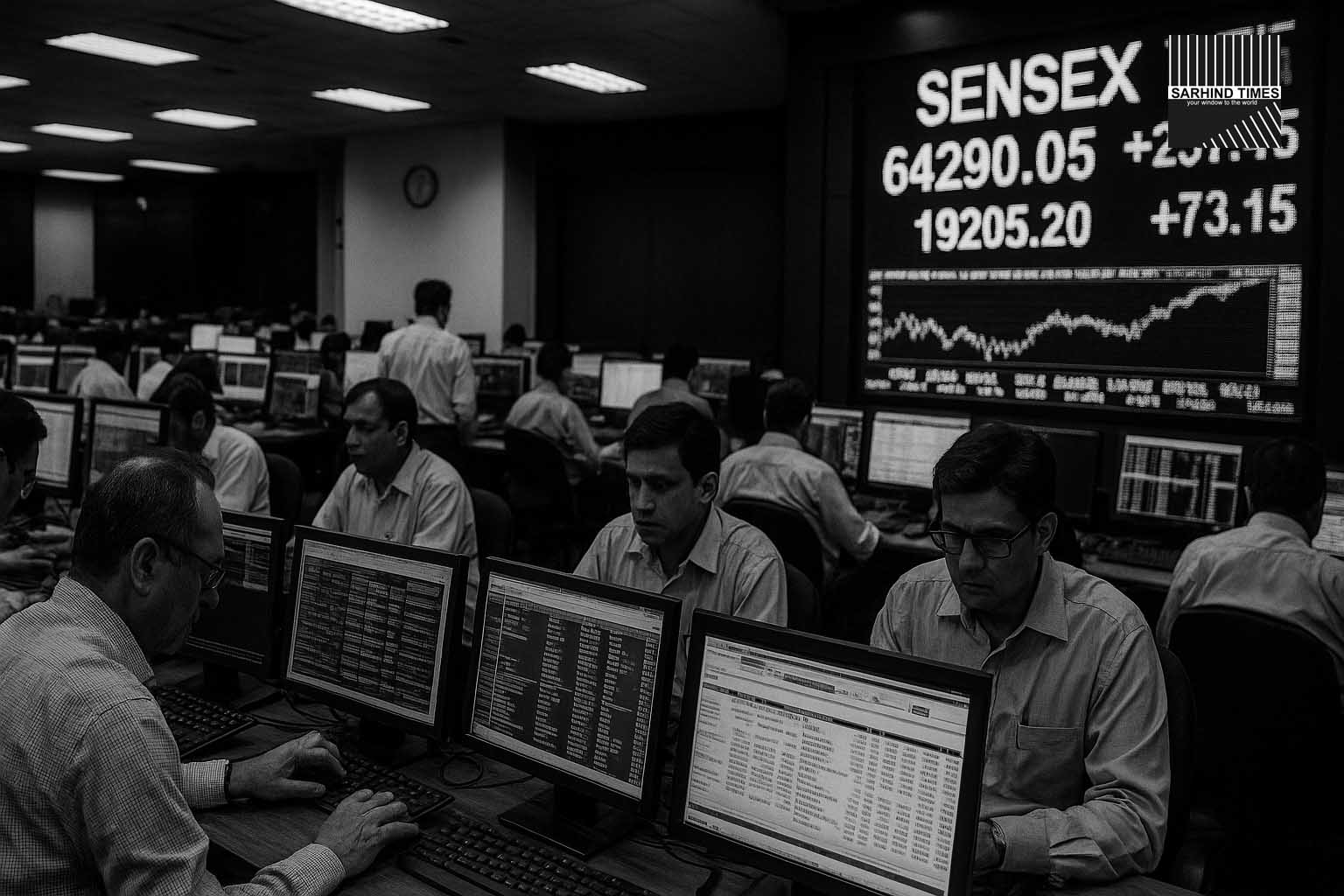
Improving domestic data, global cues and policy optimism fuel fresh momentum on Dalal Street—but structural risks remain
Dateline: Mumbai | 17 November 2025
Summary: Indian benchmark equity indices have posted notable gains in recent trading sessions, with the Sensex rising nearly 600 points and the Nifty 50 crossing the 25,850 mark. The rebound is backed by strong earnings in key sectors, improving technical indicators and signals of a possible trade deal with the US. However, analysts warn that selective buying and structural headwinds such as muted private investment and global uncertainty temper enthusiasm.
1. Market movement & recent data
On 12 November 2025, Indian equity markets closed markedly higher: the Sensex rose approximately 595 points (0.71 %) to reach 84,466, while the Nifty reached 25,875.80 after gaining 180.85 points (0.70 %). This recovery came on the back of renewed investor optimism, led by strength in sectors such as IT, autos and consumer goods. The broad market also showed signs of participation, with mid-cap indices hitting fresh highs.
Technical indicators and market watchers suggest that the indices are likely to maintain an upward bias in the near term—at least over the week of 17-21 November—supported by improving sentiment and favourable global cues.
Market commentary notes that the rally is not broad‐based across all sectors: while financials, auto and consumer have participated, IT and metals remain under pressure in some sessions.
2. What’s driving the upswing
The recovery in equities can be attributed to a convergence of factors:
- Better earnings from corporates: Several large‐cap firms have delivered stronger‐than-expected results, particularly in consumer and infrastructure‐linked sectors. This has provided more confidence in near-term business momentum.
- Technical trigger and improved sentiment: Market participants note that the Nifty clearing the 25,750-26,100 zone would unlock more upside and trigger algorithmic and momentum flows. One broker remarked that sentiment is positive so long as Nifty stays above 25,750.
- Global cues and trade deal hopes: Optimism over a possible bilateral trade deal between India and the US, easing of global tensions and hopes around policy support have helped risk-appetite.
- Strong participation in infrastructure- and consumer-linked sectors: Rising rural consumption, government capital spending and recovery in auto sales are helping underpin demand narratives, which in turn support equities. Though these are more fundamental than pure stock momentum, they bolster confidence in markets. Although primarily noted in macro view, they align with market trends.
3. Sectoral dynamics: winners and laggards
Within the market, certain sectors have out-performed while others continue to lag:
Winners:
- The auto sector saw renewed interest, as consumer demand indicators improved and investor flows rotated into cyclical names. Reports on domestic vehicle sales suggested healthy upticks.
- Consumer goods names—including paints, FMCG, and home improvement—performed strongly; for example, a leading home-improvement stock reported revenue up by over 6 % and profit jump of 43 % year-on-year, helping lift the sector.
- Financials and banks gained momentum with improving credit off-take and stability in asset-quality trends, reinforcing banks as favourites among investors renewing risk appetite.
Laggards / watch-outs:
- IT and export-oriented tech names saw mixed performance; global tech demand softness and currency pressures continue to weigh. :contentReference[oaicite:13]{index=13}
- Basic‐metals and mining stocks remain cautious, given commodity-price volatility and global demand uncertainty. :contentReference[oaicite:14]{index=14}
4. Investor flows and breadth signals
Market breadth has improved: mid-cap and small-cap indices have gained along with large caps, suggesting participation beyond top names. Commentators highlight that a healthy rally typically requires this participation and not just large-cap momentum. While flows remain moderate, the trend has improved from earlier consolidation.
Foreign institutional investor (FII) flows remain cautious. While domestic institutional investors and retail participation are stronger, FIIs are still monitoring global rate trajectories and currency risks. Any sharp pull-back could mute momentum. The upcoming state election notifications and global central-bank cues also keep FIIs alert.
5. Technical outlook and risk zones
Technically, the Nifty appears to have established a support base near 25,750-25,800. A decisive breakout above 26,100 would open further upside toward 26,500-27,000 levels in the near term. Conversely, a breakdown below 25,500 could invalidate the rally and spark consolidation or corrections.
Traders highlight that volatility is likely to remain part of the story—global shocks (such as a U.S. rate surprise or geopolitical disruption) could trigger sharp turnarounds. Thus, market participants are advised to adopt selective investment, monitor valuations and be cautious on leverage.
6. Structural caveats and medium-term questions
While the current rebound is welcome, several structural questions remain that bear on how durable this rally can be:
- Dependence on public investment and consumption: With private capex still soft, much of the positive momentum may be driven by government spending and rural consumption. For a sustainable equity rally, private corporate investment needs to pick up meaningfully. Analysts caution that without deeper investment flows, earnings growth may remain constrained.
- Global headwinds and commodity risks: Indian markets are not insulated—global slowdowns, trade tensions, commodity price shocks and currency volatility could all impact earnings, margin pressure and investor flows. Thus, the risk credit is high.
“` - Valuation comfort and margin pressure: As markets climb, valuations may stretch. If earnings do not keep pace, corrections are bound to surface. Sectors such as consumer, financials and cyclicals are more vulnerable to margin squeeze than others.
- Policy and reform fatigue: Markets often price in policy advantages ahead of time. If reforms slow down or expectations are unmet, markets could become disappointed. For example, over-expectation of large privatisation announcements or trade accords could set up a fall if delayed.
“`
7. Implications for different stakeholders
For investors, the current environment offers opportunities—but the advice from market watchers is clear: pursue selective stocks rather than broad market bets, and recognise that downside risks remain real. Sectors with structural tailwinds (rural consumption, infra, financials) may offer better risk-reward; sectors with stretched valuations demand caution.
For policymakers, the rally underlines the importance of sustaining structural momentum. The government and regulatory agencies must ensure that capex pipelines remain active, financial sector stress remains contained, and global linkages are managed. Efforts to improve business climate, private sector participation and export growth remain critical. The equity markets are sending a message: yes growth matters—but quality and durability matter more.
8. What to watch next
Key upcoming triggers for the market include:
- Corporate-earnings data for Q2FY26 across sectors and how margins shape up amid inflation and input-costs.
“` - Outcomes of state elections, policy announcements on privatisation and trade deals—particularly the India-US dialogue.
- Global monetary-policy signals, especially from the Federal Reserve in the US, and currency/commodity flows that impact emerging markets.
- Domestic credit-flow data, private-capex announcements, and breadth of final investment decisions by corporates.
- Valuation correction triggers: if Nifty breaches 26,100 convincingly, the next target is 26,500 +; else consolidation around 25,800-25,500 may ensue.
9. Expert commentary
Market strategists are cautiously optimistic. One senior analyst commented: “We believe the Indian equity market has entered a phase of selective recovery—you need to be stock-smart rather than market-smart. Breadth has improved but the risks are many, and the next few months will determine whether this is a transient bounce or the start of a sustainable leg.”
Another portfolio manager added: “Given valuations are no longer ultra-cheap, the margin for error has shrunk. Earnings need to deliver. The break of 26,100 is key; until then upside remains conditional.”
10. Summary & final take
Indian equities have demonstrated resilience and are steering into positive territory again, underpinned by favourable domestic factors and improved global mood. The rally is real—but it is not yet broad‐based nor guaranteed. For investors and stakeholders, the message is clear: engage with conviction but stay vigilant.
If India’s growth and earnings trajectory remains intact, and reforms continue, the market may well ladder higher. Yet if global shocks emerge or domestic investment disappoints, the gains could quickly reverse. In that sense, the current phase is more about opportunity than euphoria. Time, execution and discipline will distinguish the persistent bull from the fleeting spike.



+ There are no comments
Add yours