
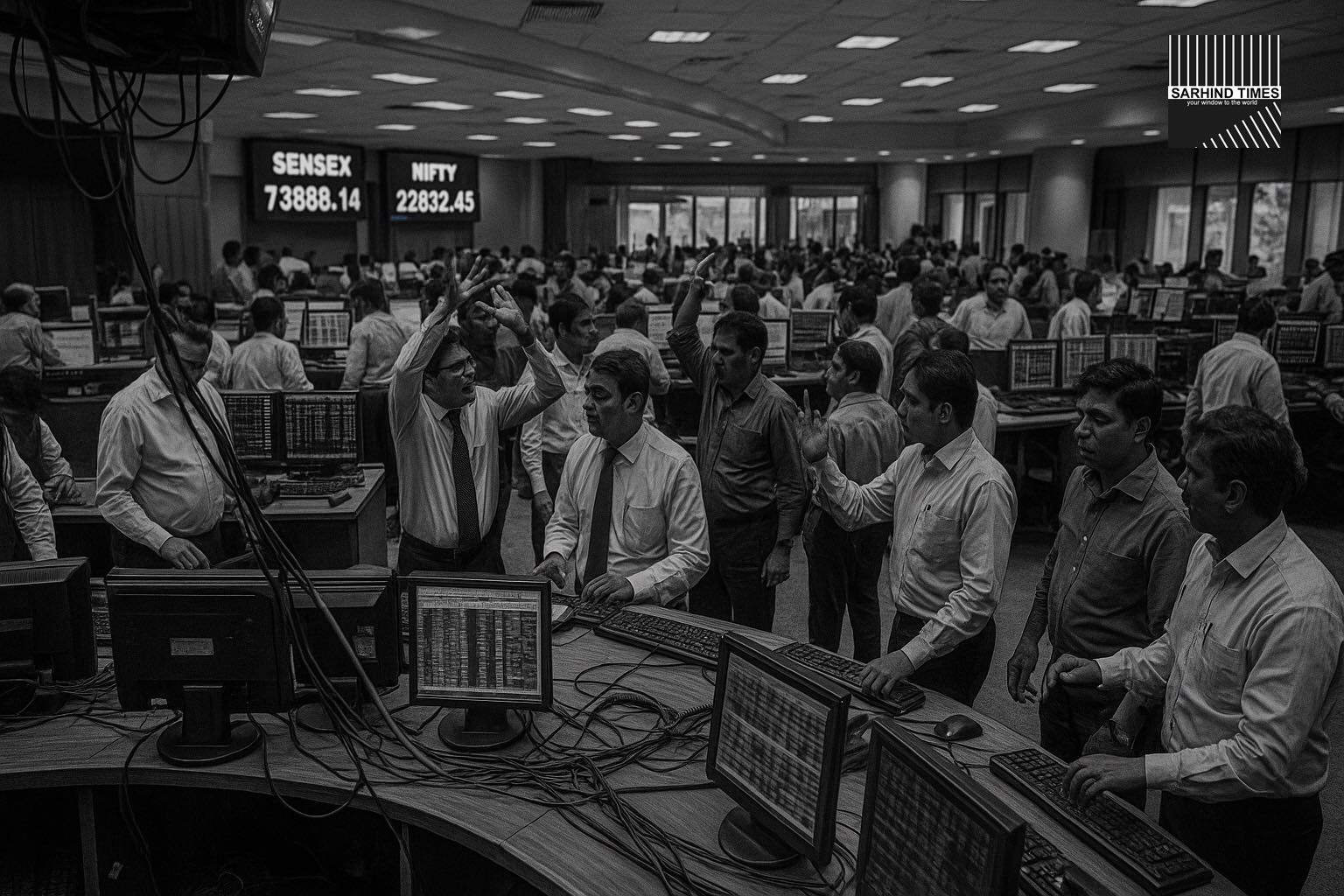
Sensors flash yellow: after strong gains, major indices pause while structural bulls eye 2026-growth pick-up
Dateline: Mumbai | 09 November 2025
Summary: The Indian equity markets have shifted into a consolidation phase following a robust October rally. Both the Nifty 50 and BSE Sensex are pausing near key levels as investors digest global cues, corporate earnings and foreign flows. Leading global houses are reinforcing long-term bullishness on India while cautioning about near-term risks. The interplay of consolidation and structural optimism is defining investor behaviour as Dalal Street enters a critical phase.
October’s rally: what happened and where we stand now
Indian equity markets enjoyed a strong rally through October on the backdrop of solid corporate earnings, improving domestic growth signs and renewed investor appetite. Yet with gains in hand, both the Sensex and Nifty are now exhibiting signs of fatigue—and entering a phase of consolidation rather than a fresh breakout.
As of early November the Nifty 50 is hovering around the 25,700 level, having dropped marginally. On November 6 it closed at approximately 25,509.70, down about 0.34% on the day. At the same time the Sensex finished at about 83,311, down 148 points or 0.18%.
The pull-back is modest (about 2% from recent highs) but notable because it occurs at a juncture where many market participants had been expecting continuation of strength rather than pause.
Analysts interpret this as a healthy consolidation: after a sharp run-up, a pause allows the market to digest gains, reassess valuations and absorb global uncertainties.
Driver checklist: What is fueling investor optimism?
Even amid near-term caution, structural positives in favour of Indian equities remain strong and provide the underpinning for long-term conviction.
One key piece: global brokerage houses are flagging India as a diversification escape from increasingly crowded themes—especially artificial intelligence. For instance, HSBC recently flagged the Indian market as a standout emerging-market opportunity, setting a Sensex target of 94,000 by end-2026.
Another element: leading investment banks such as Morgan Stanley see a recovery in India’s growth cycle. Morgan Stanley’s base case foresees the Sensex reaching 89,000 by mid-2026, with a bull case of 100,000.
These positive long-horizon calls reflect India’s favourable fundamentals: young population, rising consumption, investment in infrastructure and manufacturing, as well as supportive government policy. The domestic investor base is also expanding actively.
Why markets are pausing: risk matrix & headwinds
Despite these positives, several risk-factors justify the market’s pause outing.
First: global cues remain mixed. Equity markets abroad are showing signs of slowing momentum; the US Fed’s stance is uncertain and global growth concerns persist. This creates a cautious frame for Indian equities.
Second: valuations are elevated. With recent gains priced in, the incremental upside is less certain unless fresh catalysts arrive. Analysts suggest key levels must hold.
Third: foreign institutional investor (FII) flows are volatile. A pull-back in FII buying or net selling could put pressure on domestic indices that are partly reliant on global capital.
Fourth: the market is in an earnings season where company-specific results matter more than broad indices. Some sectors are doing well, others facing pressure, and this patchy performance adds to the caution.
Mid-term and structural outlook: where do we go from here?
While near-term action may be about consolidation, the structural trend for Indian equities remains upward. The long-term target-levels set by major brokers reflect this: Spectrum from 89,000 to 100,000 for the Sensex in the next 6-12 months. The key will be whether the market can build a new base and resume upward momentum.
For this to happen, a few outcomes will matter:
- Fresh broad-based earnings growth, especially in sectors like financials, discretionary consumption and industrials.
- A stable or accelerating foreign-fund inflow regime.
- Clearer global cues—especially around US monetary policy, trade flows, and sector-rotation trends.
- Domestic policy moves—such as further infrastructure announcements, ease of doing business improvements and favourable regulatory changes.
If these align, the pause now could be the calm before the next leg of the rally.
Sectoral dynamics: winners and laggards
The consolidation phase is not uniform—some sectors are performing better than others.
For instance, state-owned banks (PSU banks) have picked up momentum on expectations around higher foreign investment limits and improved profitability. On November 3, PSU banks gained about 1.5% while private banks and IT stocks dipped around 0.4%.
Mid-cap and small-cap segments are also showing cautious gains—on November 3, the small-cap index rose 0.8% and the mid-cap 0.4%, indicating some breadth.
Conversely, metal, power, realty and media sectors are weaker. On November 6, metals, power and realty declined between 1.5% and 2.5%.
Technical levels and investor strategy
From a technical lens, analysts are watching the following levels closely:
For the Nifty 50: Support around 25,600–25,650 and resistance near 26,000–26,100. If the index decisively breaks above 26,100, the next leg up could kick in.
For the Sensex: Support near 82,700–82,500; resistance in the range of 84,000–84,300.
In the current environment, investor strategies are tending toward:
- Focusing on high-quality names in favourable sectors (financials, consumer discretionary, industrials);
- Taking profits in over-heated segments;
- Watching for breakout or breakdown shifts rather than chasing momentum.
Regulatory & institutional actions worth noting
Several regulatory and institutional developments are also shaping investor sentiment.
The National Stock Exchange of India (NSE) has announced setting aside ₹13 billion to settle pending regulatory cases as the stock-exchange operator seeks to clear long-standing litigation and proceed with a delayed IPO plan.
These moves signal efforts to strengthen market infrastructure and enhance transparency—important for institutional investors and long-term flows.
What to watch next: trigger points for breakout
Investors will be monitoring several trigger points that could signal resumption of upward momentum:
- Better‐than-expected Q3 corporate earnings from non-IT, non-bank segments.
- A positive shift in foreign institutional investor (FII) net flows into Indian equities.
- A clear roadmap from the US Fed on rate cuts or accommodation—liquidity remains a key driver for Emerging Markets.
- Progress in government announcements around flagship infrastructure, manufacturing and consumption themes.
- A decisive breakout above resistance levels (26,100 on Nifty; 84,000 on Sensex) with sustained volume. If that happens, March onwards could see a fresh leg up. Otherwise, consolidation may extend into first half of 2026.
Risks that could derail the scenario
While the outlook still leans positive, investors should be mindful of downside risks:
If global liquidity tightens—perhaps due to hawkish surprises from the US Fed—or if foreign capital reverses, the consolidation phase could slip into a correction. Similarly, if domestic corporate earnings disappoint, or if valuations become an anchor on sentiment, the market may remain range-bound or drift lower. Additionally, broader macro issues such as inflation re-acceleration, commodity shocks or trade disruption with major partners may pose headwinds.
Implications for Indian and global investors
For Indian investors, the current phase is one of selective deployment—prioritising quality names and keeping some cash on the sidelines for a potential breakout. For global investors, India presents a compelling opportunity for long-term allocation, especially when many developed markets are saturated with similar themes (for example, AI). The endorsements from houses such as HSBC reinforce this view.
Conclusion
In sum, the Indian equity market is at a fork: The strong rally of recent weeks has led into a consolidation zone where near-term caution is sensible. But the structural thesis remains intact. If key prerequisites align—earnings momentum, foreign flows, policy clarity and global liquidity—the market may well embark on the next phase of its ascent.
For now, investors and analysts are watching, waiting—but ready.



+ There are no comments
Add yours