

The government’s ambitious National Artificial Intelligence Mission (NAIM) will focus on accessibility, ethics, and nationwide adoption — aiming to make India the world’s most inclusive AI-driven economy by 2030.
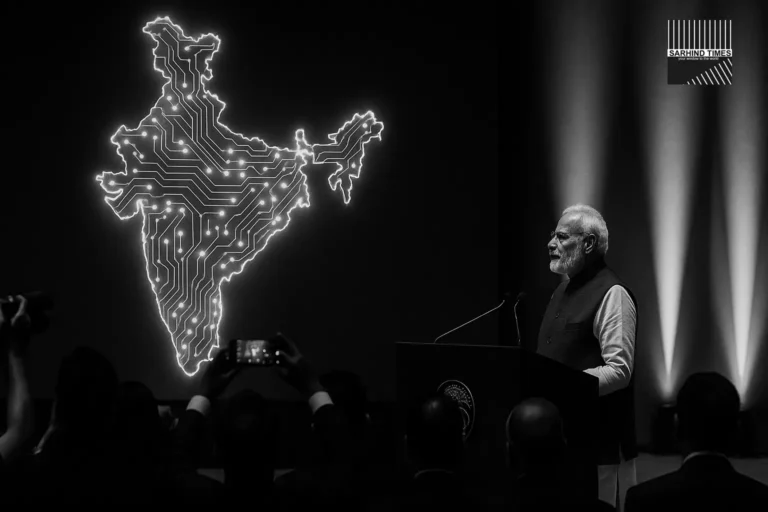
Prime Minister Narendra Modi on Thursday unveiled the National AI Mission (NAIM) — India’s most comprehensive artificial-intelligence strategy yet — to democratise AI access across healthcare, agriculture, education, and governance. The initiative seeks to balance technological advancement with ethical safeguards and social equity.
NAIM Unveiled: A Democratic Blueprint for “AI for All”
New Delhi, October 24: — In a landmark move set to define the digital decade, India today launched the National Artificial Intelligence Mission (NAIM), positioning the country as a global hub for “AI for All” — a model where innovation meets inclusion. The programme, jointly led by the Ministry of Electronics & Information Technology (MeitY) and NITI Aayog, will coordinate policy, research, and capacity building across public and private sectors. It is backed by an initial corpus of ₹ 25,000 crore, to be deployed over five years.
“Artificial Intelligence must serve humanity, not replace it. Our vision is not to chase algorithms but to uplift people — to make India the most inclusive AI-driven economy in the world.” — Prime Minister Narendra Modi
Mission Vision and Five Strategic Pillars
NAIM is framed as a whole-of-nation mission that threads technology with social purpose. Its tagline, “AI for People, AI by People,” underscores the idea that India’s demographic dividend should become a capability dividend, equipping citizens to build, govern, and benefit from AI.
- AI in Governance: Predictive analytics for welfare delivery, disaster response, and smart-city operations.
- AI in Agriculture: Drones and sensor networks to optimise irrigation, predict yields, and deliver local weather alerts.
- AI in Healthcare: Telemedicine, AI diagnostics, and multilingual medical chatbots to deepen rural access.
- AI in Education: Personalised platforms powered by Indian-language models to bridge learning gaps.
- AI Ethics & Regulation: A National AI Ethics Council (NAIEC) to audit fairness, privacy, and accountability.
Why It Matters
India, home to the world’s second-largest digital population, has long grappled with uneven access to high-quality AI infrastructure and talent pipelines. NAIM seeks to close that gap by ensuring that the “farmer in Madhya Pradesh and the coder in Bengaluru” access the same public digital rails — model repositories, compute credits, and trusted data assets — all governed by clear rights and protections.
“We will build AI that speaks all Indian languages, understands our accents, and reflects our values. This is not imported intelligence — it’s Indian intelligence.” — Rajeev Chandrasekhar, Minister of State for IT
Implementation Strategy: A PPP Engine With National Reach
The mission will operate under a Public-Private Partnership framework. Major technology firms — including TCS, Infosys, Google India, and Microsoft — are set to collaborate on AI labs, data trusts, and startup mentorship. A new anchor agency, the AI India Centre of Excellence (AI-CoE), will be headquartered in Bengaluru with regional nodes in Hyderabad, Pune, Gurugram, and Guwahati. Every state will form an AI Mission Cell to tailor solutions to local needs, from precision fisheries in coastal districts to traffic automation in metros.
The Ethical Core: “AI Ethics by Design”
To pre-empt harms and build trust, NAIM embeds safeguards into the development lifecycle. Government-use AI systems will undergo pre-deployment bias testing, adhere to explainability standards, and face annual public audits.
- Mandatory bias and safety testing for high-stakes public deployments.
- Standardised model cards and incident reporting for transparency.
- Annual independent audit of algorithms used in governance.
“AI should never become a black box that decides people’s futures. India’s framework prioritises fairness and human oversight.” — Dr K. VijayRaghavan, Former Principal Scientific Adviser
Global Partnerships and Open Collaboration
NAIM will partner with France’s INRIA, Japan’s RIKEN, and the U.S.-based AI Now Institute to accelerate research in safe and robust systems. India is also negotiating data-exchange protocols with ASEAN countries to seed a South Asia AI corridor, designed to avoid dependency on any single technology bloc and to reinforce democratic norms in AI governance.
Empowering Startups: From Unicorns to “Community-corns”
A ₹ 5,000 crore AI Startup Fund will back innovations in natural-language processing, robotics, and agri-tech. Founders will gain access to GovCloud — a secure sandbox providing government datasets and APIs for experimentation — and mentorship through the AI-CoE network.
“Our mission is inclusive innovation — not just unicorns but community-corns.” — Dr Amitabh Kant, G20 Sherpa
AI for Governance and Justice
Early pilots include an AI Judicial Assistant to summarise case law for judges and a Predictive Audit Tool to flag financial anomalies. A citizen-facing AI Dashboard will show where and how AI touches everyday life — from welfare entitlements to policing — and invite feedback and oversight.
Education and Workforce Readiness
The National AI Curriculum Framework (NAICF) will introduce coding and data-ethics modules from Class 6 onward. Over 10 million youth are expected to receive AI skills via SWAYAM AI and Skill India Digital. Universities will be funded to run AI-and-humanities programmes that examine social impacts and ethics in practice.
“Our workforce must be not only AI-literate but AI-wise.” — Dharmendra Pradhan, Education Minister
Economic Impact: Productivity, Jobs, and Sectoral Gains
NITI Aayog’s impact assessment forecasts that NAIM could add $450 billion to GDP by 2030, boost productivity by 20 percent, and create 2 million direct AI-linked jobs. The growth levers concentrate in high-friction sectors where data and prediction can reduce waste, downtime, and leakage.
| Sector | AI Use Case | Indicative Benefit |
|---|---|---|
| Healthcare | Early diagnostics, triage, telemedicine | ₹ 50,000 crore early-diagnosis market; reduced mortality |
| Agriculture | Yield forecasting, advisories, pest alerts | ₹ 15,000 crore annual savings; better resilience |
| Manufacturing | Predictive maintenance, quality inspection | Up to 30% downtime reduction; efficiency gains |
Critics and Concerns
Civil liberties groups warn that without strong privacy laws and independent oversight, AI could enable surveillance creep. The government says the Digital India Act 2025 — currently before Parliament — will codify guardrails on data use, profiling, and redress. Implementers will be required to publish risk assessments and enable opt-out where feasible.
“The mission’s success depends on implementation discipline. The code must serve the constitution, not the algorithm.” — Prof. Anand Taneja, AI Ethicist
AI and Rural Transformation
Rural pilots sit at the heart of NAIM. Krishi AI chatbots will operate in Indian languages for 20 million farmers; Swasthya AI kiosks will augment diagnostics in 300 district hospitals; and Shiksha AI will adaptively support government-school curricula. Early field reports from Jharkhand indicate improved irrigation planning and more timely crop-disease alerts.
India’s Global Position
By centring inclusivity, transparency, and multilingual data diversity, NAIM offers a democratic counter-narrative to closed and opaque AI ecosystems. Experts at the OECD AI Observatory note that India’s approach could help set norms for responsible AI at population scale.
Private Sector Reaction
“India’s AI Mission will redefine digital empowerment for a billion+ people. Proud to support open-AI models for Indian languages.” — Sundar Pichai, CEO, Google
“This is India’s moonshot in data intelligence.” — N. Chandrasekaran, Chairman, Tata Sons
International Commentary
Global institutions framed NAIM as a test of whether ethics can scale with innovation. The Financial Times called it “a bold attempt to fuse ethics with innovation at national scale,” while the U.N. Secretary-General welcomed India’s leadership, stressing that “AI must work for humanity’s collective good.”
Governance Stack: Data, Models, and Markets
NAIM’s architecture rests on three stacks. First, data trusts to host high-quality, rights-respecting datasets. Second, model repositories for Indian-language and domain models, with benchmarks and red-teaming reports. Third, open markets for verified AI services where MSMEs can procure solutions with standard contracts and liability norms. Together, these aim to reduce integration costs and level the playing field for smaller innovators.
Risks and Mitigations
- Bias and harm: Independent audits and public model cards to reveal limitations.
- Job displacement: Reskilling funds and apprenticeship pathways aligned to AI adoption.
- Security: Adversarial testing, red-team exercises, and incident response protocols.
- Vendor lock-in: Open standards, interoperability requirements, and data portability rights.
Timeline: Milestones to 2030
| Phase | Date/Year | Milestone |
|---|---|---|
| I | 2025–2026 | AI-CoE launch; state Mission Cells operational; startup fund disbursals; initial public audits |
| II | 2026–2028 | National AI Summit; scaling rural pilots; GovCloud expansion; first national evaluation of AI learning outcomes |
| III | 2028–2030 | Sectoral KPIs met in health, agriculture, and manufacturing; international corridor formalised; export of India-stack AI standards |
Looking Ahead
The first National AI Summit will convene in Delhi in March 2026 to review mission progress and announce the inaugural cohort of “AI Champions of India.” An AI Commons portal will open for citizens to track datasets, grants, and pilot outcomes — and to scrutinise algorithmic decisions that affect them.
Conclusion: Building the World’s Most Human AI
India’s National AI Mission is more than a technology policy; it is a moral framework for the digital age. It imagines machines that extend compassion, algorithms that speak every tongue, and intelligence that uplifts rather than replaces. If executed with the rigour promised today, NAIM could become the world’s most inclusive experiment in merging code with conscience.
“We are not building artificial intelligence. We are awakening India’s natural intelligence — our people.” — Prime Minister Narendra Modi





+ There are no comments
Add yours