
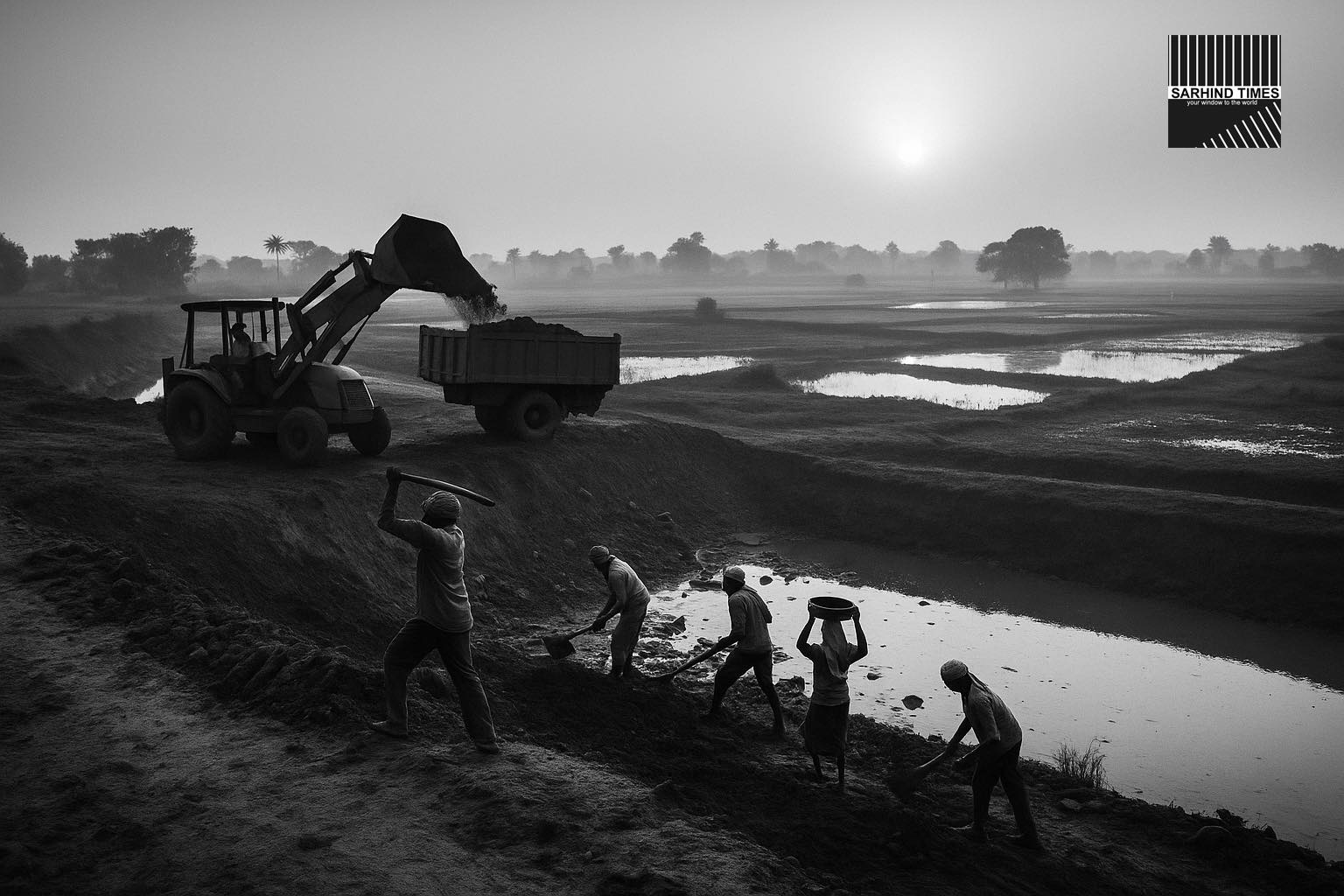
Massive conservation thrust under MGNREGA budget aims to resolve water-stress by re-engineering rural assets
Dateline: New Delhi | 4 November 2025
Summary: The Government of India has officially rolled out the National Initiative on Water Security (NIWS) on 25 September 2025, mandating that a significant share of the rural-employment budget be channelled into farm ponds, check dams, recharge structures and community tanks. The move signals a new phase in India’s water-management policy and places water conservation at the heart of infrastructure and employment strategy.
Water at risk: why India needs a new push
Challenge of water scarcity in India has been underlined repeatedly: despite being home to nearly one-fifth of the global population, India holds just about 4 % of the world’s fresh-water resources. Over-extraction of groundwater, inefficient irrigation, seasonal rainfall, and climate variability have combined to create profound water-stress in many districts. The most recent IIT-led review noted that nearly 600 million Indians face high to extreme water stress, and unless action is taken the country risks cutting into agricultural output, livelihoods and rural health.
In this context, the NIWS represents an attempt to shift from piecemeal awareness to large-scale asset creation and resource-focus across rural India.
What is the Initiative and how will it work?
The National Initiative on Water Security sets out to channel resources from Mahatma Gandhi National Rural Employment Guarantee Act (MGNREGA) budgetary allocations into water-conservation works. Under the initiative:
- In districts classified as “over-exploited” or “dark-zone” for groundwater, a **minimum 65%** of MGNREGA funds must be used for water-security works (rainwater harvesting, groundwater recharge, farm ponds).
- In “semi-critical” blocks, the minimum share is **40%**, and in all other blocks **30%**.
- More than 1.25 crore water-conservation assets (farm ponds, check dams, community tanks) have already been created under the scheme’s early roll-out.
- The initiative focuses on rural/sub-rural areas, particularly where agriculture, livestock and drinking-water stress coincide. It seeks to provide both employment and durable water infrastructure.
The government held the launch event in New Delhi on 25 September 2025, at which the Union Ministers for Rural Development and Jal Shakti unveiled the new directive for MGNREGA funding.
Early impact: what has been achieved so far
Early data from the press release suggest that the NIWS has already created a significant number of rural water assets: 68,000 reservoirs (under the earlier ‘Mission Amrit Sarovar’) in phase one, and farm ponds and check-dams numbering over 12.5 million across targeted blocks.
These constructions are seen in states such as Madhya Pradesh, Rajasthan, Uttar Pradesh, Gujarat and parts of east India where groundwater tables are rapidly declining. For example, in one northern state, local reports indicate that newly built farm ponds have begun to reroute monsoon rainwater into usable buffers for the summer months.
From the employment perspective, the diversification of MGNREGA into water-asset creation means that workers engaged in these tasks are learning basic civil-infra skills (pond-lining, bunding, channel excavation etc) and gaining income while contributing to long-term resilience. Some district administrations are actively recruiting village-level monitors, and linking work to skill modules such as USHA (Urban & Social Home Aid) or IBS (Infra & Basic Services) training under labour-schemes.
Why this matters for agriculture, livelihoods and climate
Agriculture in many water-stressed districts has been suffering from erratic rainfall, reduced irrigation capacity and shrinking groundwater. Small and marginal farmers are particularly vulnerable. By creating water-storage and recharge assets, farmers can reduce their dependency on unpredictable monsoons and expensive deep-tube-wells. This may stabilise cropping patterns, help shift away from water-inefficient crops and even encourage higher-value cropping.
From the climate-resilience angle, the initiative seeks to enhance groundwater recharge, reduce soil erosion, improve micro-climates and deliver ecosystem co-benefits (such as improved biodiversity and reduction in the risk of drought). Analysts note that water-security infrastructure is a key pillar of adaptation under climate-stress and will be increasingly important as monsoon patterns become more volatile.
Implementation challenges ahead
While the initiative is bold, several implementation risks and institutional issues persist:
- Block- and district-level absorption capacity: Some rural administrations may struggle to deploy the required share of funds toward water works while also managing asset quality, staff-training, and supervision.
- Maintenance and sustainability of assets: Construction alone is not enough. Farm ponds, check dams, recharge structures require maintenance, de-siltation, vegetation control and community stewardship. If this is neglected, initial gains may erode.
- Coordination across departments: Water-resource departments, rural development, panchayati raj, agriculture, and local self-governance all need to coordinate. Watershed management has historically suffered from fragmented responsibilities and weak monitoring. The article on India’s water policy emphasises this fragmentation.
- Monitoring, data-tracking and impact measurement: Without real-time data on groundwater levels, usage, asset status and recharge outcomes, the initiative may deliver infrastructure but not track actual change. Researchers have repeatedly flagged lack of ground-data as a policy gap.
State-level response and regional variations
Implementation pace and focus will vary across states. In regions with strong administrative capacity (such as Gujarat or parts of Maharashtra), the initiative may proceed smoothly; in states with weaker rural governance the rollout may lag. Some districts have already announced targeted asset-creation numbers and are recruiting additional staff or local NGOs to help implement the work.
For example, in one central Indian state, the rural-development minister noted that his department had revised its rural-asset list and included “water-pond creation” as a high-priority category under the upcoming plan, aligning with NIWS goals. The state is now mapping all village-water-assets and integrating them with district-water-action plans. Similar mapping is happening in other states, signalling that the national initiative is beginning to filter down to the field level.
What this means for urban linkages and migration-prevention
While NIWS primarily targets rural areas, its success will also affect urban migration, economic stability and state-to-state labour flows. Water-deprived rural zones often trigger out-migration to cities; by improving water security, the initiative may help retain labour locally and prevent distress migration. Moreover, with agriculture stabilised, agro-processing, agro-industries and rural enterprise may find stronger bases.
The water security infrastructure may also reduce pressure on urban water systems, especially in satellite towns where rural catchment contributions and peri-urban recharge matter. A rural-urban ripple effect of greater water resilience is plausible, strengthening broader regional balance.
Timeline, indicators and watch-points
The government has indicated that key milestones will be defined in quarterly reviews. Watch-points in the coming months include:
- Number of water-assets created (farm ponds, check-dams, community tanks).
- Groundwater-level trends in targeted blocks (especially dark-zone blocks).
- Number of rural households reached and reliant farmers stabilised due to water-security assets.
- Maintenance budgets and community-adoption rates of these assets.
- Budget-absorption rates under MGNREGA water-works category by block and district.
Long-term implications and global significance
If successfully implemented and sustained, the NIWS has the potential to reshape India’s water frontier: by 2030 it could reduce groundwater stress in large swathes of the country, bolster agricultural productivity in marginal zones, and enhance climate-adaptation capacity. The initiative also signals to global observers that India is moving beyond reactive water policy to proactive infrastructure and employment frameworks.
From the global climate perspective, India’s move may serve as a template for other developing countries grappling with seasonal rainfall, rural-water scarcity and climate-variability. The dual model—linking employment guarantee funding with strategic water‐infrastructure creation—could be replicated elsewhere.
Conclusion
The launch of the National Initiative on Water Security marks a pivotal moment in India’s resource management story. Against a backdrop of mounting groundwater depletion, climate shocks and rural vulnerability, the government has moved decisively to institutionalise water-conservation assets into rural employment mechanisms. The coming months will test the initiative’s execution, community adoption and ability to convert assets into resilience.
However, even as the spotlight shines on volume and scale, the real test will be sustainability: will these water-assets survive the next drought, be cared for by local communities and drive long-term change? The promise is real—but so are the challenges. For India’s rural heart-land, this initiative offers a potentially transformative path from scarcity to security.



+ There are no comments
Add yours