
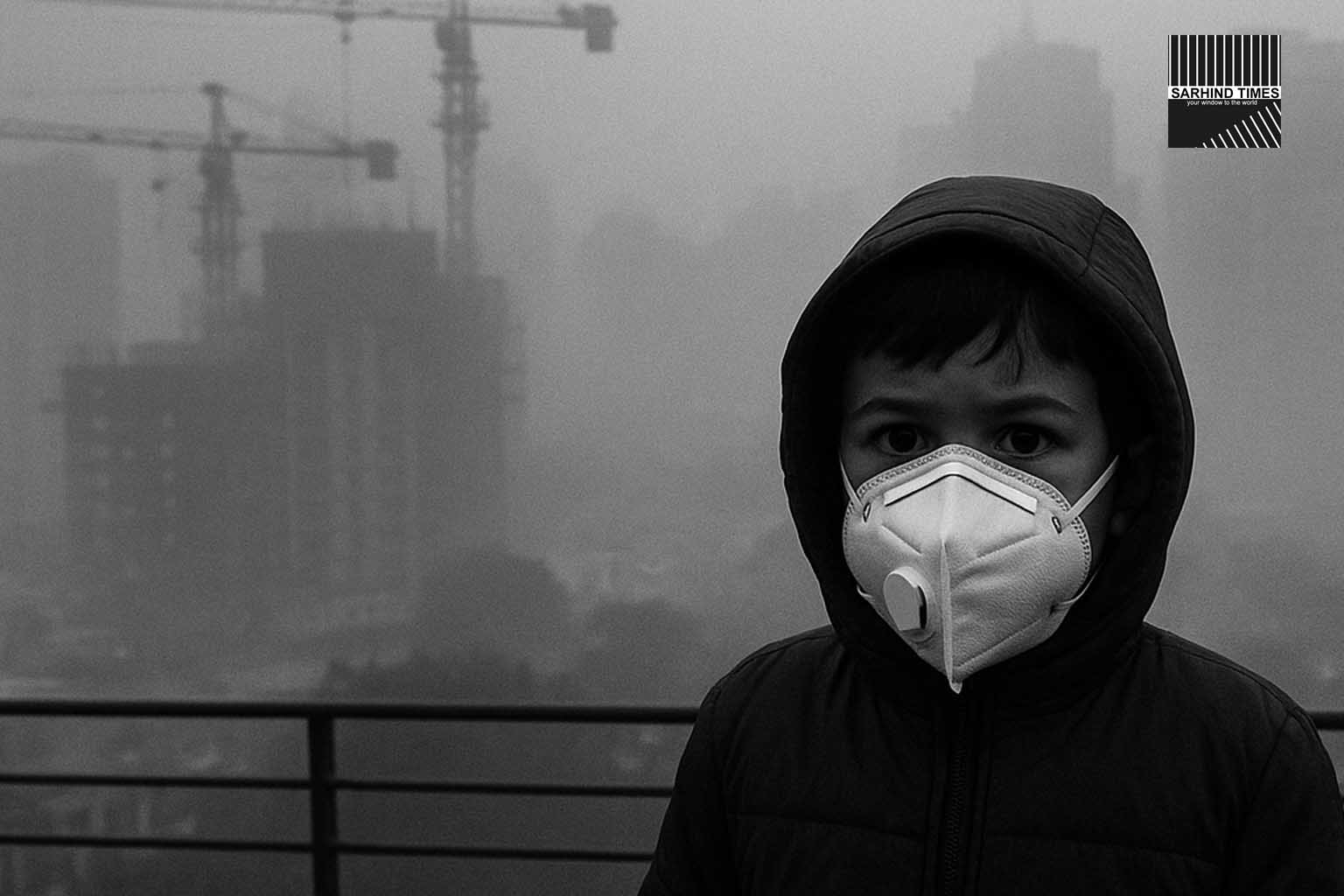
With severe smog choking Delhi-NCR and public pressure mounting, government imposes Stage 3 alerts and bans non-essential construction, even as mining-buffer protections ease to the surprise of many environment watchers.
Dateline: New Delhi | 17 November 2025
Summary: The Indian capital region has entered a serious air-quality crisis, prompting authorities to enforce Stage 3 measures under the Graded Response Action Plan, including halting non-essential construction and industrial fuel usage. Simultaneously, the Ministry of Environment, Forest and Climate Change amended wildlife-buffer mining rules, removing hefty per-species fees for lease-holders—raising concerns among conservationists that one crisis is being tackled while another regulatory rollback slips quietly in.
1. Smog season returns with a vengeance
As winter approaches and air stagnation sets in, the skies over the national capital region (NCR) have deteriorated sharply. At multiple monitoring stations, the Air Quality Index (AQI) has crossed 400—placing it firmly in the “severe” category. Under the authorities’ own classification, levels above 300 signify an emergency state for public health. In response, the Commission for Air Quality Management in NCR and adjoining areas activated Stage 3 of the Graded Response Action Plan (GRAP), triggering mandatory measures such as a ban on non-essential construction, suspension of polluting industrial activities using solid fuels and increased monitoring of stubble-burning in neighbouring states.
The deterioration is not a surprise: as per satellite and surface data, the early winter inversion layer traps emissions from vehicles, construction dust, industrial sites and crop-residue burning. The government noted that although stubble-burn incidents this season are still lower compared to previous years, the cumulative effect of local emissions plus regional atmospheric stagnation is forcing the crisis. Public protests around the India Gate have amplified the urgency: hundreds of youth, parents and civil-society activists marched to demand action, and police detentions have followed.
2. Immediate measures and their implications
With Stage 3 in effect, a set of urgent corrective actions is now enforced:
- All non-essential construction activity across Delhi and adjoining districts is suspended until further notice. Heavy machinery and dust-generating works are stopped, scaffolding operations paused and water-sprinkling mandated for any permitted minimal works.
- Industries using polluting fuels or generating heavy emissions have been instructed to curtail production, shift to cleaner fuels or temporarily suspend operations. Particular scrutiny is being applied to brick kilns, diesel-generator sets and older cement plants.
- Vehicular restrictions may be broadened if the AQI remains above 400 for sustained periods—measures such as odd-even rationing, parking prohibitions, or bans on diesel trucks may be activated soon.
- Awareness campaigns are in full swing, with health-advisories issued for vulnerable populations (children, elderly, respiratory patients) to avoid outdoor exposure. Some schools may shift to online or hybrid mode if conditions worsen.
The urgency is clear: city health authorities warn that prolonged exposure to PM2.5 and PM10 at these levels significantly increases hospital admissions for respiratory and cardiovascular ailments. The cost in human suffering is high—and the government is under visible pressure to act.
3. The causes: more than just crop fires
While the role of stubble-burning in Punjab and Haryana remains significant, officials emphasise the local emission sources cannot be ignored. Vehicle traffic, dust from construction, domestic heating and fuel combustion all contribute to the mix. In past winters, Delhi’s AQI used to hover near 200–300; this season the spike to 400 + perhaps reflects early onset of inversion and heavier traffic loads.
Experts also point out that while crop-burn incidents since 15 September remain lower than previous years, the difference is not large enough to offset the heightened local emissions and unfavourable meteorology. Thermal inversion—where cold air traps pollutants near the ground—kicks in earlier in November in the NCR zone, reducing vertical dispersion. Without swift intervention, the coming weeks may bring sustained hazard levels.
4. Social and health consequences
The human cost is immediate and growing. Studies estimate that long-term exposure to hazardous AQI levels reduces life expectancy, increases incidence of lung disease, exacerbates asthma and raises risk of stroke and heart-attack among older citizens. In Delhi alone, health researchers estimate more than 17,000 deaths annually are attributable to urban air-pollution levels. The city’s air-quality crisis is no longer seasonal—it is being framed by many as a public-health emergency of perennial proportions.
Parents, especially those in schools and worker-hostels, are anxious. Air-pollution alarms at playgrounds echo warning bells for school-managements. Some private schools have begun shifting morning outdoor-play sessions indoors; corporates are asking staff to reconsider commuting during peak hours. The city’s inequality dimension is stark: while wealthier households may deploy air-purifiers or retreat to cleaner suburbs, lower-income groups—workers, outsourced staff, residents of peripheral colonies—bear the brunt.
5. The regulatory-response challenge
While banning construction and restricting polluting industries are essential short-term moves, critics argue that the government still lacks a credible mid-term plan to shift the underlying emission base. Issues remain: how to reduce the legacy fleet of diesel vehicles, raise construction-dust standards, enforce closer monitoring of building sites, expand public-transport capacity, and effect behavioural change in a city of 30 + million. Without structural reform, temporary bans only buy us time. Moreover, agencies will have to coordinate across state boundaries—pollution does not stop at political borders.
6. Mining buffer regulation rollback—a concurrent story
In a move that appears, at first glance, to run counter to the heightened air-quality focus, the Ministry of Environment, Forest and Climate Change quietly amended its rules for mining-leases in zones near wildlife and forest buffers. Under the earlier framework, mining-lease-holders operating within a 10 km buffer of protected zones were required to deposit ₹5 lakh for each sensitive wildlife species identified in that area—a cost that, given multiple species, could run into ₹25–50 lakh per lease. Under the revised guidelines, this deposit requirement has been removed entirely; instead the operator must simply submit a Wildlife Conservation Plan to the forest-department for approval. The sapling-deposit requirement was reduced from ₹2,000 per sapling to ₹800, and the onus of plantation may now shift to the lease‐holder rather than mandate forest-department managed plantations.
According to industry sources, the change will fast‐track 250–300 mining-leases pending approval and reduce compliance costs significantly. From an industry-perspective this is positive; from a conservation-perspective it raises concerns about how environmental safeguards may be diluted.
7. Why two narratives in one story?
The co-existence of a sharp regulatory clamp-down on air-quality in urban zones while mining regulatory burdens are being lightened has raised eyebrows among environment watchers. On one hand, the government is signalling urgency over urban-air disasters; on the other hand, some argue that natural-resource-governance standards may be slipping quietly. These dual trajectories may reflect a balancing act between growth-and-livability imperatives. In political and economic terms, urban pollution demands urgent action because of high visibility and large populations; mining regulation may be being eased to accelerate resource extraction, jobs and infrastructure supply-chains. The question is whether this duality will undermine long-term sustainability.
8. State-level and inter-state dimensions
For the Delhi-NCR region, sharing airshed with Haryana and Punjab, inter-state coordination is critical. While Delhi may enforce bans, if adjacent areas continue heavy stubble-burning, soil-tilt dust and uncontrolled emissions, the effect will be muted. The GRAP enforcement will require active collaboration among municipal bodies, state pollution‐control boards and rural/urban agencies. Observers note that until Haryana and Punjab lock in parallel action (e.g., incentivised stubble-management, dust-control on highways, truck-emission checks) the urban gains may be limited. At the same time, the mining-lease amendment has a national dimension: as mining picks up in buffer areas, local communities may face increased disturbance, habitat-disruption and longer-term exposure to resource-extraction externalities.
9. What to watch next
The immediate horizon will be critical. Key indicators to monitor include:
- Whether AQI remains above 400 despite bans—failure may push authorities into Stage 4 or trigger wider vehicular restrictions.
- Hospital‐admission data for respiratory illnesses in the coming fortnight, which could illustrate the health burden in real time.
- The response of adjacent states: stubble-burn counts, mechanised alternatives deployment and highway‐dust control measures.
- The number of mining-leases processed under the new buffer-zone rules, and whether any environmental‐impact objections are recorded or sidelined.
- Whether activist and civil-society pressure grows around the mining rule change and prompts legislative or judicial responses.
10. Final reflection
India’s environment story this week is one of urgency and contradiction. On the one hand, the darkest air in years is forcing dramatic regulatory action in the capital region—pause the construction sites, stop the kilns, warn the citizens. On the other, a less visible policy shift carves out room for resource-extractors near protected zones. For citizens, the choice is stark: either we commit to cleaner air today or we tolerate incremental gains alongside latent risks. Urban health demands swift action; but long-term sustainability will demand more than emergency measures—it will demand coherence across policies, across states and across sectors. Whether India will thread that needle remains to be seen.



+ There are no comments
Add yours