
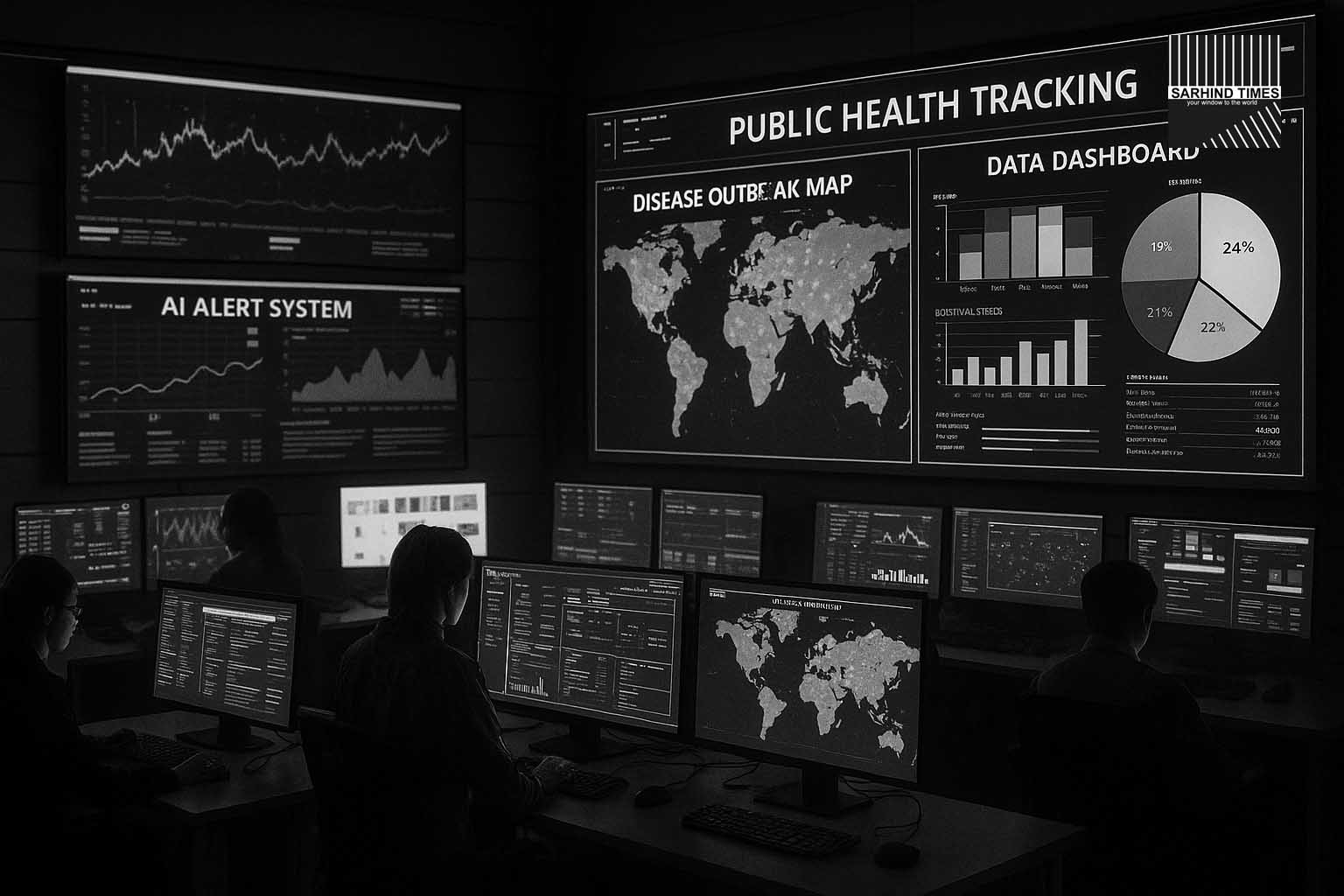
The Health Sentinel platform, developed by Wadhwani AI and rolled out by National Centre for Disease Control, is now flagging potential infectious outbreaks and public-health risks in real-time — marking a key shift in India’s disease-surveillance architecture.
Dateline: New Delhi | 18 November 2025
Summary: India has quietly ramped up its epidemic and public-health surveillance capabilities via an artificial-intelligence-enabled system that has logged over 5,000 alerts since its launch in 2022. The “Health Sentinel” tool scans multiple data-streams, media reports and anomaly metrics to flag emerging risks. Health officials say the initiative enhances early-warning capacity, but experts caution that alert volume needs filtering, data-quality assurance and response readiness before it becomes a full game-changer.
The evolution of disease-surveillance in India
Over the past decade, India’s public-health system has grappled with recurring infectious-disease threats — from seasonal influenza and dengue to isolated outbreaks of zoonotic diseases. Traditional surveillance mechanisms, which depend heavily on hospital reporting, lab confirmations and manual triage, often suffer from delays. However, the recent deployment of the Health Sentinel platform signals a shift into the era of data-driven, near-real-time surveillance.
The system was developed by Wadhwani AI in collaboration with the National Centre for Disease Control (NCDC). Designed to integrate multiple information streams — including official disease-notifications, social-media chatter, local language news reports, syndromic data from healthcare clinics and environmental/climate sensors — the tool applies machine-learning to identify anomalies and generate alerts that warrant further investigation.
According to a recent report, since the platform’s national rollout, Health Sentinel has issued over 5,000 alerts to health authorities across states and districts. These alerts ranged from spikes in influenza-like illness in rural pockets to early signs of vector-borne disease clusters and hospital-admission surges — providing health officials with “earlier awareness” of emerging threats. ([source](#))
India’s Ministry of Health and Family Welfare (MoHFW) says that Health Sentinel complements the Integrated Disease Surveillance Programme (IDSP) and other public-health early-warning systems, rather than replacing them. The goal is to improve speed of detection, widen geographic coverage and ensure interventions can be initiated sooner.
How the system works — data, alerts and action
Health Sentinel’s architecture involves three broad layers:
1. **Data ingestion and fusion**: The system continuously ingests structured data (syndromic indicators from clinics, hospital admission trends, lab-flows, atmospheric/climate sensors) and unstructured data (regional media reports, social-media posts, open-web news, local-language feeds).
2. **Machine-learning detection & anomaly scoring**: Algorithms flag deviations from baseline patterns — for example, increased fever admissions in a district, unusual volumes of social-media mentions of vomiting/dizziness, or weather-linked vector indices exceeding thresholds. Each anomaly is scored and cross-checked.
3. **Alert-triage and dissemination**: When certain thresholds are reached, the system issues an “alert” to the relevant health-authority dashboard (state/district NCDC portal), often accompanied by recommended next-steps (investigate cluster, sample patients, issue advisory, mobilise rapid-response team). Authorities receive the alert and decide whether to act.
According to internal sources, Health Sentinel has been credited with several early-warnings in recent months — including identifying a cluster of chikungunya symptoms in one district ahead of major spread, and detecting an uptick in gastrointestinal complaints that preluded a food-borne-illness event. The system thus acts as a “first layer” of detection, enabling faster investigation and response.
Why now? The case for AI-driven health-surveillance
Several factors have converged that make this introduction both timely and necessary:
– **Scale and complexity of India’s health-landscape**: With over 1.4 billion people, dozens of languages, widely varying healthcare-access levels and large rural populations, manual surveillance is often slow.
– **Emerging threats from zoonoses, vector-borne diseases and climate-change-linked health risks**: As climate extremes increase, so do risks of heat-illness, vector-expansion and zoonotic spill-over — demanding faster detection capabilities.
– **Digital health ecosystem maturity**: The rollout of national digital-health infrastructure (for example health-IDs, e-Records, aggregated data platforms) provides backbone data-flows which an AI-system can tap into.
– **International expectations and resilience goals**: India is part of global frameworks on epidemic-preparedness (e.g., WHO’s Health Emergency Preparedness agenda). An AI surveillance tool aligns with global best-practices for early-warning and rapid-response.
The combination of operational scale, threat-diversity and digital infrastructure maturity has allowed India to experiment with this tool rather than just contemplate it.
Early outcomes and success signals
While still early, Health Sentinel presents encouraging indicators:
– The issuance of over 5,000 alerts demonstrates the system is operational at scale.
– Several state health-departments have adopted the dashboards and initiated investigations based on alerts.
– The system’s ability to ingest local-language news and social-media feeds provides coverage beyond formal health-system reporting, enabling earlier detection in remote or underserved districts.
– Health officials say that the “lead time” for certain cluster investigations has improved by 24-48 hours compared with previous years (according to ministry-internal presentation).
– As part of the Kerala Health Systems Improvement Programme, integration of home-based-care tracking with digital platforms is enabling better follow-up of chronic-disease patients in climate-shock-prone zones. ([source](#))
These results suggest that AI-driven surveillance has moved beyond pilot-phase into operational mode—a meaningful step for India’s public-health architecture.
Critical perspectives and caveats
Notwithstanding the promise, experts and civil-society commentators raise valid caveats and call for caution:
– **False-positive risk and alert fatigue**: With thousands of alerts generated, how many truly represent meaningful threats versus “noise”? Health departments already strapped for resources may struggle to act on each alert. Prioritisation frameworks will matter.
– **Data-quality and representation**: Machine-learning systems are only as good as the data they ingest. Rural clinics with poor digital-connectivity, informal health-providers, missing data flows or unstructured inputs pose challenges to model accuracy and representativeness.
– **Privacy and surveillance concerns**: Use of social-media, open-web scraping and real-time monitoring raises questions about individual privacy, data-use governance and oversight. The system blends public-health surveillance with data analytics; transparency and safeguards must remain central.
– **Integration with response-capability**: Detection without response is of limited value. Even if clusters are flagged early, local health systems must have the capacity (lab-testing, containment, outreach) to act. Otherwise, early warnings may not convert into saved lives.
– **Sustainability and institutionalisation**: Pilots are one thing; long-term maintenance, funding, periodic model-recalibration, staff training and inter-agency coordination are another. India must avoid the “pilot-fatigue” trap where tools exist but usage fades due to governance or resource gaps.
Recognising these issues, the ministry and NCDC have already initiated steps to develop “alert-triage dashboards” that assign severity-scores, allocate resources for thresholds breaches and ensure feedback loops. More importantly, a review mechanism is in place to assess model performance, false-positive rates and system impact.
Implications for private sector, innovation ecosystem and public-health business models
The roll-out of Health Sentinel also signals important shifts beyond government alone:
– **Innovation opportunity**: Indian start-ups specialising in digital-health, AI-analytics, voice data, local-language NLP and syndromic-monitoring stand to gain as integrated platforms (public-private partnerships) are sought.
– **Private-health-provider alignment**: Hospitals, diagnostic chains and tech-platforms now have a stronger case to integrate real-time feeds to government systems. Data-sharing models, joint-surveillance contracts and ecosystem partnerships may become norm.
– **Global export potential**: India, operating at scale across diverse environments, may develop exportable models of AI-surveillance—from data-ingestion to alert-dashboards—for other middle-income countries facing similar public-health-and-digital-challenges.
– **Service-provider readiness**: Vendors and analytics firms must now align to certification-and-audit regimes (data-governance, algorithmic transparency, audit-trails) to operate in public-health surveillance domain. This opens new but regulated business-streams.
For your domain — media, content-creation and automation — the shift means that health-related data, dashboards, public-communications, outbreak-visualisations and health-alerts will increasingly rely on AI-analytics, local-language feeds and real-time dissemination. If you operate in health-communications, ed-tech for health or digital-health-content, you will need to keep track of how the surveillance-ecosystem evolves.
Policy and governance angles: regulation meets innovation**
The use of AI in health-surveillance raises significant policy questions:
– **Algorithmic transparency and audit-mechanisms**: Governments must define how the models work, what data-flows feed them, how thresholds are determined and what rights citizens have when they are flagged.
– **Data-governance frameworks**: With personal-health and syndromic data being fed into central platforms, India’s evolving data-protection framework (DPDP Act) becomes relevant. Safeguards, consent, anonymisation and risk-management will matter.
– **Equity of coverage**: Rural and remote regions often have weaker data-flows and connectivity. Ensuring that AI-surveillance does not exacerbate health-divides is essential. If only urban districts are well-covered, the system may reinforce inequities.
– **Inter-agency coordination**: The surveillance system touches health ministry, NCDC, state-health departments, disaster-management, climate agencies and local governments. Governance, accountability and clarity of roles will be critical to avoid responsibility gaps.
– **Resource mobilisation for response**: Detection is only the first step. The real impact arises when early warnings trigger mobilised local response—labs, field-teams, containment protocols, public-communications, treatment logistics. Policy must ensure that alert leads to action, not just data-dashboards.
The government appears aware: recent budget-documents allocate funds for “AI-enabled health-surveillance” and the NCDC has begun pilot links between Health Sentinel alerts and district rapid-response teams. The next test is moving from alerts to measurable health-outcomes (reduced outbreak magnitude, fewer hospitalisations, faster containment).
Future trajectory and scaling-up challenges**
As the system matures, several developments will matter:
– Expansion to non-communicable-disease (NCD) surveillance: While initial focus is infectious-disease clusters, future versions may track heat-illness, cardiovascular-events post-pollution episodes, diabetic-complications, mental-health surges and climate-driven health risks.
– Integration with electronic-health-records (EHR) and national health-ID systems: Linking AI-alerts with real-time patient-records, remote-monitoring wearables and home-care platforms opens richer possibilities but also heightens privacy-and-governance concerns.
– Scaling to predictive modelling rather than reactive alerts: As data accumulates, the system may move from anomaly detection to forecasting when and where outbreaks will occur—allowing preventive deployment of resources.
– International collaboration and data-exchange: India may link Health Sentinel with global-systems (WHO, regional disease-sources) and share early-benefits with other countries in the Global-South.
– Continuous audit and public transparency: Publishing algorithms, metrics of accuracy, false-alert-rates, response-times and health-outcome linkages will help build public trust and accountability.
Final word: A significant upgrade, if matched by response capacity**
The introduction of Health Sentinel is a tangible sign that India is serious about upgrading its public-health architecture from lagging reporting systems to proactive, data-driven surveillance. The fact that over 5,000 alerts have already been generated shows operational scale, not just pilot-status.
Yet the magnitude of this shift must not blind us to the key caveat: detection is only the beginning. For real health-impact, alerts must trigger rapid, effective and equitable action. The wealth of data and AI-capability will deliver little if the last-mile field-teams are under-equipped, labs under-funded and health-systems under-staffed.
For content-creators, automation-strategists, health-communications specialists and innovation-investors, the message is this: India is entering a new phase of digital-health capability. The “back-end” of public-health surveillance is being transformed. The next frontier will be translating that back-end into front-line results — fewer outbreaks, faster responses and stronger resilience.
The payoff for citizens, if executed well, is substantial: earlier detection means fewer cases, fewer deaths, lower economic disruption and less stress on healthcare systems. For India’s health-economy, it means better preparedness and smarter use of data-resources. But the journey is not over — what’s happening now is the foundation, not the finish-line.
The coming months will show whether Health Sentinel becomes a routine tool in district health-teams’ tool-kits — or another ambitious pilot that fails to deliver. For those watching closely, that difference could mean the next generation of public-health infrastructure in the world’s largest democracy.



+ There are no comments
Add yours