
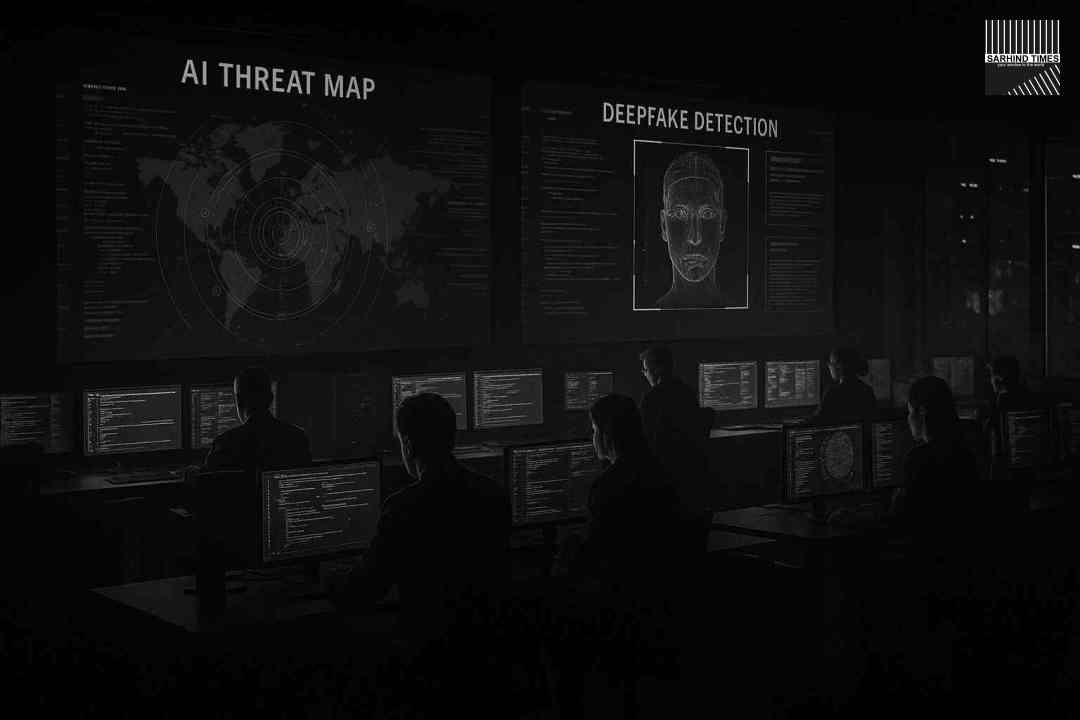
From voice-cloned CEO frauds to hyper-realistic fake videos targeting families, India’s AI threat landscape shifts dramatically — prompting new laws, major industry collaboration, and the country’s most ambitious cybersecurity overhaul.
Dateline: Bengaluru | 28 November 2025
Summary: India is facing an unprecedented rise in artificial intelligence–driven fraud, deepfake crimes, and synthetic media manipulation. With thousands already affected and financial losses running into hundreds of crores, the government, tech companies, and cybersecurity agencies have launched a coordinated response involving new legislation, AI watermarking, advanced detection grids, and the creation of a nationwide digital safety network.
The New Face of Digital Crime: AI-Powered, Fast, and Invisible
India’s digital landscape has changed dramatically in the last twelve months. What were once sporadic cases of phishing and identity theft have evolved into a dense web of synthetic fraud powered by advanced artificial intelligence. Deepfake calls mimicking bank officials, cloned voices convincing employees to transfer funds, and hyper-realistic videos impersonating family members are redefining online risk at a scale previously unimaginable.
Bengaluru, the technology hub of India, has emerged as the epicenter of both innovation and risk. With over 5,000 AI startups, rising fintech adoption, and a highly connected population, the city has become a prime target for AI-driven cybercrime. The paradox is striking: the same technology advancing India’s global leadership in AI is now being weaponized by criminal networks with alarming sophistication.
Cybercrime helplines across India have recorded a surge in calls involving deepfakes, many involving convincing but entirely fabricated audio and video clips. Officials note that the problem is expanding across cities like Mumbai, Hyderabad, Delhi, Pune, and Gurugram — the largest financial and technology centers of the country.
Deepfake Scams: How Criminals Are Outsmarting Citizens
Unlike traditional frauds, deepfake scams are psychological as much as they are technical. Criminals leverage AI models trained on publicly available voice samples, interviews, social media posts, and family videos. A 15-second audio clip is often enough to create a voice clone. With small facial samples from photographs or low-quality videos, scammers can generate deceptive video calls that look and sound real.
The frauds generally fall into four major categories:
- CEO Fraud: Employees receive urgent messages or video calls from what appears to be their CEO requesting an immediate confidential transfer of funds.
- Family Emergency Scams: Parents receive video clips of their children crying for help — entirely synthetic and AI-generated.
- Bank Official Impersonation: Deepfaked voices of senior bank managers instruct customers to perform “verification transfers.”
- Matrimonial & Social Media Manipulation: Fake audio and video evidence used to extort individuals, particularly women.
The emotional impact of deepfake fraud has shocked investigators. Victims describe the experience as “confusing, surreal, and psychologically devastating.” When the voice sounds identical and the face looks perfect, doubt becomes nearly impossible.
India’s Largest Deepfake Crime Yet: A Bengaluru Case Study
The biggest deepfake crime uncovered this year involved a leading IT services firm based in Bengaluru. A finance manager received a video call from his “CEO” during a supposed emergency acquisition. The CEO — or rather the AI-generated version — instructed him to wire ₹28 crore immediately to a series of “escrow accounts.”
The fraud succeeded. The funds were dispersed across 14 mule accounts within minutes and converted into cryptocurrency before investigators could freeze the chain. The real CEO was in Singapore at the time and unaware of the incident.
Cybersecurity experts described the deepfake quality as “nearly flawless.” The lip movements, lighting consistency, pauses, and vocal tone were indistinguishable from the real CEO’s usual call style. Only a detailed forensic examination revealed algorithmic artifacts invisible to the human eye.
The case has shaken corporate India. Companies are now mandating new verification protocols, including callback confirmations, multi-layered approval systems, and banned use of WhatsApp for financial instructions.
The Government Steps In: India’s Biggest Digital Safety Reform
Recognizing the urgency, the Government of India has launched an ambitious nationwide initiative aimed at making India the safest digital ecosystem in the world. This initiative centers around three major pillars:
- Legal Reform: New AI misuse regulations, deeper provisions for digital impersonation, and criminal penalties for deepfake creation with malicious intent.
- AI Watermarking Standards: Mandatory cryptographic watermarking for all AI-generated images, audio, and video produced by companies operating in India.
- National Deepfake Detection Grid: A massive AI-powered surveillance and detection system linked to law enforcement and telecom carriers.
The Ministry of Electronics and IT has confirmed that India will deploy the world’s largest deepfake detection framework by mid-2026. The system will use millions of training samples, open-source intelligence feeds, and real-time scanning across major platforms to identify synthetic media within seconds.
Officials say this will operate like a “digital radar,” picking up anomalies in voice waves, pixel movement, AI artifacts, and generative model fingerprints to alert authorities instantly.
Industry Joins the Fight: Big Tech, Startups, and Telecom Companies Unite
Unlike earlier phases of cybersecurity reform, the response to deepfake crime has sparked a rare unity across sectors. Leading Indian startups, global tech giants, telecom operators, and fintech firms are building shared databases of malicious AI activity. Data exchanges allow companies to alert each other when they identify new deepfake patterns or criminal behavior signatures.
Telecom companies are integrating AI detection modules into their networks. Video call services are adopting “authenticity indicators” that highlight whether the face is genuine, AI-altered, or synthetic. Payment companies are designing fraud controls specifically triggered by suspicious communication patterns.
The startup ecosystem has responded with remarkable speed. Bengaluru-based cybersecurity firms are building advanced forensic tools, watermark verification systems, AI-clone blockers, and emotion-recognition safety features for video platforms.
Rising Deepfake Abuse in Elections and Politics
Another area of concern is political deepfake manipulation. As India approaches multiple state and national elections, agencies have flagged the rising use of synthetic videos meant to mislead voters, defame candidates, or instigate social unrest. Political deepfakes often spread rapidly across WhatsApp groups, microblogging platforms, and short-video apps.
Election bodies are coordinating with AI labs to build real-time detection units capable of flagging manipulated political content. “The biggest threat is not the deepfake itself,” one official noted. “The real danger is the speed of misinformation spread before detection.”
Several high-profile political leaders have already issued warnings to their teams and constituents, citing concerns over misinformation engineered using AI-generated voice clones and doctored speeches.
The Human Side: Families Living With Fear of AI Manipulation
Beyond corporate and political spheres, ordinary citizens are facing the daily fear of deepfake deception. Parents worry about fake videos of their children. Young women fear extortion threats from synthetic content. Elderly citizens, lacking technical literacy, struggle to distinguish real from fake.
Helplines report that many callers describe anxiety, sleeplessness, and distrust even after they learn they were targeted by deepfake attempts. Psychologists confirm that the psychological toll is real — victims struggle with loss of confidence, emotional trauma, and paranoia about online interactions.
Experts warn that India must address not just technical safeguards but also emotional resilience, digital literacy, and counseling support to help victims recover.
How Criminal Networks Build Deepfakes So Fast
Investigators have discovered that deepfake factories operate like modern tech startups. They purchase GPU time from international cloud providers, train custom voice models overnight, and deploy fraud attempts the next morning. These networks use powerful open-source models combined with locally modified datasets, making detection challenging.
Typical deepfake factories invest in:
- High-end graphics cards capable of fast model training
- Autonomous voice cloning pipelines
- Face-swapping engines that run on consumer-grade laptops
- VPN farms that mask geographic origins
- Thousands of compromised phone numbers to execute scams
The speed is astounding — cloning a person’s voice now takes under five minutes, and generating a synthetic video can take less than two hours. Criminals often combine multiple AI tools to enhance realism.
Deepfake Threat to Corporate India: A New War Room Culture
Companies across India are creating “AI Fraud War Rooms” — dedicated teams monitoring digital threats in real time. These war rooms simulate deepfake attack scenarios, test internal vulnerabilities, and rehearse response protocols. CFOs and HR heads undergo drills mimicking deepfake CEO calls to ensure they do not authorize transfers without verification.
Corporate boards are being briefed on the strategic risk of synthetic identity attacks. Major outsourcing companies handling global financial processes are developing multi-factor authentication layers, including biometric verification and AI-powered liveness checks.
Some firms have begun recording unique verbal “verification phrases” used only for emergency instructions — a countermeasure against voice cloning.
India’s Upcoming AI Law: What We Know So Far
The government is finalizing a landmark AI regulatory framework expected to be tabled in Parliament soon. The law will include specific provisions targeting deepfake misuse, digital impersonation, and algorithmic transparency. Key elements likely to be included are:
- Mandatory watermarking for all India-trained AI media
- Criminal penalties for malicious deepfake creation
- Licensing for high-risk AI systems
- Compulsory reporting of synthetic media incidents
- A national victims’ compensation fund
India aims to position itself as a global leader in ethical and secure AI deployment, balancing innovation with protective safeguards.
The Road Ahead: Can India Stay Ahead of the AI Crime Curve?
The deepfake crisis marks the arrival of a new era in digital security, one where threats are intelligent, fast, and often invisible. But India’s response — combining policy reform, industry collaboration, citizen awareness, and technological innovation — signals determination to stay ahead of the curve.
Experts believe that India’s large talent pool in AI, combined with strong state capacity and centralized coordination, gives the country an edge in building one of the world’s strongest digital safety infrastructures. The challenge will be ensuring rapid implementation, public trust, and continuous evolution in the face of ever-advancing AI capabilities.
The next two years will be critical. If India succeeds in building its national deepfake detection grid, the world may adopt similar models. If not, synthetic fraud could become one of the most destabilizing forces of the decade.
For now, one thing is certain: the AI revolution brings immense promise, but without vigilance, it also carries unprecedented risks. India stands at the crossroads, shaping the rules of a future that the entire world will soon face.



+ There are no comments
Add yours