
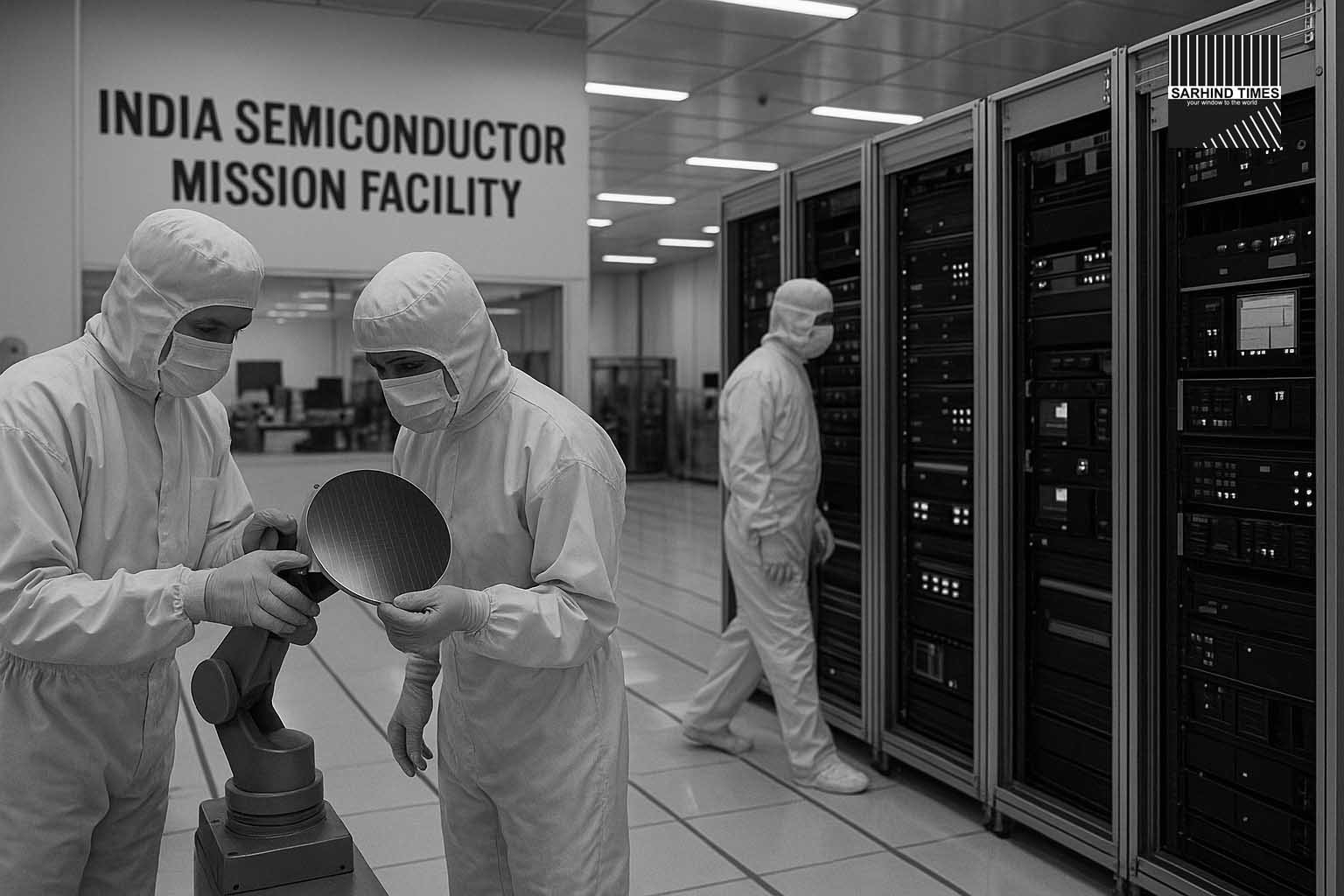
With the latest approvals under the India Semiconductor Mission (ISM), India seeks to move from ‘chip consumer’ to ‘chip creator’ — but path ahead is not without obstacles.
Dateline: New Delhi | 14 November 2025
Summary: The Indian Union Cabinet has approved four additional high-volume semiconductor manufacturing projects in three states, raising the total number of sanctioned ISM projects to ten, with combined investment of about ₹1.60 lakh crore. The move signals a sharp escalation in India’s bid to build a domestic semiconductor ecosystem, spanning wafer fabrication, advanced packaging, design and testing. While the opportunity landscape is promising, execution risks—land acquisition, supply-chain readiness, talent gaps, and global technology competition—must be managed tightly.
1. Setting the stage: why semiconductors now matter for India
Semiconductors are often described as the “new oil” in the digital economy: everywhere from smartphones to cars, from telecom networks to defence systems, chips form the foundation of innovation, value-creation and strategic competition. For India, a country that has historically been a major consumer of chips but a negligible manufacturer, the scale of the gap is vast. The decision to push a manufacturing ecosystem embeds ambitions at several levels: macro-economic (export growth, manufacturing GDP share), strategic (technology sovereignty, supply-chain resilience), employment (high-skilled jobs), and regional-development (industrial clusters).
India’s dependence on imports in the semiconductor value-chain has long been flagged. Some estimates place the global chip industry at over US$500 billion in revenue—and India participates mainly as a downstream consumer, importer of modules and systems-integration, rather than a location for front-end wafer-fab manufacturing. The aim now is to shift that dynamic.
2. The new approvals: what exactly has been cleared
On 12 August 2025 the Union Cabinet approved four new projects under ISM. With these four, the total count of sanctioned projects rose to ten. The investment commitment across all ten is approximately ₹1.60 lakh crore (about US$18.2 billion) and they span multiple states including Odisha, Punjab and Andhra Pradesh.
Key details of the latest four approvals:
- Project company: SiCSem Private Limited in Odisha (Info Valley, Bhubaneswar) — focusing on Silicon Carbide (SiC) compound semiconductor fab.
- Project company: 3D Glass Solutions Inc. in Odisha — advanced packaging and embedded glass substrate unit.
- Project company: Continental Device India Pvt. Ltd. (CDIL) in Mohali, Punjab — brownfield expansion for high-power discrete devices (MOSFETs, IGBTs, etc).
- Project company: ASIP Technologies in Andhra Pradesh — new fab for discrete devices for mobile, automotive and set-top applications.
The fact that approvals cover both advanced packaging and compound-semiconductor (SiC) fabs is noteworthy—it signals that India is not only targeting mature nodes but also strategic materials and advanced value-chains, which serve automotive, power-electronics and EV applications.
3. The policy mechanics: incentives, mission structure and financials
The India Semiconductor Mission (ISM) under the Ministry of Electronics & Information Technology (MeitY) provides a suite of incentives to anchor chip manufacturing value-chains in India. As per official scheme documents, support includes fiscal assistance of up to 50 per cent of project-cost for approved wafer-fab units.
Additionally, India has approved a Design-Linked Incentive (DLI) scheme which supports chip-design startups and MSMEs with grants and other advantages. The SEMICON India programme, which brings together the industry, start-ups and academia, is another pillar of the ecosystem push.
On the financial side: the total investment envelope of ~₹1.60 lakh crore corresponds to roughly US$18 billion. This is ambitious by any standard and places India among the more serious global locations seeking large-scale chip investments. To put it in perspective: many countries and locations spend decades building heavy-cap semiconductor ecosystems; India is attempting to leap-frog into manufacturing and packaging within a compressed timeframe.
4. Strategic rationale: supply-chain resilience, technology sovereignty and export push
A few strategic themes underpin this push:
- Supply-chain de-risking: Geopolitical tensions (US-China tech rivalry, Taiwan risk) have heightened interest globally in diversifying chip manufacturing. India hopes to position itself as a reliable alternative region, capturing investment that might otherwise be constrained.
- Technology sovereignty: For India, chips are relevant to defence, national infrastructure, telecom (6G), automotive (EVs) and more. Having domestic capability reduces external dependencies and aligns with the “Atmanirbhar Bharat” agenda.
- Export growth and value capture: Chips are high-value and high-technology components. Building domestic capability enables India to move from being an assembly hub to design, packaging and possibly front-end manufacturing, thereby retaining larger value within the economy. For job creation, skill development and GDP impact, this is desirable.
- Adjacent industrial development: Large chip fabs catalyse ancillary industries – equipment suppliers, materials, chemicals, clean-rooms, logistics, and research. This has multiplier effects for the manufacturing ecosystem and regional development.
5. The obstacles: what could go wrong and what to watch
Despite the momentum, there are significant risks and uncertainties:
Land-acquisition and infrastructure readiness: Many big-ticket manufacturing units require large contiguous land parcels with strong infrastructure (power, water, clean-rooms). Delays in land-clearance, environmental approvals, or supply-chain logistics could slow pace.
Technology and talent gap: While India has strong talent in software and services, front-end wafer fabrication, process engineering, and top-end packaging require niche skills. Building wafer-fab workforce, equipment maintenance, yield improvement takes years and is not easily shortcut.
Global competition and cost pressures: Many countries (Taiwan, South Korea, US, Singapore) offer established ecosystems and incentives. Cost of production in India (logistics, power, supply-chain) needs to be competitive to attract global integrators. Also, semiconductor technology evolves rapidly; by the time a fab is built, it must still be relevant, or risk obsolescence.
Supply-chain bottlenecks: Chips rely on chemicals, gases, rare materials, precision equipment. Establishing these ancillary supply-chains domestically or ensuring dependable imports is key. Delays here can stall output or raise costs.
Tight timelines and gestation risk: Given the announcement of first “Made-in-India chip by year-end”, expectations are high. But commercial production at scale takes time; pushing unrealistic timelines could lead to reputational risk and investor caution.
Regulatory and environmental compliance: Large fabs have high water use, require extensive waste and emissions management, and face environmental scrutiny. Ensuring regulatory alignment and local community support is critical.
6. Early signals and ecosystem momentum
Some encouraging signs: multiple states are vying to host projects; global players are entering. The approval of compound-semiconductor (SiC) fabs is particularly significant because SiC chips are key for EVs, power-electronics and next-gen systems. The design-linked incentive scheme is helping smaller firms and start-ups. Reports indicate that India’s first domestically made chip may reach market by end-2025.
The participation of states such as Odisha, Punjab and Andhra Pradesh shows that the momentum is not confined to one region; this may help spread industrial development beyond just Gujarat and Karnataka which have dominated previously.
7. Implications for stakeholders: business, policy, workforce
For businesses: global chip companies and equipment suppliers may increasingly view India as a location for manufacturing and packaging operations or for design-centres that complement global supply chains. Domestic firms in India (electronics, materials, components) must position themselves to capture upstream and downstream opportunities.
For policy-makers: the challenge shifts to implementation—ensuring the announced incentives translate into delivered capacity, aligning state-level infrastructure, cluster ecosystems, industrial policy and skilling programmes. The government will need to oversee yield improvement, encourage export orientation, and monitor ecosystem health rather than just headline approvals.
For workforce and talent: there is a major opportunity for new high-skill jobs—but also a need to build training, R&D centres, academic-industry collaboration, and attract global process-engineering talent. India’s education-to-industry alignment for chips must ramp up.
8. What to watch over the next 12–24 months
A few key indicators will reveal how the story unfolds:
- Which of the ten approved projects enter ground-breaking and commissioning phases within the next 12 months.
- Whether the first “Made-in-India chip” hits the market by end-2025 as predicted, and what node and application it covers.
- How many jobs (direct and indirect) are created—whether the promise of thousands of skilled jobs translates into reality.
- Whether ancillary supply-chains (chemicals, gases, precision equipment, packaging) mature domestically or India remains import-reliant.
- Export figures for semiconductor products, and value-added captured domestically rather than only low-value assembly.
- Cost-competitiveness vs. global peers — benchmarking cost per wafer, yield rates, defect levels, time-to-market.
- State-level infrastructure readiness—water, power, effluent, connectivity—especially for sites in Odisha, Andhra Pradesh and Punjab.
9. Broader implications: for India’s manufacturing and geopolitical posture
On a macro-scale, this push aligns with India’s broader ambition of manufacturing-led growth, leveraging digitalisation, export orientation and strategic independence. It complements other flagship programmes like Production-Linked Incentives (PLIs), Digital India, and Make in India.
From a geopolitical viewpoint, as global tensions grow around chip supply-chains (e.g., US export-controls on China, Taiwan contingency concerns), India’s role becomes more interesting as an alternative node in Asia. This offers India diplomatic and economic leverage—not just commercial benefits.
In summary: if successful, India could shift from being a major consumer/importer of chips to being a credible manufacturing and packaging hub—and if that aligns with global supply-chains and cost-competitiveness, the export potential could be substantial. For the Indian economy, the value leverage is high: higher GDP share, stronger manufacturing base, technology-led jobs, and competitive differentiation.
10. Conclusion
The approval of four new semiconductor manufacturing projects and the cumulative scale of ₹1.60 lakh crore mark a significant moment in India’s industrial evolution. The government has sent a clear message: India is serious about fulfilling its semiconductor ambitions. Yet, as always the devil is in the details. Approvals are the start—not the finish. The real test will be in execution: whether factories get built, yields get improved, ecosystem matures, exports begin rolling, and whether India can keep pace with global developments in chip technology.
For stakeholders—policy-makers, investors, industry and educators—the message is clear: the opportunity is real, but the timeline is ambitious and the challenges are material. India’s semiconductor journey may well be at an inflection point—but whether it becomes a paradigm shift or just another policy moment remains to be seen.


+ There are no comments
Add yours