
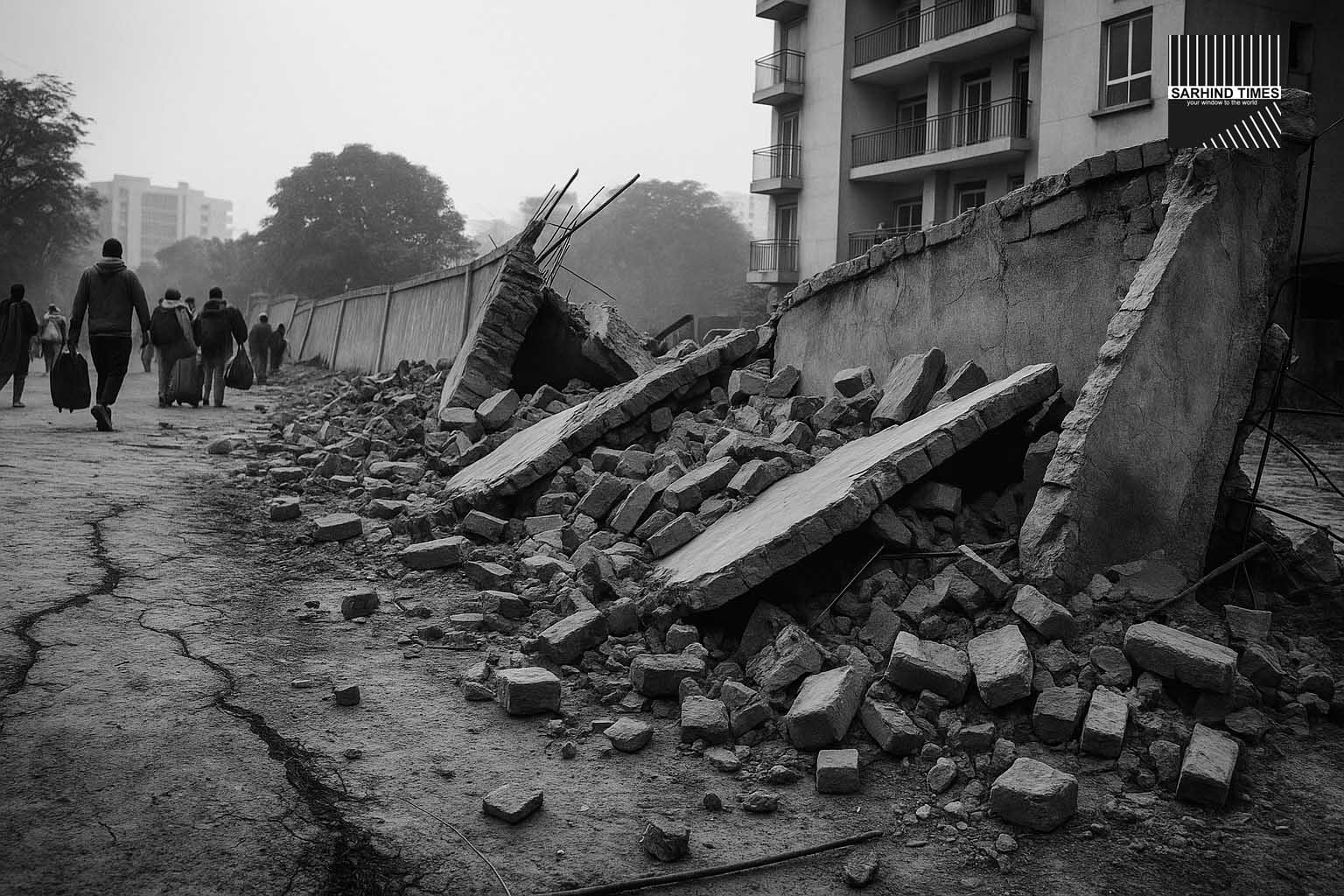
Foreshadowing of larger structural risk in fast-growing urban belt as cracks spread and evacuations began
Dateline: Gurugram | November 12, 2025
Summary: A large boundary wall of a construction site in Sector 69, Nilkanth Colony, Gurugram collapsed after several hours of heavy rain, triggering soil erosion and widespread cracks in adjoining residential buildings. Around 300-400 residents were evacuated as officials sealed affected blocks and ordered structural audits. The incident raises questions about building safety in India’s rapidly expanding urban belts.
Incident unfolds: Wall collapse and evacuation
Evening downpour in Gurugram proved more than just a rainfall event—it became a trigger for structural instability. On Thursday morning in Sector 69, Nilkanth Colony, heavy rain had been falling for hours. Around mid-day, a massive boundary wall belonging to a private builder’s adjacent construction site collapsed with a loud explosion-like sound, caused by soil erosion beneath it. Officials estimate the wall measured approximately 200-250 feet in length. The collapse destabilised the soil, leading to visible large cracks in at least eight to ten nearby residential buildings. Residents report meters-long fissures running vertically down exterior walls, sagging balconies and water-logged foundations.
The local Civil Defence team, which was first on scene, mobilised with the district police and the Gurugram administration. Announcements were made for immediate evacuation. In what officials described as a “precautionary zone” some 300-400 residents were asked to leave their homes until structural audits determine safety. Many of these residents live in paying-guest accommodations and hostels located in Nilkanth Colony. The evacuation began in the afternoon; by evening some residents had relocated to temporary shelters established by the district administration.
Why it matters: Urban risk, soil stability and weak regulation
event draws attention to multiple intersecting risks in Gurugram’s real-estate landscape. First, the pace of construction and land reclamation in Gurugram and surrounding areas has outpaced soil-and-water-management infrastructure. Heavy rainfall—especially intense short bursts—is increasingly common due to changing weather patterns. When large sites are cleared, the retention of runoff, erosion control and drainage become critical; failure can lead to foundational instability, as seen here.
Second, residential structures adjacent to active construction sites are vulnerable when protective measures like retaining walls, proper drainage, and foundation buffers are absent or inadequate. In this case, once the wall collapsed, the escarpment of soil moved and affected foundation support for nearby buildings.
Third, the regulatory and inspection frameworks in fast-growing NCR (National Capital Region) belts often struggle to catch up. Building-permission conditions, site-monitoring and drainage audits may exist on paper—but ground-level implementations can lag. The fact that residents reported visible cracks only after the incident suggests that early warning systems were either absent or not heeded.
Resident accounts and impact
residents gave detailed accounts of what happened: “We heard a massive growl of soil giving way, and within minutes the wall just folded,” said one pay-guest resident. Another described how she could feel the ground beneath her balcony shifting slightly before the cracks appeared. Shops in the affected colony were shuttered for the remainder of the day. Some residents spent the evening at neighbours’ homes while others slept in temporary shelters provided by authorities.
For many young workers and students housed in PGs, the evacuation brought disruption. Several reported being unable to retrieve personal belongings, citing locked gates and chaos. Sensing the scale of risk, parents of some residents drove overnight into the city to bring children home.
Official response: Audits, closure and investigations
< The district administration acted quickly. The area was sealed off and affected buildings were marked as “under observation”. A structural audit order was issued, specifying engineering firms must assess the buildings’ foundations, wall integrity, water-table shifts and soil settlement risk. The developer responsible for the collapsed wall has been instructed to halt construction activities at that site until further advanced clearance. Teams from the Town & Country Planning Department along with civil-engineering consultants were dispatched to assess damage and determine whether the residential buildings must be declared unfit.
Officials say that the evacuation is a proactive step rather than a presumed condemnation: buildings may yet be deemed safe for re-occupation once audits confirm structural soundness. Nonetheless, the event has raised broader concerns about monitoring of construction-adjacent housing and drainage infrastructure.
Underlying patterns: Rain, erosion and fast-track construction
analysis by urban-planning experts points to a worsening pattern in the region. As remote and semi-urban land gets redeveloped into multi-storey housing and integrated townships, the natural topography is often heavily altered—hills flattened, soil excavated, drainage channels re-routed. In monsoon or post-monsoon periods, heavy rainfall can inundate such zones, putting pressure on soils and retaining structures.
In this case, differential settlement appears to have occurred when the construction-site boundary wall collapsed and allowed soil to slough off into an adjacent embankment, undermining foundations of neighbouring buildings. Observers highlight that regulatory mechanisms to check construction-site safeguard (drainage pits, silt fencing, retentive bunds) are often missing or not enforced rigorously.
Repercussions for housing and real-estate sector
For home-buyers in Gurugram, this incident is a reminder of risk in high-density growth corridors. Investors often focus on speed of delivery and amenities; structural safety and long-term site-stability may get lower priority. Evacuations and wall-failures like this can add hidden risk premiums to housing stock, increase insurance costs and reduce future resale value if perceived as “unsafe zone”.
Real-estate players say they are monitoring the incident closely. Some developers pledged to issue safety certifications or audit results proactively. Others expect increased scrutiny from the Haryana state government and the District Town & Country Planning Department across NCR growth areas. If pressure mounts on site-compliance, smaller developers or earlier-phase projects may face cost escalation or delays.
Lessons and policy angles
Several policy-actions emerge from the incident:
– Drainage and soil-retention audits must become part of every large housing or construction permit in monsoon-vulnerable zones.
– Adjacent residential structures to active construction need mandatory structural-monitoring sensors or visual audits, especially if heavy excavation has taken place.
– Builders should retain contingency bonds for site-risk mitigation, and local governments should tie occupancy certificates to evidence of proper drainage, retaining walls and geological stability.
– Municipalities could establish real-time reporting of building-cracks and provide emergency alert-systems for residents.
– For residents, awareness of signs (cracks, sagging balconies, wall-sounds) is critical—they should push for third-party audits or structural reports before purchase or after heavy rainfall events.
Broader urban-India relevance
While this event occurred in Gurugram, the features are common across rapidly growing Indian cities—the interplay of heavy monsoon rains, excavated land, high-rise residences and sensitive soil. As infrastructure and housing expand, many cities may face similar incidents unless future-proofing becomes central. In the context of climate-change projections where intense rainfall events increase, the risk of such structural failures will likely escalate. Urban planners must treat foundation-and-soil-risk as integral to building-safety rather than an after-thought.
What to watch next
Key follow-up issues include:
- Audit reports and determination of safe/unsafe status for the evacuated buildings.
- Compensation and relocation frameworks for residents if buildings are declared unsafe for long-term use.
- Regulatory action against the developer whose wall collapsed—whether fines, stoppage orders or remediation mandates.
- Amendments or stricter rules in Gurugram’s building-permissions, including required drainage and soil-retention plans before approvals.
- Insurance-industry response—whether premiums for residences near active construction sites spike post-incident.
Conclusion
This isn’t just a story about one collapsed wall—it’s a wake-up call. In Gurugram’s high-velocity growth zones, construction risk, soil erosion, monsoon intensity and residential proximity collide in ways that threaten safety and confidence. Residents evacuated today may eventually return—but the broader message is that the infrastructure supporting rapid development must match the scale of ambition. Without robust enforcement, proper drainage, scheduled audits and resident engagement, many more incidents may follow. For a city aspiring to global-scale residential and commercial growth, foundational resilience—not just fancy facades—must be the anchor.



+ There are no comments
Add yours