
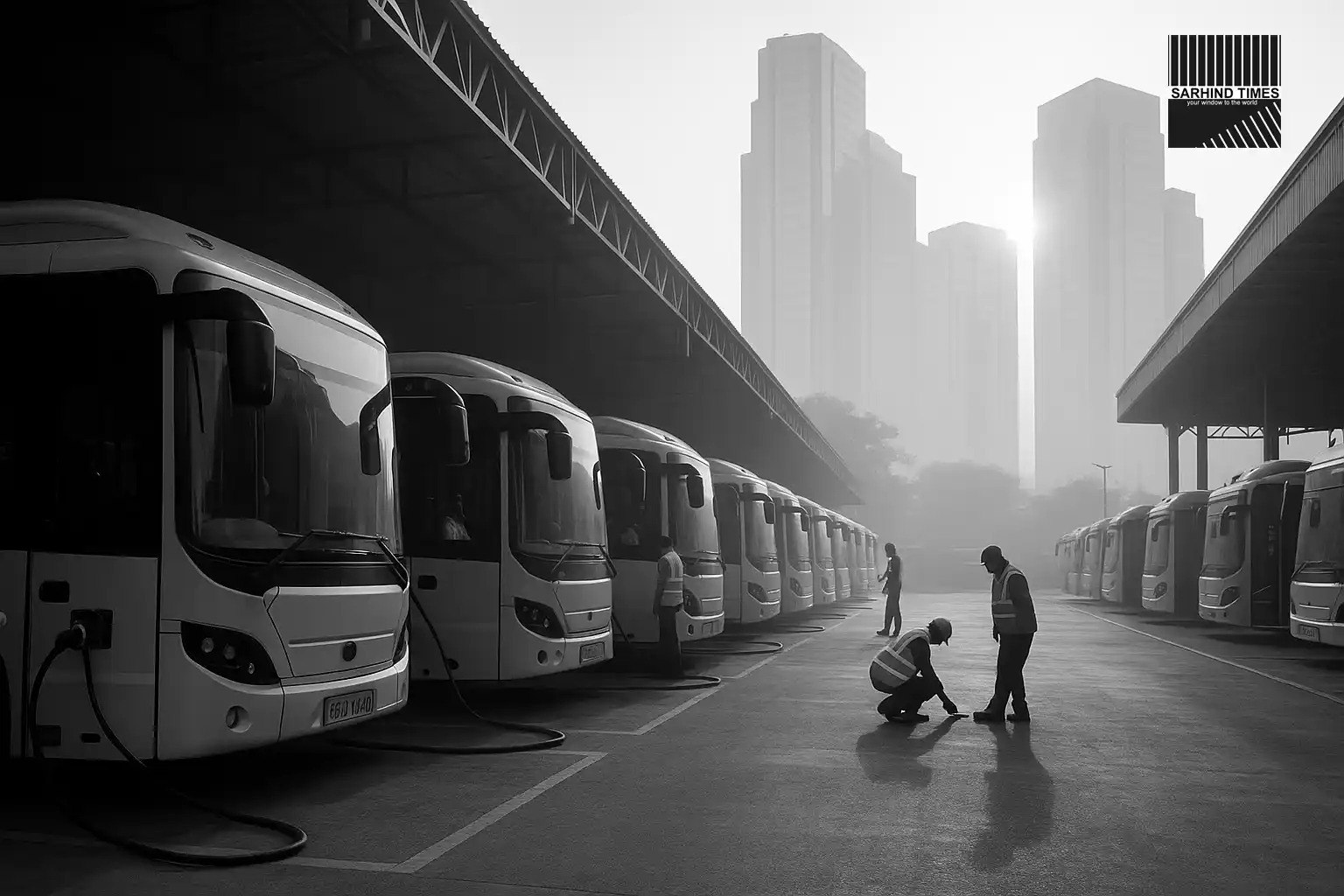
State government plans fleet upgrade to tackle congestion, pollution and sprawl in one of India’s fastest-growing cities
Dateline: Gurugram | 8 November 2025, Asia/Kolkata
Summary: The Government of Haryana has announced plans to deploy 100 electric buses (e-buses) in Gurugram by March 2026 under the national PM e‑Bus Sewa initiative, as part of a 450-bus statewide rollout. The move aims to modernise public transport, reduce vehicular emissions and strengthen the city’s connectivity amid rapid urban growth.
1. Context: Why Gurugram needs this push
Gurugram has long been a textbook example of high-speed urban expansion. With booming corporate campuses, residential enclaves, metro links and multi-lane highways, the city has outpaced many infrastructure metrics. But in the process, one of the more critical systems—public transport—has lagged behind. A substantial share of commuting still falls on private vehicles and ride-hailing services, leading to congestion, high parking demand, and worsening air quality.
According to local transport officials, the city’s public bus fleet under Gurugram Metropolitan City Bus Limited (GMCBL) effectively stands at about 150 buses after 50 buses were diverted to Faridabad. That fleet size is grossly inadequate for a city with a metropolitan-area population of over 2.5 million — let alone the thousands commuting from its expanding new sectors and satellite nodes. The dependency on private vehicles and lack of robust feeder services to metro and inter-city transit remain major bottlenecks.
Adding to this, air-pollution episodes in the winter months and escalating traffic delays have triggered demand for a more sustainable, higher-capacity mobility framework. The e-bus initiative emerges at this juncture not just as a transport upgrade, but as an instrument of urban planning and environmental policy.
2. The announcement and scheme details
During the inauguration of the 18th edition of the Urban Mobility India Conference 2025 held in Gurugram, the Union Minister for Housing & Urban Affairs announced that under PM e-Bus Sewa a large number of electric buses would be rolled out across smaller and mid-sized cities, with 100 e-buses allocated for Gurugram. The overall state allocation is 450 e-buses. These e-buses are to be deployed in a phased manner, with a target of reaching Gurugram by March 2026.
Key features of the initiative include:
- Designation of 100 electric buses for Gurugram within the larger 450-bus state allocation.
- Tendering and concessionaire process completed, with contract rates around ₹55.8 per km for the
- Infrastructure upgrade components: charging sub‐station at the Sector 10 depot, new bus depot in Sector 48, feeder network routing through metro corridors planned.
- An explicit linkage of this plan with broader mobility planning—last-mile connectivity, bus-metro integration and modal share shift to public transit.
3. Timeline, status and implementation hurdles
While the announcement is bold, several hurdles remain. The tender process saw litigation which delayed contract signing. Reports indicate that although the concessionaire has been selected, the state transport department’s final agreement is pending government approval.
The timeline roughly follows:
- By March 2026: Deployment of the first 100 e-buses in Gurugram and Faridabad each.
- Short-term: Infrastructure works such as charging stations and new depot construction. Sector 48 depot targeted for December this year.
- Medium term (1-2 years): Full route coverage, integration with metro stations, expansion of bus fleet beyond e-buses. The target for city by 2026 is cited as 1,550 buses in total.
That said, public transport users and stakeholders note that past delays in bus-fleet upgrades and depot expansion in Gurugram have been striking. One local commuter noted: “We’ve been promised better buses for months — but the old ones keep breaking down.” The success of this e-bus roll-out will hinge on swift execution of approvals, procurement, depot readiness and route realignment.
4. Operational imperatives: what must happen on the ground
Deploying new buses is only half the battle; making them effective requires systemic change. For the new e-buses to impact mobility patterns in Gurugram, several operational imperatives need to be addressed:
- Feeder connectivity: Many residential zones such as those along Dwarka Expressway, Southern Peripheral Road, and Manesar currently lack reliable bus access. Without multi-modal linkage to the metro and other major nodes, new buses may operate but not reach intended users.
- Route redesign & scheduling: Fixed frequency, dedicated bus lanes, and strong priority at junctions will matter. Without such, even new e-buses will get stuck in the same congestion as conventional ones.
- Charging & maintenance infrastructure: Electric bus operations depend on dependable charging, grid capacity at depots, maintenance staff trained for EV systems, and backup planning for breakdowns. Sector 48’s upcoming depot is a critical part of this.
- Affordability & integration: For citizens to shift from private vehicles, bus ticketing must be affordable, seamless with metro (NCMC card integration mentioned), and last-mile options (bike, e-rickshaw) aligned. The policy talk signals this but real-world deployment is key.
5. Benefits expected: environment, equity, mobility
The benefits of deploying e-buses in Gurugram are manifold:
- Reduced emissions: A high share of private vehicles fuels pollution. E-buses reduce particulate emissions, help improve air quality especially in winter months.
- Lower operating cost: Though initial capital cost is high, lifecycle cost of electric buses is lower, reducing dependence on fossil fuels and volatile oil prices.
- Improved public-transport share: With new, modern coaches, reliability may increase, thereby inducing mode-shift from private vehicles. This reduces congestion and improves travel time.
- Urban-planning synergy: The bus rollout aligns with the broader mobility narrative — metro connectivity, TOD zones, and higher-density development near transit corridors. It can steer the city away from car-centric sprawl to a more sustainable path.
6. Risks & caveats to monitor
Despite the promising framework, several risks warrant attention:
- Delayed rollout: If the deployment slips further, new buses may arrive only after commuter habits have already adjusted (or not). Delay dilutes momentum.
- Limited coverage: If routes remain focused on central corridors and neglect peripheral sectors, large residential clusters may not benefit, resulting in under-utilisation.
- Funding & cost risk: Dependence on concessionaire performance, rising electricity costs, grid constraints, and maintenance complexity can undermine operations.
- Consumer perception: New bus looks good; but if reliability remains low (breakdowns, delays), trust won’t shift. The reputation of the existing fleet is weak. The new fleet must perform and be well-maintained.
- Infrastructure mismatch: If charging infrastructure or depot readiness lags, new buses will sit idle or under-perform, reducing return on investment.
7. Impact on residents and daily commuters
For everyday commuters in Gurugram, especially those in newer residential sectors or satellite corridors, the arrival of e-buses could mark a noticeable change. Currently, many rely on private cars, shared taxis or auto-rickshaws for work, school, and errands. With better bus services:
- Commute costs may come down — bus fares tend to be cheaper or more predictable than ride-hailing options.
- Commute times may improve if buses are given priority lanes and integrated with metro feeder services.
- Passengers who avoided buses due to age or discomfort of existing fleet may reconsider public transport as a viable option.
- Reduced traffic congestion helps everyone — including drivers, residents near main roads and delivery services.
One commuter living in Sector 69 remarked: “If there is a regular, comfortable bus every 10–15 minutes that takes me to the metro or downtown, I’ll leave the car for good.” Such responses reflect pent-up demand waiting for reliable alternatives.
8. Wider regional significance and comparative perspective
“`
Gurugram’s decision is not isolated. Across India, urban nodes are shifting toward electric and shared mobility frameworks. Yet, the challenge lies in aligning policy, infrastructure and operations in fast-growing cities. For Haryana, this deployment dovetails with national and state goals of net-zero emissions, smart city frameworks and efficient land-use.
“`
Internationally, cities such as Shenzhen and Barcelona have already shown that electric bus systems, when combined with good network design and affordable fares, can shift transport modal share significantly. For Indian cities, the “fleet upgrade” phase is important, but the deeper shift is in commuter behaviour — reliability, safety, affordability, integration matter more than the bus alone.
9. Developer & investor angle
Real-estate, infrastructure and mobility-tech stakeholders are watching the rollout. For developers with land parcels further from metro stations, the promise of stronger bus connectivity may uplift attractiveness. For mobility-tech firms (EV charging, telematics, bus-fleet monitoring) the e-bus network opens opportunities. Investors looking at Sustainable Urban Transport as an asset class will note the state’s commitment and rollout roadmap.
10. What’s next — aligns with other mobility policies in Gurugram
The e-bus deployment is one piece of a larger mobility transformation in Gurugram. It aligns with:
- The upcoming TOD policy for metro zones (allowing high-rise near transit corridors).
- Expansion of metro and feeder network linking new sectors and industrial zones.
- Improvements in last-mile connectivity — bike-sharing, e-rickshaw hubs, pedestrian networks.
- Infrastructure upgrades (depots, charging stations, bus-priority lanes).
In the immediate term, the following actions are critical: signing of the concessionaire agreement; commissioning of the Sector 48 depot; route redesign for e-bus coverage; creation of dedicated bus lanes; charging-infrastructure rollout; user-outreach and communication to shift behaviour.
11. The commuter’s checklist: What to look out for
If you are a daily commuter or resident, these are the indicators to watch:
- Is the new fleet visible on major routes between your residential zone and metro or business parks?
- Are bus timings reliable and frequent (every 10–15 minutes)?
- Are the buses clean, modern, comfortable and air-conditioned (given Gurugram’s climate)?
- Is there a real fare advantage or at least cost-predictability compared to ride-hailing?
- Is there a single card or mobile app for bus + metro + last-mile (National Common Mobility Card or other)?
- Are boarding points and shelters improved, and can you access bus stops safely (lighting, signage, pedestrian access)?
12. Conclusion: Momentum matters more than announcement
Haryana’s announcement of 100 electric buses for Gurugram under the PM e-Bus Sewa scheme is a bold step in the city’s mobility evolution. It reflects recognition of systemic gaps and the need for modern, greener transit solutions. But that is not the end of the story — the real test lies in delivery, coverage, reliability and commuter shift. If executed well, this could mark a turning point: from car-dependent suburbia to transit-integrated city. If not, it may become yet another under-delivered promise in India’s urban mobility challenge.
For Gurugram’s residents, the next 12–24 months will be critical. They will watch whether new buses actually turn up, whether they improve their commutes and whether this structural shift enables a more liveable city. For policymakers, the measure will determine future credibility. The potential rewards are clear — a cleaner, less congested, more accessible Gurugram — but the execution will determine whether that potential becomes reality.



+ There are no comments
Add yours