
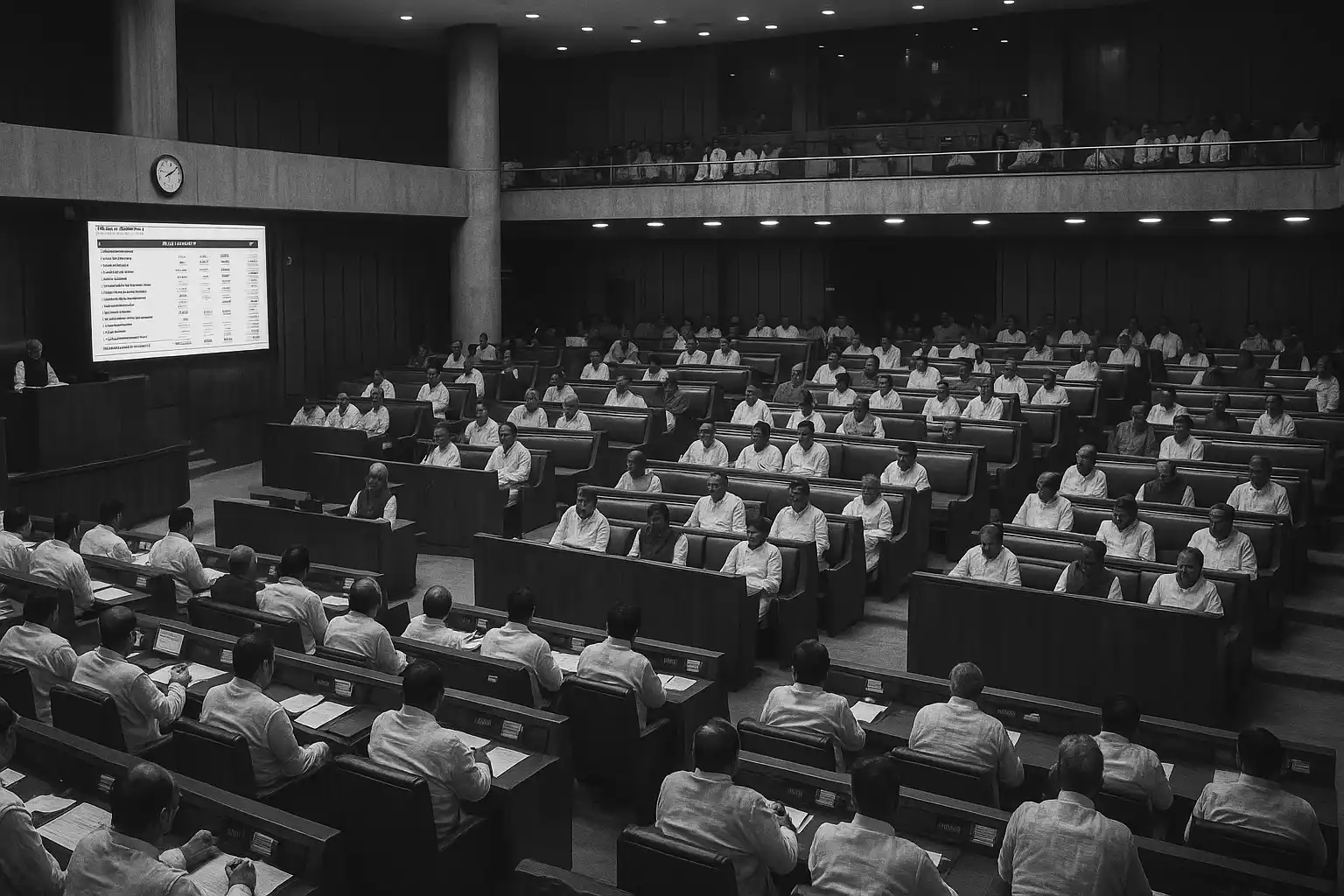
State targets 11 % GSDP growth as expenditure rises 15 %, with welfare and investment taking centre stage in new fiscal roadmap
Dateline: Chandigarh | 05 November 2025
Summary: The government of Haryana has presented a ₹2.05 lakh crore budget for the 2025-26 fiscal year, forecasting Gross State Domestic Product (GSDP) growth of 11 % and maintaining a fiscal deficit of 2.7 % of GSDP. Key thrusts include a new monthly cash transfer scheme for women, a skill development programme for youth, expansion of natural farming over 1 lakh acres and increased capital outlay of ₹16,164 crore. The budget underscores the state’s shift towards social welfare and investment-led growth.
Fiscal Framework and Macro-Parameters
The budget for 2025-26 marks a significant fiscal statement by the �Government of Haryana. The state projects its current-price Gross State Domestic Product (GSDP) at ₹13,47,486 crore — an 11 % increase over the revised estimate for 2024-25. Expenditure (excluding debt repayment) has been budgeted at ₹1,69,229 crore, representing a 15 % rise year-on-year. Receipts (excluding borrowings) are estimated at ₹1,33,234 crore, up 17 % from the previous year. The fiscal deficit is targeted at 2.7 % of GSDP (₹35,995 crore) while the revenue deficit is projected at 1.53 % of GSDP (₹20,600 crore). These figures show the state balancing higher expenditure with controlled borrowing.
Committed expenses – salaries, pensions and interest payments – are estimated at ₹74,701 crore, or 58 % of revenue receipts. This leaves about 42 % of revenue resources for other developmental and welfare-oriented schemes.
Major Policy Highlights and Welfare Thrusts
The budget contains several headline schemes and allocations:
• The launch of the “Lado Lakshmi Yojana,” a monthly cash-transfer of ₹2,100 to eligible women, with a budget of ₹5,000 crore in 2025-26.
• Youth skill development under the “Mukhyamantri Yuva Kaushal Samman” scheme, aiming to provide support and training to 2,000 graduates annually.
• Natural farming expansion over one lakh acres, to strengthen sustainable agriculture and reduce input-costs for farmers.
• Important allocations for sectors: Social welfare and nutrition ( ₹19,828 crore, up 28 % ), Education ( ₹21,295 crore, up 8 % ), Health and family welfare ( ₹9,674 crore, up 7 % ).
Investment and Capital Outlay Focus
Capital outlay has been significantly increased to ₹16,164 crore (up 27 % over revised estimates). This reflects the state’s focus on asset creation, infrastructure, and future-oriented investments rather than merely recurring expenditure.
Within investment priorities, the budget document signals the establishment of a new “Department of Future” tasked with technology, sustainability and environment-related oversight.
Welfare, Social Equity and Inclusion
The Lado Lakshmi scheme represents a bold welfare commitment to women — a large monthly payment designed to provide economic security and empowerment. It aligns with the state’s broader welfare agenda and reflects a strategic pivot: welfare plus investment rather than mere subsidy.
In education and nutrition, the state is increasing allocations for primary schooling, school meals and kitchen-garden programmes in schools — pointing to multi-dimensional investment in human capital.
Growing Revenue and Fiscal Risks
While the budget projects healthy growth in revenue (own tax revenue estimated at ₹92,144 crore, up 12 %), risks remain. A revenue deficit of 1.53 % of GSDP indicates that the state’s current revenues will not fully cover current expenditure, necessitating borrowing or drawing down reserves.
Similarly, high committed expenditure constrains flexibility: more than half of revenue receipts are already tied up in salaries, pensions and interest. For capex expansion and new schemes, the state will need to keep budget discipline, accelerate monetisation of assets and improve revenue mobilisation.
Sectoral Impacts: Agriculture, Industry and Urban Development
In agriculture, the push for natural farming signals a move away from input-heavy cultivation and towards ecological sustainability and cost-efficiency — a worthwhile structural thrust given Haryana’s agrarian background. The one-lakh-acre target is ambitious and will require coordination between departments, farmer education and market linkages.
On industry and investment, the budget’s emphasis on infrastructure, the Department of Future and capital spending provides a favourable environment. The state has recently signed MoUs worth ₹3,000 crore, underscoring its investment momentum.
Urban and infrastructure development stands to gain from higher capex — which may translate into improved transport, energy, water management and digital infrastructure. For a state like Haryana, whose industrial and services sectors remain key growth drivers, improved infrastructure must underpin competitiveness.
Key Implementation Challenges to Watch
Despite the positive thrust, several execution-risks and structural challenges remain:
• **Absorption of capital expenditure**: Increasing capex must be matched with effective implementation — delays in projects could erode the value of the allocated amounts.
• **Revenue execution**: Tax-collection performance, state’s ability to raise non-tax-revenues (land, congestion charges, user fees) and the management of grants from the centre will matter.
• **Welfare delivery capacity**: For the new schemes (cash transfers, skill programmes, natural-farming subsidies) the administrative capacity at district and block levels must ramp up; bottlenecks could delay benefits.
• **Maintaining fiscal discipline**: With the revenue deficit rising and committed outlays high, deviations or economic shocks (crop failure, global slowdown, commodity inflation) could impact the state’s fiscal health.
• **Equitable distribution**: Given that Haryana shows intra-state disparities (rural-urban divide, migrant labour concentrations, peri-urban growth pressures), ensuring that welfare and infrastructure benefits reach marginalised districts is critical.
What This Means for Citizens and Stakeholders
For citizens, the budget offers tangible signals: more money for welfare, especially women; improved schooling and skill opportunities for youth; and a commitment to sustainable farming. For businesses and investors, the higher capex and investment orientation suggest favourable conditions, provided the state delivers on infrastructure and regulatory facilitation.
For development practitioners, the budget represents a test case in co-ordinated growth: welfare plus investment, inclusive yet growth-oriented. The success will depend on how well Haryana bridges policy announcements and on-ground execution during the year ahead.
Conclusion
The 2025-26 budget of Haryana marks a marked shift — from incremental annual adjustments to a more assertive fiscal policy linking welfare, agriculture reform and investment. The headline figures are ambitious, and if implemented well, could accelerate the state’s transition into a higher-growth, more sustainable economy. The key will be delivery: speed, efficiency and equitable outcomes. Haryana has set the ambition; now the task is execution.

+ There are no comments
Add yours