
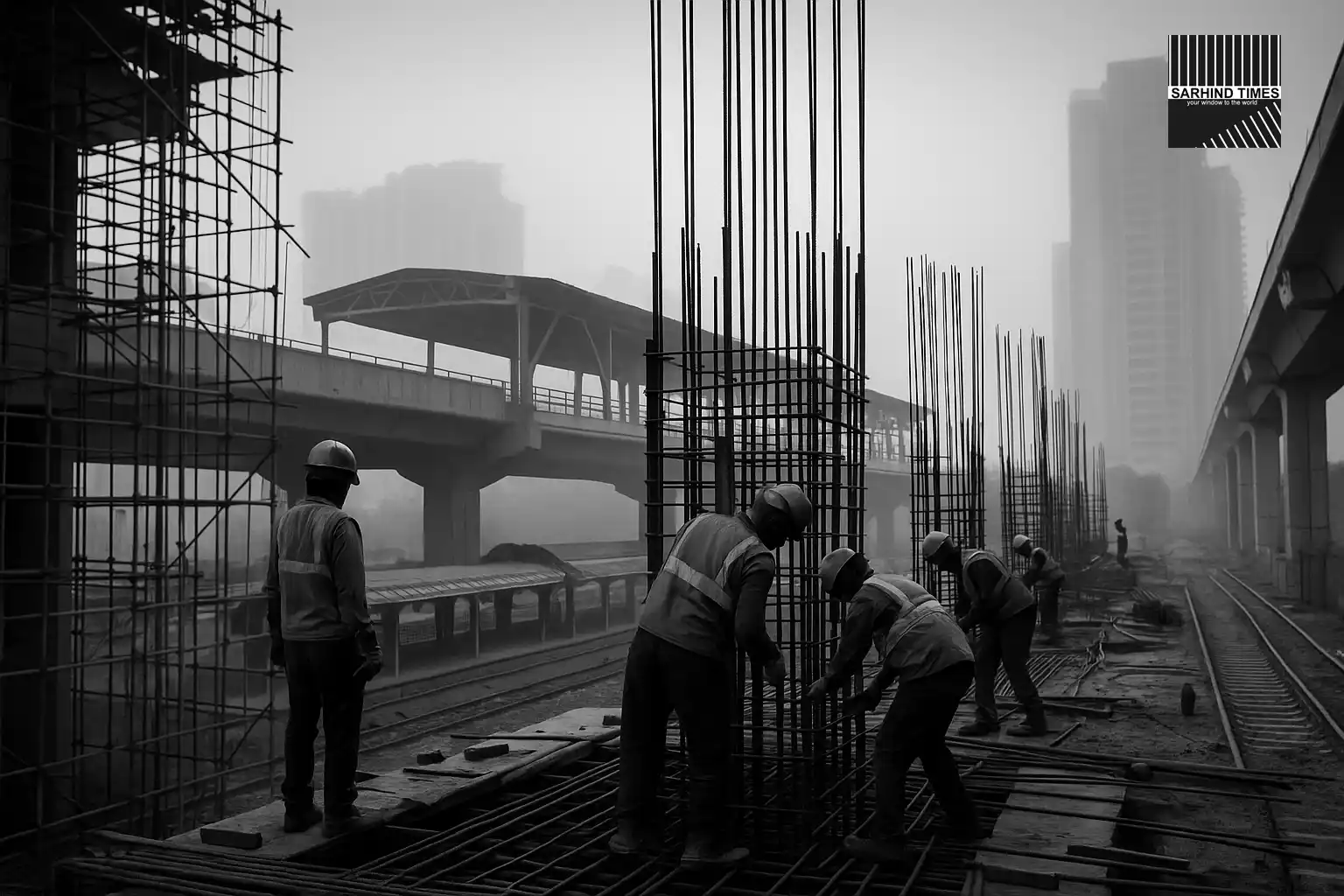
Infrastructure push aims to reshape mobility and urban form in the NCR with major implications for residents, developers and city planners
Dateline: Gurugram | 8 November 2025, Asia/Kolkata
Summary: The Haryana government has announced that a Transit Oriented Development (TOD) policy for the Delhi-Gurugram region will be unveiled within a month. The plan will allow high-rise buildings up to 500-800 metres from metro corridors, integrate metro stations with skywalks and tunnels and shift the city’s urban mobility paradigm. The decision marks one of the most significant infrastructure junctures for the NCR in recent years.
1. Introduction: A new mobility chapter for Gurugram
The northern Indian city of Gurugram — long a symbol of high-speed urban expansion, IT parks and corporate campuses — is once again at a critical juncture. The state government of Haryana has declared that within a month it will announce a detailed Transit Oriented Development policy (TOD) covering the Delhi-Gurugram corridor. This move, made during the inauguration of the 18th Urban Mobility India conference in Gurugram, promises high-rise developments in areas near metro lines, seamless connectivity via skywalks and tunnels, and fresh momentum for the region’s public transport infrastructure. The shift signals a significant departure from traditional city-centric expansion to a more rail-based, mixed-use development model anchored by the metro network and structured urban growth.
The implications of this planning pivot are profound: for residents, for developers, for city planners, for real-estate markets and for the broader mobility ecosystem of the National Capital Region (NCR). It raises questions about affordability, displacement, environmental impact, governance and execution – aspects that will shape how this plan unfolds. This article unpacks the policy announcement, examines the state of urban mobility in Gurugram, explores stakeholder reactions, investigates potential headwinds, and assesses the future scenario of the city’s built environment.
2. The announcement and key features
The announcement came at the Urban Mobility India (UMI) conference held in Gurugram, where the Haryana Transport Minister stated that the TOD policy for the Delhi-Gurugram region would be formalised within a month. High-rise buildings would be permitted within 500 to 800 metres of a metro corridor. Residents and commercial projects near the metro would benefit from rapid access to transit. The policy also mandates the interconnection of metro stations with adjacent structures through skywalks and underground tunnels, enabling a seamless transition from station to building without relying entirely on road traffic.
Specifically, the key features include:
- Definition of a TOD zone: land parcels within 500–800 metres of a metro corridor in the Delhi-Gurugram region will be designated as TOD zones.
- Permission for high-rise construction within these TOD zones, encouraging vertical growth and mixed-use developments (commercial, residential, retail) to reduce horizontal sprawl.
- Integration of transit infrastructure: metro stations will be connected to adjacent buildings, residential towers, offices, and commercial complexes via skywalks and underground pedestrian tunnels.
- Incentives for developers: relaxed floor area ratios (FAR), reduced parking requirements, mandates for inclusion of affordable housing or mixed-income units in designated TOD zones.
- Focus on mobility-first urban planning: taxi drop-zones, bike-sharing stations, pedestrian-first corridors, and minimisation of car dependency.
- Environmental safeguards: green building norms, energy-efficient designs, and storm water management – though details are yet to be fleshed out.
The policy description is still high-level, with many implementation details pending. But the direction is clear: the state government and city-planning apparatus are signalling a shift from road-centric, sprawling urban growth to a condensed, transit-anchored model – one that aligns with global practice in metropolitan areas.
3. Why Gurugram and the NCR? The context
Gurugram’s rapid emergence as a corporate hub, combined with its proximity to Delhi and the presence of multiple metro corridors, makes it a prime candidate for TOD policy. However, it also faces severe challenges: traffic congestion, pollution, high real-estate costs, inadequate last-mile connectivity, and fragmented urban form.
Recent government data show that public transport share in Gurugram remains low compared to car and two-wheeler use. With the city’s population and built-up area growing fast, the pressure on roads, parking, utility infrastructure and urban services is mounting. The traditional model of incremental expansion — more roads, more flyovers, more cars — has reached its limits in terms of space, cost and sustainability.
The TOD policy seeks to arrest the negative consequences of sprawl by locating new development around transit nodes. Thanks to the multiple metro lines planned and under construction in the NCR, the opportunity is ripe. For example, the existing and upcoming corridors of Rapid Metro Gurgaon, extensions of the Delhi Metro network, and the planned airport line create a dense transit grid which could be leveraged to reshape the city’s footprint.
For the state government and city planners, this is both an opportunity and a necessity: with land becoming scarce and expensive in Gurugram, and infrastructure costs spiralling, aligning development with transit can deliver higher density, better connectivity, and potentially improved urban quality of life if done right. The timing aligns with global shifts: cities across Europe, Asia and North America are revitalising around transit corridors to reduce reliance on cars, lower emissions and improve accessibility.
4. Developer and market reaction: Mixed signals
Developers in Gurugram and the NCR have responded with a mix of anticipation and caution. On the one hand, the explicit policy signal that high-rise projects will be permitted within TOD zones has sparked excitement. Multiple major real-estate players are believed to be reviewing land parcels near metro lines to reposition them for high-density development.
One developer commented: “If the policy is clear and implemented quickly, it could unlock land with massive potential, reduce risk of arbitrary zoning change, and streamline efforts.” The possibility of relaxed parking norms and premium FAR incentives are particularly attractive in a land-scarce and cost-high market like Gurugram.
On the other hand, there are concerns. For instance:
- Will the policy deliver appropriate infrastructure upgrades — skywalks, tunnels, station-building integration — on time and with quality?
- What happens to landowners who are not near metro corridors? Is there a risk of creating a two-tier development pattern, with TOD zones booming and other areas left behind?
- Will local residents face displacement or inflated costs due to new high-rise developments and possible gentrification?
- Will the environmental and social safeguards be sufficiently rigorous, or will the push for density compromise public open space, landscaping and service delivery?
In summary, while the policy framework offers strong attraction for developers, successful execution will depend on governance, clarity of rules, infrastructure delivery and equitable treatment of stakeholders.
5. Urban mobility and public transport current status
Despite its corporate headlines, Gurugram still lags in seamless public transport connectivity, particularly in last-mile access and non-motorised transport (walking, cycling). The city’s growth pattern has been car-centric and sprawling, with large gated communities, business parks and wide roads. According to recent reporting, the city’s air quality is worsening each winter, pointing to a reliance on private vehicles and skeletal public transport coverage.
Under the current fleet of the city bus service (operated by Gurugram Metropolitan City Bus Limited – GMCBL), only around 150 buses are active after a re-allocation of 50 buses to nearby Faridabad. The aging fleet means breakdowns and unreliable service. Against this backdrop, the state’s decision to add 450 electric buses (e-buses) across Haryana, with 100 slated for Gurugram, is a timely complementary move. But the scale of public transport still remains small relative to city size and private vehicle numbers.
Equally, the metro network, while influential, has yet to fully realise its network effect in the region: extensions, feeder services and station-adjacent development are still works-in-progress. Achieving the TOD vision will thus require synchronised upgrades: transit infrastructure, land-use regulation, and urban design must all align.
6. Socio-economic implications for local residents
For the growing resident population of Gurugram, the TOD policy carries mixed implications. On the one hand, improved access to metro stations, walkable streets, skywalks, reduced car dependence could enhance liveability — shorter commute times, less congestion, better air quality, more predictable transport costs.
On the other hand, high-rise, high-density development often comes with concerns: cost of living may rise in the premium zones, shadowing and micro-climate effects may intensify, infrastructure demand (water, sewage, power) will increase, and social equity becomes a question. If affordable housing is not mandated or enforced, the benefit may accrue disproportionately to higher-income groups.
Urban planners emphasise that TOD is not just about high-density near transit, but also about accessible public spaces, mixed-income housing, pedestrian networks, and inclusive urban environments. The risk in Gurugram is that the focus may tilt heavily towards commercial high-rise towers serving corporates, rather than inclusive neighbourhoods.
7. Environmental and sustainability angle
From an environmental standpoint, TOD has the appeal of reduced vehicle kilometres travelled (VKT) and lower emissions per capita if properly implemented. Shifting urban growth from horizontal sprawl to vertical density along metro corridors can reduce land consumption, protect green zones and improve efficiency of service delivery (water, power, waste). Given Gurugram’s recent struggles with air quality — including winter smog and particulate pollution — the transit-anchored model offers a pathway to mitigation.
That said, the devil lies in the details. High-rise construction, if not done with attention to sustainable building practices, can itself become energy-intensive and environmentally burdensome. Storm-water drainage, micro-climate implications, heat-island effects, and the increased burden on utilities must all be managed. There must be clear requirements for green roofs, water recycling, shading, passive design and renewable energy integration.
Another environmental risk is the potential pressure on open space and uphan inclusive amenities if densification proceeds without controls. To avoid the outcome of dense high-rises with minimal public realm, planners must enforce canopy cover, pedestrian zones, and resilient infrastructure. For Gurugram’s often-criticised urban design — with gated clusters and limited street life — this is the key shift.
8. Governance, regulation and execution challenges
Policy announcements — even bold ones — are only as effective as their execution. In Haryana’s case and particularly in Gurugram, multiple governance layers exist: state government, city municipal corporation, metro rail corporation, township developers, builders, resident welfare associations (RWAs), traffic police and others. Coordinating them is non-trivial.
Regulatory clarity is another issue: definitions of TOD radius, building envelopes, mixed-use zoning, eligibility criteria, developer incentives, affordable housing quotas, parking norms — all must be spelled out, ideally in a single integrated policy document. As of now, only high-level parameters are visible. Ambiguity may lead to delays, litigation, hoarding of land, and speculative inflation.
Land acquisition, relocation of existing informal structures, negotiation with land owners and RWAs, and citizen engagement are all potential bottlenecks. In Gurugram’s case, past experiences of infrastructure delay and murky stakeholder alignment increase risks. Ensuring that skywalks and tunnels are built on time and connect seamlessly with buildings and stations will require disciplined project management, monitoring and maintenance mechanisms.
9. Implications for real-estate markets
The real-estate sector, one of Gurugram’s economic pillars, is likely to see transformation. Land parcels near metro lines and corridors will become increasingly valuable. Developers may shift strategy from horizontal township expansion to vertical, transit-oriented towers with integrated retail and office spaces. Investors may also reallocate capital to assets within the future TOD zones.
However, with opportunity comes risk. Speculation can drive prices higher, affordability may suffer, and lower-income segments may get squeezed. The magnitude of incentives offered by the government (e.g., FAR premium, reduced parking, tax benefits) will determine whether the uplift is broad-based or narrow. Projects far from transit or outside the TOD radius may see slower appreciation or even lagging supply. For buyers, understanding whether a given property truly falls within the upcoming TOD zone will matter greatly.
Buyers will also need to evaluate whether the promised infrastructure — skywalks, station integrations, building-walkway connectivity — is indeed being delivered, rather than relying solely on title or proximity claims. A well-positioned tower without functional mobility connectivity may under-deliver in value and convenience.
10. Comparative lens: learning from other global cities</ >
Globally, cities like Tokyo, Seoul, Singapore and Hong Kong have developed transit-oriented zones where high-density development follows major rail nodes. Such patterns enable efficient land use, reduced travel times and vibrant mixed-use neighbourhoods. Some Indian cities like Mumbai and Bengaluru have attempted TOD, but implementation friction has been high.
In India’s context, one relevant example is the Delhi Metro corridor itself, where initial TOD efforts (stations like Dwarka, Noida City Centre) show varying success due to fragmentation of land holdings, weak last-mile connectivity and inconsistent urban design. For Gurugram, the opportunity is to adopt best practices — clear zoning, developer-government alignment, pedestrian-first design and real-time monitoring — rather than replicating sub-optimal models.
11. Risks and pitfalls to watch
Several risks loom:
- Delayed infrastructure delivery: If skywalks, tunnels or station-building connectivity lag, the TOD zones may underperform.
- Displacement and gentrification: Existing low-income neighbourhoods near metro corridors may face redevelopment pressure, rising rents and displacement without protections.
- Traffic spill-over and infrastructure strain: High-density developments generate more water, sewage, traffic (even pedestrian) and service demand. If utilities don’t upgrade, quality of life may suffer.
- Speculation bubble: If land near metro corridors is hoarded or overvalued before the zoning is clear, affordability may collapse.
- Environmental compromise: High-rise towers without green design, open space or proper connectivity may worsen micro-climate issues and reduce urban liveability.
- Fragmented governance: Multiple agencies with overlapping jurisdiction may delay approvals, synergies may fail, and coordination may weaken.
12. What happens next: timeline and processes
The government has committed to unveiling the TOD policy within a month. After that, we may expect:
- Release of draft policy document for public comment covering zoning rules, eligibility, incentives and timelines.
- Identification and mapping of TOD zones: metro corridors and their 500-800 metre buffer zones will need to be demarcated and published.
- Preparation of detailed infrastructure plans: station-adjacent skywalks, tunnels, pedestrian networks, feeder bus networks, bike-sharing stations.
- Developer registration and approval mechanisms: builders with projects within TOD zones may apply for incentives and will need to comply with design, sustainability and integration criteria.
- Monitoring and evaluation mechanism: the government may set up an urban mobility cell or nodal agency to monitor progress, enforce compliance and publish periodic performance reports.
- Phased roll-out: initial pilot zones may open for development earlier, while larger scale projects may follow over two to five years.
For citizens, these processes will define how quickly they see benefits — from reduced commute time to quality amenities. For developers, timelines will determine investment decisions and land acquisition strategies.
13. Expert commentary & stakeholder voices
Urban planning experts highlight that the TOD concept itself is sound, but its success depends on “walking-radius accessibility” and integration of multiple modes of transport. One urban transportation specialist noted: “The critical missing link in many Indian cities is not just the metro, but the architecture of the station precinct — the public realm, the streets, the last-mile connections.” In Gurugram’s case, that means developers, municipal bodies, station managers and traffic police must align. Past delays in feeder bus services, inconsistent pavement quality and fragmented land parcels show the gap.
Residents too share a mix of optimism and scepticism. One long-time resident of South City-II observed that commuting into Delhi or to a distant corporate park often takes more than an hour, and that a well-connected metro station with integrated commercial and residential towers could improve quality of life. Yet she also questioned whether the high-rise model would make the area unaffordable, or whether construction disruption would worsen living conditions in the short term.
14. Broader implications for the NCR and regional planning
While the policy is anchored in Gurugram, its implications radiate across the broader NCR — Delhi, Noida, Faridabad, Ghaziabad. If the TOD framework succeeds, it may reshape how the entire region approaches mobility and growth. Instead of bigger roads and flyovers, development may concentrate around transit nodes, freeing up peripheral land, reducing travel distances and improving sustainability.
In policy terms, Haryana’s move also signals strong alignment with national objectives: the government’s push for sustainable urban mobility, reduction of carbon emissions, and efficient land-use aligns with frameworks like the Smart Cities Mission and the National Urban Transport Policy. For the private sector, the message is clear: transit-oriented growth is the future. Investors and developers therefore will reassess their portfolios accordingly.
15. Citizen-centric view: what to watch and ask
For ordinary citizens, several questions matter:
- Are existing metro stations accessible and safe for pedestrians and cyclists? Will the new skywalks and tunnels be designed with inclusive access (elderly, differently abled)?
- Will housing within TOD zones include affordable units or floor-space sponsored schemes for lower-income groups? Or will it be premium-only towers?
- How will the municipal corporation manage increased density—will water, sewage, power and solid waste services scale up? Or will service delivery degrade?
- What happens to indirect effects: Will traffic through adjacent roads reduce? Will parking demand shrink? Will public spaces improve?
- Will there be transparency in how the zones are demarcated, how incentives are given to developers, and how environmental/amenity obligations are enforced?
16. What this means for businesses and investors
Businesses may benefit from enhanced connectivity — reduced commute times for employees, attractiveness of commercial real-estate near transit stations, better footfall for retail in mixed-use towers. Investors in real-estate may find opportunities in land parcels within the corridor, and infrastructure funds may target transit station precinct redevelopment. However, the reward will favour those who time this early-phase transition well and navigate policy, regulatory and construction risks effectively.
For companies in mobility, this may open new business models: last-mile services (bike-sharing, e-rickshaws), transit-oriented retail, station-linked office campus redesign, parking-management firms, data-driven urban-mobility platforms. The emerging skyline of Gurugram may shift from corporate podiums surrounded by parking lots to transit-adjacent towers seamlessly connected to the metro network.
17. Timeline of anticipated impact and key milestones
Looking ahead, the approximate timeline could be:
- Short-term (next 6-12 months): Draft policy released, TOD zones mapped, pilot notifications issued, developer interest spikes, initial infrastructure tenders floated.
- Medium-term (1–3 years): First wave of high-rise mixed-use projects launched within TOD zones, station-building interconnection works (skywalks, tunnels) executed, e-bus and feeder network expanded, early operational feedback emerges.
- Long-term (3–5 years+): Major transformation of station precincts becomes visible: replaced surface-parking with transit plazas, large mixed-use towers functional, modal share of public transport significantly improved, peripheral sprawl stabilises, and real-estate markets adapt.
18. Conclusion: Opportunity with caution
The upcoming TOD policy for the Delhi-Gurugram corridor marks an ambitious milestone in the city’s urban evolution. If executed well, it can deliver a more compact, accessible and sustainable city—offering residents better mobility, environmental gains and more vibrant urban neighbourhoods. For developers and investors, it signals where future growth is headed. Yet the pathway is littered with execution risks: infrastructure delivery, governance alignment, affordability guardrails and inclusive outcomes must not be ignored.
For Gurugram to transition from being a sprawling high-rise suburb of Delhi into a truly transit-integrated, liveable urban centre, the policy must go beyond permitting towers: it must activate station precincts, improve public realm, connect people to places and ensure everyone benefits—not just the affluent few. As the countdown to the official policy launch begins, stakeholders across public and private sectors will need to shift from anticipation to action.



+ There are no comments
Add yours