
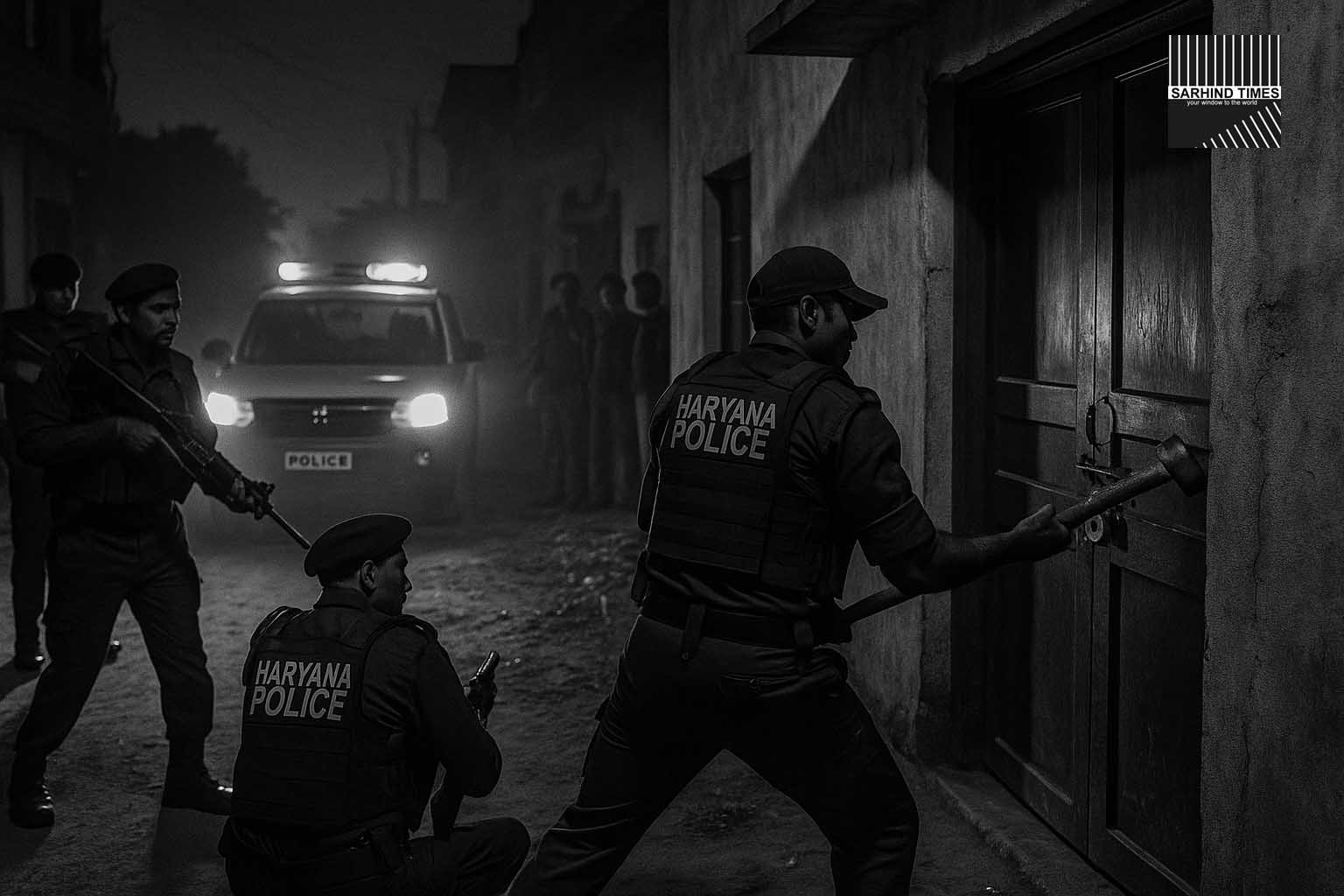
16-day statewide mission targets absconding shooters, bail-violators and interstate fugitives — including heightened focus in Gurugram and adjoining belts
Dateline: Gurugram | November 16, 2025
Summary: The Haryana Police have kicked off a major law-enforcement drive named “Operation Trackdown” running from November 5 to 20. The campaign aims to arrest fugitives tied to recent shooting incidents, cancel bail for active criminals, and tighten accountability across the policing chain — with particular emphasis on the high-growth city of Gurugram and its surrounding districts.
The Launch: What Is Operation Trackdown?
In response to an uptick in firearm-related crimes, the Haryana Police, under its Director General of Police O. P. Singh, announced the 16-day mission officially titled “Operation Trackdown”, covering all districts across the state. Each police station has been instructed to compile a “worst 5” list of offenders who remain at large; each district or zone must compile a “worst 10”; and statewide the Special Task Force (STF) will maintain a “worst 20” list of organized-crime and gun-violence suspects.
The operation’s goal is three-fold: rapid arrest of fugitives, cancellation or review of bail for criminals who continue to commit offences, and close coordination with neighbouring states to block interstate escape.
Why Now? The Spike in Firearm Incidents
Gurugram and other fast-growing districts have seen increased reports of gun-violence, either in the form of targeted shootings, gang-related incidents, or emerging inter-district criminal mobility. The dense urban expansion, rising migrant population and proliferation of organised networks have complicated policing.
Officials argue that prior enforcement drives were more ad-hoc. Operation Trackdown is framed as a structured, time-bound campaign with clear metrics and accountability, intended to send a strong message to criminals that fleeing justice will become harder.
Gurugram Focus: Urban Pressure and Crime-Mobility Links
Though the drive covers all of Haryana, Gurugram receives special emphasis. With booming real-estate, high-mobility corridors (NH-48, Dwarka Expressway) and growing adjacent belt clusters, the city has become both a hub for legitimate economic activity and an attractive zone for fugitives or organised elements seeking transit or hide-outs.
Police sources say that arrests already made in Gurugram include individuals who were previously on bail and suspected of involvement in gun-firing incidents, as well as absconders who moved across the Delhi-NCR belt to evade detection. Regular vehicle checks, use of drones for surveillance, and joint raids with adjacent jurisdictions have been stepped up.
Legal Levers: Bail Cancellations and Asset Seizures
A key feature of the operation is not just arresting fugitives but leveraging legal infrastructure: police will directly file for bail cancellation and invoke organised-crime provisions where networks are identified. Asset-seizure notices are being prepared in parallel for those financing or harbouring offenders. The DGP’s directive emphasises that station-level officers will face accountability if listed offenders re-offend or evade arrest.
Coordination with Neighbouring States
Criminal mobility across state borders remains a significant challenge. To counter this, the operation includes explicit coordination with police forces in Delhi, Punjab, Rajasthan, Himachal Pradesh, Jammu & Kashmir and Chandigarh. Joint check-posts and intelligence-sharing mechanisms are activated to prevent fugitives from slipping through regional gaps.
Initial Results: Arrests, Lists and Momentum
Early into its launch, on November 8 the police announced that 32 designated criminals were arrested across districts on day one, marking a strong start. Some of the arrests were made in Gurugram and adjoining districts, involving individuals with known links to prior firearm cases and suspected networks.
The STF is said to have already actioned several cases flagged for cancellation of bail, and notices for asset seizure are in process. While full numbers remain under review, police officials describe the initial phase as “on track”.
Community Response: Mixed But Watchful
Residents in Gurugram’s sectors report an increased visibility of police in the early mornings—roadblocks, vehicle checks, ID verifications in residential pocket markets and even drone surveillance over less-monitored clusters. Some acknowledge the higher sense of security; others complain that the heightened checks cause inconvenience and fear profiling.
RWAs (Resident Welfare Associations) have largely welcomed the operation but demand that the focus extend beyond arrests to systemic steps: quicker prosecution, closure of pending cases, and improved community policing. They emphasise the need for follow-through so that arrests convert into convictions and not merely statistics.
Human Rights & Oversight Concerns</
Advocacy groups point out that while the crackdown may be necessary, safeguards must still be in place. They raise concerns over possible misuse of preventive detention, use of force during unannounced raids, and monitoring of bail-revocation for possible bias. Transparency in police action, timely disclosure of arrest data and civilian oversight are being demanded to avoid overreach.
Challenges Ahead: Sustainability and Legal Back-end
Police admit that mass arrests and crackdowns create short-term impact, but long-term reduction in gun-violence demands systematic reforms: strengthening forensic labs, speeding trial dispositions, clearing back-log of cases, improving witness protection, and closing legal loopholes that allow bail and evasion.
Also, larger criminal networks are shifting tactics: they use urban anonymity, safe-houses in Mid-NCR, logistics corridors, and tech-powered surveillance to stay ahead. The stakes for law-enforcement are rising.
Impact on Local Business and Urban Life
For a city like Gurugram—economically vibrant, globally connected and home to multinational firms—the presence of organised crime and gun-violence poses reputational and investor-risk dimensions. Enhanced safety is now a business imperative, and certain companies are already reviewing security protocols around employee transit, site-perimeter checks and residential clusters. Increased policing presence during operations affects traffic flow in early hours and disrupts to some extent the commuting routine, but many executives see this as short-term pain for long-term gain.
What’s Next: Monitoring, Accountability and Metrics
The Haryana Police have set internal metrics: each station must report daily on “worst 5” targets; district command must accumulate “worst 10”; STF takes the “worst 20” list to weekly review. Performance evaluation includes number of arrests, cancellations of bail, cases registered under organised-crime statutes, asset-freezes effected, and reduction in firearm-incident rates.
Authorities have indicated that if the operation proves successful, a longer-term mission may follow later in the year focused on cyber-enabled crime, narcotics and money‐laundering across the state.
The Bottom Line
Operation Trackdown represents a significant shift in how Haryana intends to tackle gun-violence and fugitive crime: from reactive policing to proactive, metric-driven campaigns. For Gurugram citizens, early signs are visible. But the success of such missions will be judged not by arrests alone but by sustained reduction in crime, faster justice delivery and enhancement of trust in law enforcement.
As the mission unfolds through mid November, the eyes of the state and the public will watch whether this ambitious strategy can translate into lasting safety improvements or simply become another tick-box exercise in dossier building and enforcement optics.


+ There are no comments
Add yours