
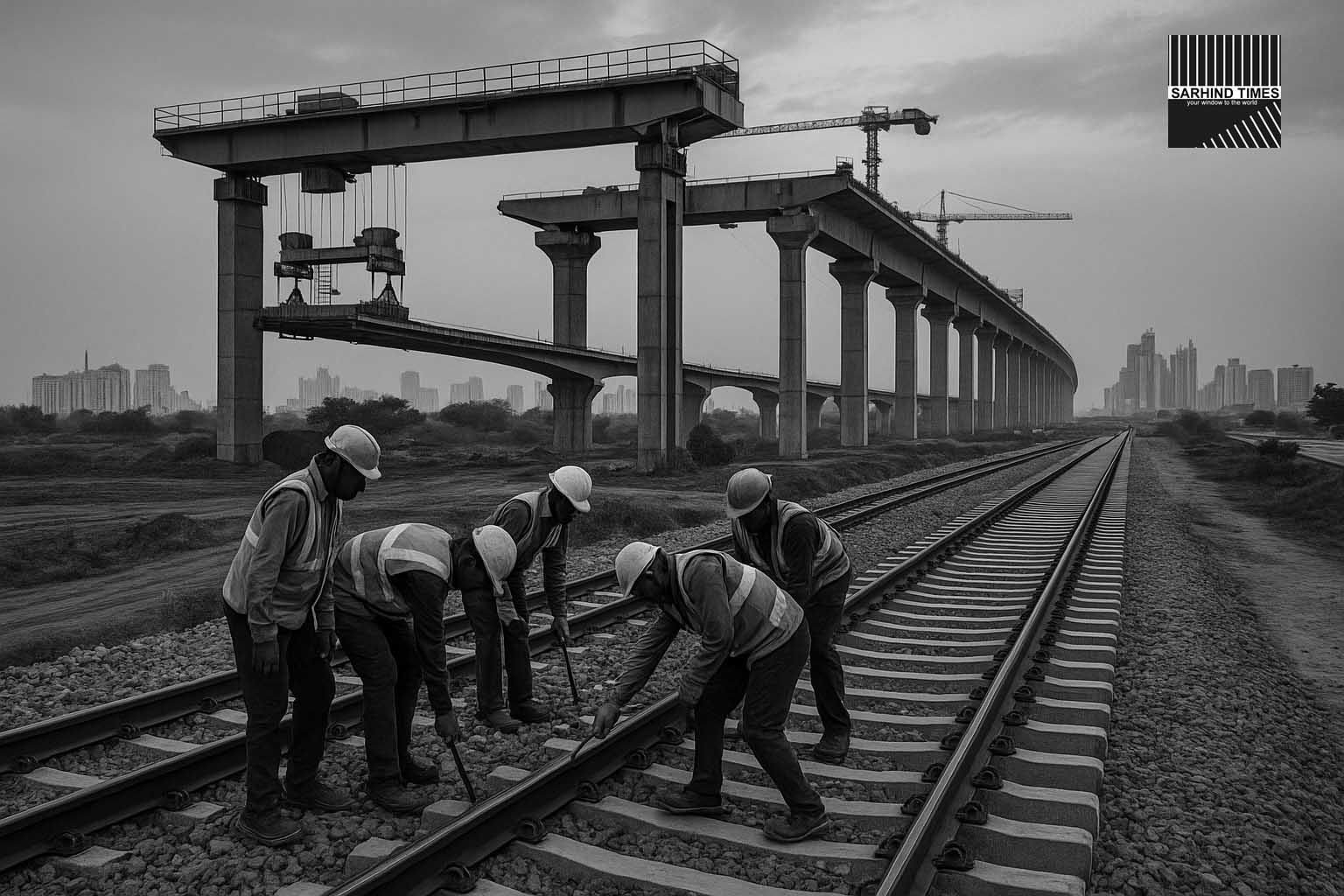
New ₹ 10,000-crore corridor through Gurugram aims to transform commuter access as the NCR region braces for boom
Dateline: Gurugram | 14 November 2025
Summary: The government of Haryana has formally launched the next phase of the Haryana Orbital Rail Corridor (HORC), which will loop from Palwal to Sonipat via Manesar and Gurugram, marking one of the largest transit infrastructure investments in the National Capital Region. With construction contracts awarded, land acquisition underway and targeted completion within five years, the corridor promises to alleviate congestion, integrate freight and passenger movement, and boost regional development, but execution challenges remain significant.
Background: Why this corridor matters
Gurugram’s rapid transformation over the past decade—from industrial belt to high-rise corporate hub and residential sprawl—has placed intense pressure on its transport systems. The city is part of the larger Delhi-NCR region, where commuting grids, suburban rail, expressways and metro extensions converge. But despite multiple transit options, analysts and officials agree that connectivity remains a bottleneck: traffic congestion, long commutes, inadequate orbital links and under-utilised rail corridors hamper productivity and quality of life.
Enter the Haryana Orbital Rail Corridor (HORC). The project is designed to run approximately 121.7 km from Palwal (south of Gurugram) to Sonipat (north), via key nodes such as Manesar, Kharkhoda and Sohna. It links with the Western Peripheral Expressway (WPE) corridor and is envisioned as a combined passenger-freight line that relieves both commuter loads and logistic flows.
State officials describe the corridor as a “game-changer” for Haryana’s industrial belt and the NCR region, enabling faster east-west connectivity, diverting freight trains away from central tracks, and unlocking economic zones near Manesar, Sohna and Gurugram.
Current update: What’s happening now
As of November 2025, the work schedule includes:
– Land acquisition completed or nearing completion for key packages through the Gurugram corridor (Sultanpur-Manesar-Patli segment).
– Contracts awarded for civil-works such as Package C23 (26.02 km Sultanpur-New Patli) and Package C1 (5.9 km Patli-Manesar) which reportedly completed initial structural work.
– Haryana’s rail authorities, in partnership with the state and central rail-mins, have begun the process of awarding larger packages and procurement of track systems, signalling the shift from planning to execution phase.
– The corridor is linked to the national rollout of the PM GatiShakti National Master Plan which emphasises multimodal transport and logistics integration; in its 101st meeting, the Network Planning Group reviewed this very corridor and supporting road-rail links.
– State budget-provisions and investor-briefings are underway, with estimates pointing to an investment envelope in the region of ₹ 8,000 to 10,000 crore for the Gurugram-centric segments, including ancillary road upgrades, stations and signal systems.
Why Gurugram sector was chosen and what’s the economic logic
Several drivers make the corridor especially relevant through Gurugram:
– **High commuter demand**: Thousands of daily commuters travel within Gurugram, to Delhi, and across Haryana. The orbital rail offers an alternative to radial metro/trains and congested highways.
– **Industrial and corporate concentration**: Manesar-Gurugram is home to major manufacturing, technology and export zones; improved rail connectivity supports workforce mobility and freight movement.
– **Real-estate and urban growth spill-over**: Better transit unlocks new residential and commercial nodes along the corridor, potentially de-pressurising saturated Gurugram micro-markets while shifting development to peripheral clusters.
– **Freight-passenger synergy**: The design allows for dual use—freight traffic can bypass central Delhi tracks, freeing capacity, while passenger trains serve new stations linking township-clusters.
– **Strategic infrastructure integration**: The alignment with the Western Peripheral Expressway and other links means land-value uplift, logistics clusters and transit-oriented development (TOD) opportunities.
Projected benefits and economic impact
The corridor is expected to deliver multiple benefits:
– **Reduced commute times**: For example, a commuter from Sohna to Manesar or from Palwal to Sonipat could cut journey times by 30-40 per cent compared to current options.
– **Relief of highway congestion**: A portion of passenger load will shift off NH-48 and other corridors that suffer peak-hour gridlock.
– **Freight de-congestion**: By diverting goods trains away from Delhi’s busy network, the line will free capacity and reduce transit cost for logistics operators.
– **Regional investment attraction**: Improved connectivity will attract new manufacturing units, IT parks and services hubs along the corridor, particularly in under-utilised zones like Sohna-Khurja, Kharkhoda and Manesar.
– **Employment generation and inclusive growth**: New stations, logistic hubs and associated industries will generate jobs in construction, operations, services and manufacturing over the next decade.
– **Real-estate uplift**: Peripheral nodes stand to benefit from “rail premium” effect—expectation of rising land-values, clusters near stations, growth of suburban towns.
– **Transit-oriented development (TOD)**: The project opens up the possibility of TODs with mixed-use hubs combining housing, offices, retail and rail access, thereby reducing vehicle dependency and enabling more sustainable growth.
Key challenges and risks ahead
Despite the promise, several hurdles must be addressed:
– **Land-acquisition and social impact**: Some segments still require acquisition or are in litigation. Delays here could stall packages and escalate cost.
– **Funding and cost over-runs**: Large rail projects often face budget creep; ensuring fiscal discipline and securing private participation (if any) will be critical.
– **Technical and construction complexity**: Elevated tracks, tunnelling (in the Aravalli section), signalling systems and station construction demand high-quality execution; any delays can ripple.
– **Coordination across agencies**: Multiple stakeholders—state government, national railway entities, NHAI, local municipalities—must align on design, land use, station planning and operations. Fragmentation can slow progress.
– **Ridership and revenue modelling**: The financial viability of passenger operations depends on ridership uptake, pricing, integration with other modes (metro, buses) and first/last-mile connectivity; over-optimistic forecasts can derail financial return.
– **Urban-environmental and regulatory hurdles**: Elevated track segments, station construction in urban areas and alignment through developed zones may face regulatory and social resistance.
– **Integration with existing transport networks**: For maximum utility, the corridor must link seamlessly with metro lines, bus networks, and new residential hubs; failure to do so reduces impact.
Implementation timeline and what to watch
Officials expect the corridor to become partially operational by 2028-29, with major segments through Gurugram commissioned by 2030. Key checkpoints include:
– Award of remaining civil-work contracts by mid-2026
– Completion of all land-acquisition by end-2026
– Station work and track-laying to commence from late-2026
– Pilot passenger services by 2028
– Full freight-passenger operations by 2030
Over the next 12-24 months, observers will watch progress on two specific indicators:
– Notification of package tenders and mobilisation of contractors
– Launch of last-mile connectivity plans around station precincts (mobility hubs, feeder bus services, parking, pedestrian access)
Policy and strategic dimensions
The corridor fits into broader national infrastructure strategy. Under the Prime Minister’s GatiShakti plan, India is emphasising multimodal connectivity, logistics efficiency and capital-intensive link-projects to drive growth. This rail corridor aligns with those goals and demonstrates a shift from simply building roads to embedding rail and inter-modal networks. (See the Network Planning Group review on 12 Nov)
On a state-level, Haryana’s policy push to de-centralise growth from Delhi, accelerate new townships, expand industrial parks and support corporate campuses in NCR South means transit infrastructure like this becomes foundational rather than optional. From a corporate real-estate investor’s lens, ease of access and logistics connectivity are becoming top decision-drivers—and this corridor responds directly.
What this means for businesses, real-estate, commuters and governance
– **Businesses** in Gurugram and its periphery should factor in the timeline of this rail corridor when locating offices, warehousing, parks and connectivity decisions.
– **Real-estate players** will look at station precincts as upcoming nodes. Residential and hospitality developers can consider future growth clusters around Manesar-Sohna-Kharkhoda.
– **Commuters and residents** may gain significantly in terms of lesser commute stress, improved access to work hubs, and better quality of life—but these benefits will only unfold gradually.
– **Governance and local bodies** must proactively align land-use, integrate feeder transport, build parking and bus networks, and coordinate urban planning around the corridor. Without that, the infrastructure risk is that the corridor becomes a “white elephant” rather than a catalyst.
Conclusion
The announcement of the Haryana Orbital Rail Corridor through Gurugram represents a pivotal moment in the evolution of northern India’s transport infrastructure. After years of congested growth and radial commuter flows, the shift to an orbital, multi-purpose rail line signals a maturity of vision—where transport corridors are not just for moving vehicles but for shaping regional economies, mobility patterns and urban form.
The potential is high—but so are the stakes. Execution will determine whether this transforms Gurugram and the NCR into a more connected, efficient and inclusive region—or whether ambitious intent becomes an extended project with limited everyday impact. For stakeholders from commuters to corporations, from developers to state officials, the time to lean in is now. The rails are being laid—but turning steel tracks into real-world relief, opportunity and smarter cities is the challenge ahead.



+ There are no comments
Add yours