
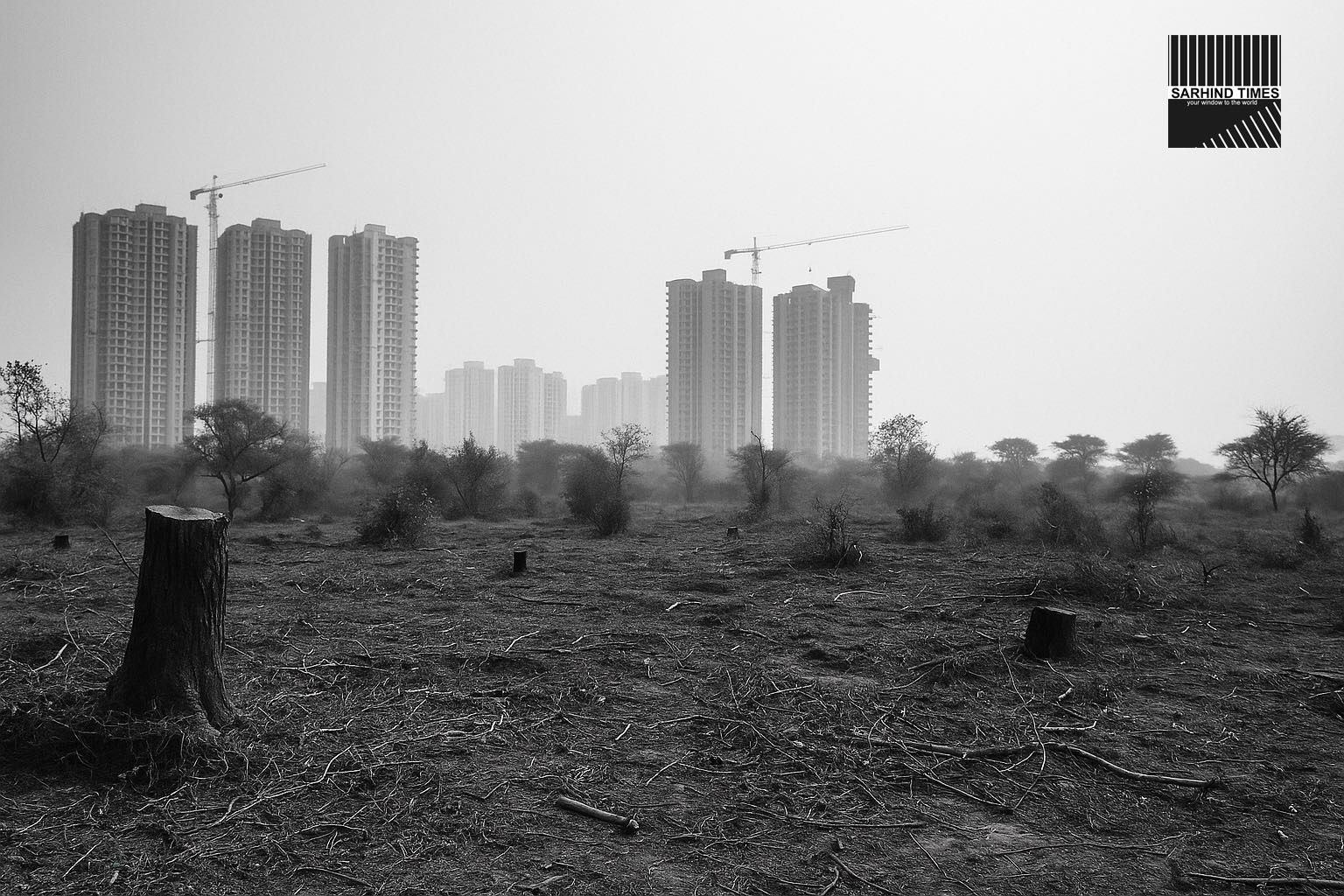
Data reveals continued shrinkage of green footprint amid agriculture, infrastructure pressures across state
Dateline: Gurugram / Chandigarh | 09 November 2025
Summary: The state of Haryana lost 32 hectares of natural-forest area and 12 hectares of tree cover in 2024, releasing an estimated 5.9 kilotonnes of CO₂ equivalent. While the absolute numbers appear minor, they mark a persistent downward trend: since 2001, the state has lost 440 hectares — about 1 per cent of its tree-cover baseline of 2000. The principal causes: agricultural expansion and infrastructure development, which together accounted for around 87 per cent of loss. The data highlights mounting pressure on fragile ecosystems such as the Aravalli Range foothills and raises questions on regulatory protection and ecological planning.
What the data shows
According to satellite-based monitoring from the global platform Global Forest Watch, Haryana recorded a loss of 32 ha of natural forest and 12 ha of additional tree cover in 2024. These combined losses resulted in an estimated emission of 5.9 kilotonnes of CO₂ equivalent. This amount is small in national context, yet the trend is telling: between 2001 and 2024 the state has shed approximately 440 ha of tree cover, which equals about one per cent of what the state had in 2000.
In detail the losses by district show that the most affected zones over the 2001-24 period include Panchkula (179 ha), Ambala (71 ha), and Yamunanagar (49 ha). The city of Gurugram itself accounted for 15 ha of tree-cover loss in that span. Agriculture accounted for 217 ha and infrastructure/settlements for around 40 ha — together about 87 per cent of cumulative loss.
These figures expose an underlying tension between state growth, urbanisation, infrastructure and ecosystem stability.
Why this matters for Haryana and Gurugram
Haryana is one of India’s smaller states in terms of natural forest cover — the legal forest cover is reportedly only 3.6 per cent of its land area, according to earlier assessments. The declining tree-cover erodes ecological resilience, undermines air-quality filtration, reduces groundwater recharge, and weakens biodiversity corridors. For Gurugram, a city experiencing rapid built-up growth and infrastructure pressure, the loss of even modest green patches contributes to cumulative environmental stress.
The Aravalli range and its allied belts—though not fully classified as legal forest land—play critical roles as ecological buffer zones against desertification, extreme heat, wind-erosion and habitat fragmentation. The decline in tree cover in Gurugram and adjacent districts serves as an indicator of creeping degradation, especially at the urban-peripheral interface.
Drivers of the loss
Several underlying factors emerge from the monitoring report and local commentary:
- Agricultural expansion: Farming remains the leading driver of tree-cover loss. Land formerly under scattered trees or small forest patches is converted to more intensive crop use. In Haryana, 217 ha of cumulative loss trace back to this root cause.
- Infrastructure and settlement growth: Leaning into highways, urban sprawl, warehouse parks, high-rise residential clusters and industrial estates — all consume land previously occupied by tree cover or marginal forests. Approximately 40 ha of cumulative loss is linked to these pressures.
- Unrecognised forest governance: Much of the Aravalli-fringe landscape lacks protection under the Forest (Conservation) Act because large swathes remain unrecorded as formal forest. That ambiguity weakens legal safeguards and allows land-use change to proceed more easily.
Regulatory and governance context
Haryana’s forest cover is rated among the lowest in the country, both in terms of area and legal recognition. According to some assessments, only 3.6 per cent of land is legally classified as forest, significantly below the national average. The lack of formal classification for many hill-fringe and Aravalli-adjacent areas leaves them vulnerable to encroachment, quarrying, illegal mining and conversion to non-forest uses.
Critics say the amendment to the state’s forest-laws in 2023 — which had sought to exclude “non-recorded forests” from protection and was later struck down in court — reflected systemic weaknesses in protecting marginal forests. Unless legal recognition and monitoring are strengthened, loss may continue quietly. In effect, these degraded zones act as green gaps rather than protected corridors.
The local picture in Gurugram
Gurugram district accounted for around 15 ha of cumulative tree-cover loss since 2001. Given the magnitude of construction, high-rise expansion, and infrastructure corridors in Gurugram, even small losses here amplify local heat-island effect, reduce urban green buffer, and stress drainage, micro-eco systems and local biodiversity.
Local resident-groups in Gurugram report seeing small patches of trees being cleared, shifting use of plots for clubhouses, private parking, or warehouses, and deterioration of green belts. While these may not show up in headline figures immediately, such incremental degradation adds up.
State-forest department data indicates that while major afforestation drives continue, the growth of tree cover is not necessarily compensating for the specific ecological functions lost when natural forests or diverse tree clusters are removed.
Climate and carbon dimensions
The loss of 44 ha tree cover in 2024 represents roughly 5.9 kilotonnes of CO₂ e emissions. While this is a modest number in the national climate-accounting framework, it underscores how small-scale losses add up across time and geographies. In a state seeking to support climate-resilience and contribute to national emission-goals, each hectare counts.
Moreover, ecosystems function non-linearly: the removal of trees in ecologically sensitive zones triggers erosion, reduces soil moisture, increases runoff, reduces carbon-sequestration capacity, and may compromise local micro-climates. These effects are particularly relevant in high-growth zones like Gurugram where urban heat, water-stress and environmental risk are imminent.
Impacts on biodiversity, water, heat stress
From an ecological viewpoint, the loss of even small forest patches has medium to long-term effects:
– decline of urban wildlife corridors and reduction of habitat connectivity;
– increased soil erosion, especially in slopes and hill-fringe zones;
– less groundwater recharge and higher surface-runoff, affecting both rural and urban hydrology;
– aggravation of urban heat-island — less shade, fewer transpiration cooling effects;
– degraded air quality: fewer trees means fewer pollutant-filtration opportunities in fast-growing urban clusters.
What officials say
Forest-department officials note that the fall in fire-alerts is a positive sign: high-confidence fire alerts in 2025 fell to around 115 incidents compared to a peak of 727 in 2013. This indicates improved fire-control, but officials concede that structural land-use change remains the bigger issue now. The focus is shifting from battling fires to preventing conversion of green areas for agriculture, industry or infrastructure.
A senior officer stated: “Our goal now is no longer only to stop tree-fires. We must ensure that the categorisation, mapping and legal recognition of forest-fringe land is complete, so this green belt doesn’t become a silent casualty of growth.”
Initiatives and plans in motion
Haryana has several initiatives underway: expanded plantations along city-peripheries, agro-forestry outreach, smart-tree-monitoring using remote-sensing, community-forest committees and restoration of degraded patches. In Gurugram the civic body and forest department are planning a “Green-Buffer” project along highway corridors, with native-species planting and soil-moisture retention landscaping. While these are promising, critics say they need to match scale and pace with the rate of growth and conversion.
Why this is worrying despite scale-up of green efforts
Firstly, not all tree cover is equal. While plantation drives and afforestation help, natural forests have far higher ecological value in biodiversity, soil stability, hydrology and resilience. Replacing natural fragments with monoculture plantations or roadside trees does not fully compensate for the loss.
Secondly, legal and monitoring mechanisms lag behind: land-use approvals, clearance systems, mapping of un-recorded forests remain slow. Thirdly, urban-frontal growth in districts like Gurugram is accelerating; unless green-belt protection is proactive, loss will continue to outpace gains. Fourthly, climate change amplifies risk: heat-waves, erratic rainfall, unplanned urban growth—all make the remaining green cover more critical, not less.
Looking ahead: what needs to change
For Haryana to turn the corner on forest and tree-cover loss, the following must be prioritised:
- Accelerate legal classification of marginal and un-recorded forest patches, especially in the Aravalli foothills and peri-urban zones, bringing them under formal protection.
- Strengthen land-use governance: ensure that agriculture-expansion and infrastructure approvals incorporate ecological-impact assessments, and require compensatory afforestation that is measurable and monitored.
- Focus on restoration of degraded forest fragments, not just new plantations—meaning better soil, native species, and biodiversity focus, especially in fringe zones like Gurugram.
- Enhance monitoring using remote-sensing and citizen-science, combined with enforcement: tree-cover loss should trigger rapid action rather than delayed response.
- Integrate urban-growth planning with green-belt optimisation: in Gurugram the high-density growth must incorporate corridors, tree-canopy targets and limits on conversion of novel green pockets.
- Improve public awareness and accountability: local residents, housing societies and corporates should be engaged in protecting tree-cover and flagging small-scale loss events early.
Conclusion
While Haryana’s headline figure for forest-cover loss may appear modest in aggregate, it reflects deeper undercurrents: rapid growth, shifting land-use, and weak classification of ecological land. For states like Haryana — where forest area was already low — each hectare counts. The fact that agriculture and infrastructure dominate the loss-drivers points to a need to manage growth smarter.
For Gurugram as the frontline city of growth, this means balancing the ambition of built environment with the imperative of ecological buffer. Growth cannot proceed at the expense of the thin green margin.
The data is a warning signal: the gains from plantation drives and afforestation will not compensate if natural forest fragments continue to shrink quietly. With climate impacts rising, ecological shocks more likely and urban stress intensifying, preserving and restoring tree-cover and forest patches is not optional—it is essential.
The time to act is now.



+ There are no comments
Add yours