
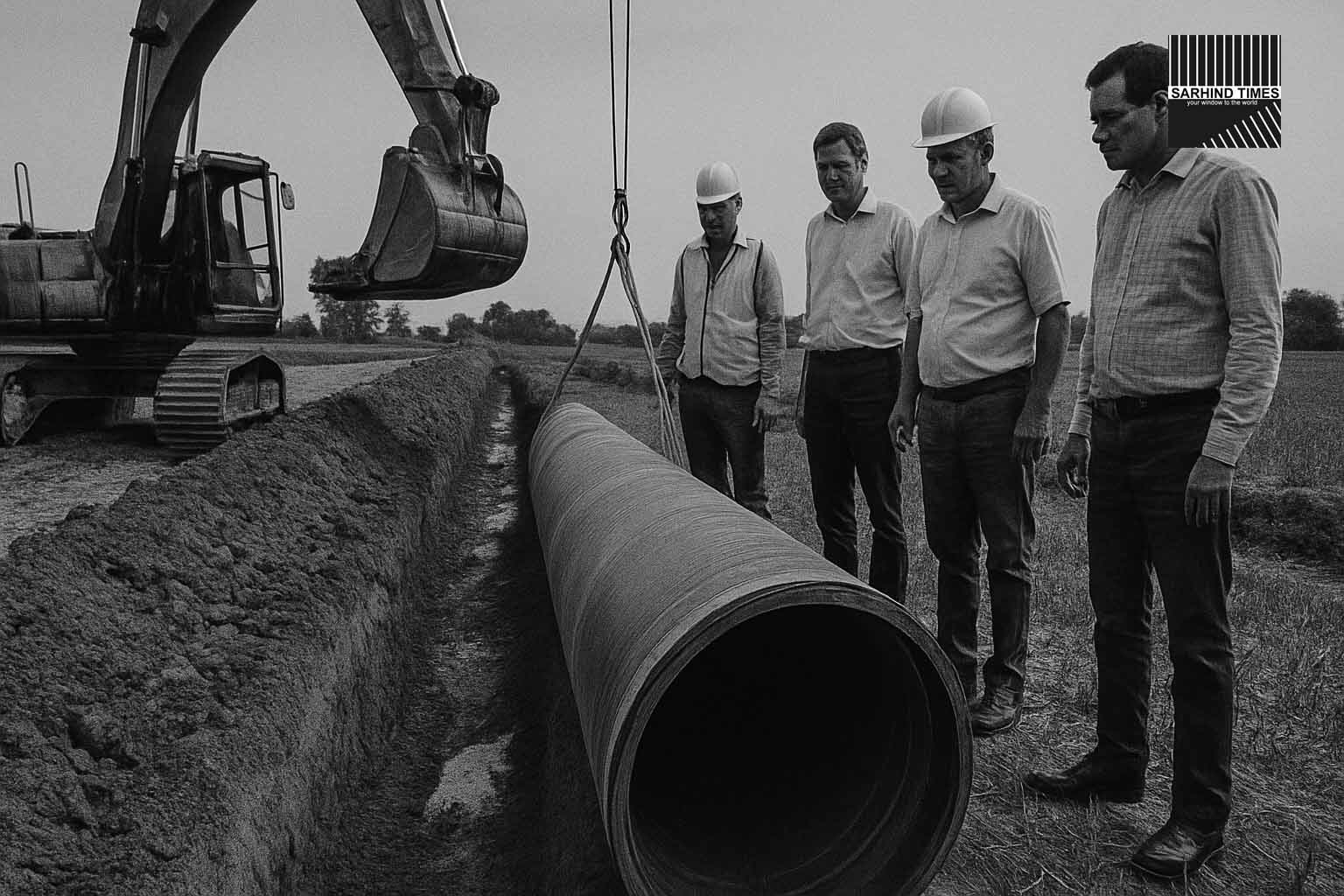
Massive investment drive aims to link rural, peri-urban and industrial areas through high-capacity pipelines, boosting both drinking-water access and agricultural productivity
Dateline: Chandigarh | November 26, 2025
Summary: The Government of Haryana has announced a major infrastructure package valued at ₹18,000 crore aimed at building an integrated water-supply and irrigation network across the state, with priority given to fast-growing districts such as Gurugram. The plan features the construction of high-capacity trunk pipelines, new storage reservoirs, supply-link upgrades to peri-urban sectors and targeted agricultural irrigation interventions — signalling the state’s intent to address rising water-stress even as urbanisation accelerates.
Why Haryana is Making the Move
Haryana is undergoing rapid transformation — especially in districts like Gurugram and its periphery — from agrarian hinterlands into sprawling economic and residential satellites of the National Capital Region. This transition presents escalating pressures on water supply, agricultural irrigation and infrastructure resilience. The newly announced ₹18,000-crore scheme seeks to pre-empt some of these stresses by creating an integrated water-supply and irrigation architecture, rather than piecemeal upgrades.
The state government’s rationale is anchored in two inter-linked challenges. First, shifting water-demand patterns: as rural settlements convert to residential colonies, industrial estates and logistics parks, the traditional canal-and-well system of Haryana is no longer enough. Second, climate variability and groundwater depletion have combined to raise risk levels. Water tables in several districts have dropped significantly; rainfall patterns are increasingly erratic; and peri-urban agricultural zones are squeezed between urban expansion and vanishing irrigation support.
In his announcement, the Chief Minister emphasised that this investment signals Haryana’s move “from traditional tubewell and canal models to a 21st-century pipeline-grid that links villages, new residential sectors and industrial zones through a smart-network.” He added that the goal is to ensure “safe, reliable and equitable water access” across all zones – urban, peri-urban and rural — over the next 10 to 12 years.
What the Programme Will Build: Key Components
The infrastructure package has multiple components, which together form a cohesive water-system strategy:
- High-capacity trunk pipelines: Several new pipelines of 1.2–1.5 metre diameter will be laid to connect major water-source storage units in western and southern Haryana with fast-growing districts such as Gurugram, Rewari and Faridabad. These pipelines will bypass older, inefficient systems and deliver bulk supply at higher pressure and reliability.
- Storage reservoirs & balance tanks: The plan includes the creation of additional 30 large reservoirs with capacity ranging from 5–15 million cubic metres each, acting as buffer zones between sources (canals, river lifts, groundwater recharge sites) and supply networks. These will ensure continuity even in dry spells or maintenance shutdowns.
- Peri-urban supply upgrades: Recognising the fast-changing landscape of areas such as Gurugram’s outer sectors, the scheme proposes dedicated supply lines to industrial estates, logistics hubs and residential pockets transitioning from rural to urban. This means separate metering and prioritised allocation instead of treating all areas under one rural scheme.
- Irrigation grid enhancements: Using the same corridor, the state plans to dual-use the pipeline network for agricultural supply in selected zones. This includes modernising canal off-takes, replacing open-channel distribution with piped delivery for farms adjacent to urban-fringe zones, thus reducing evaporation losses and improving efficiency.
Focus Zones: Why Gurugram Features Strongly
Gurugram district, due to its high growth rate, peripheral expansion and shifting land-use patterns, has been identified as an early priority within the package. The state’s announcement highlights that one of the new trunk pipelines will enter the district from the south, linking to existing canal-lift zones and bypassing bottlenecked portions of the KMP-expressway corridor. The aim is to support both residential colonies and industrial estates located in the Bilaspur-Udaypuri-Bhondsi belt.
Officials projecting the district-specific allocation say roughly ₹1,200–1,500 crore of the scheme will be earmarked for Gurugram over the initial two years — used for metering upgrades, reservoir augmentation, supply line replacement and installation of smart-monitoring sensors. Local municipal bodies and the urban-fringe management authority will participate in joint execution, ensuring water supply in new residential sectors keeps pace with housing growth.
Financing, Execution and Timeline
The funding model is a hybrid—comprising state budget allocations, special infrastructure bonds and credit lines from multilateral development banks. Some portion of the funding (≈30 %) may also be sourced through public-private partnership models where distribution networks are privatized or operated via service contracts. The government expects phased roll-out over five years (2025-30) for the initial network, with full completion by 2032.
Execution will be managed by the state’s newly formed ‘Integrated Water Infrastructure Cell’, housed within the Public Works Department and co-ordinating with HUDA, town-planning departments, irrigation and utility agencies. A digital dashboard will track kilometre-wise progress, cost-variance, leak-reduction indicators and user-satisfaction metrics. Once fully live, the system aims to reduce non-revenue water (NRW) — i.e., lost water through leaks or theft — from current levels of ~40 % in some peri-urban zones to under 25 %. It also aims to reduce average supply pressure drop-outs from ~18 hours per day to uninterrupted 24-hour supply in major new residential zones by 2030.
Who Benefits — Social, Economic and Environmental Angles
From a social-equity standpoint, the plan addresses supply disparity between burgeoning new colonies and older settled zones. Many new residential sectors around Gurugram suffer from intermittent supply, low pressure, reliance on private‐tankers and informal providers. By upgrading the institutional network, the government hopes to eliminate that gap.
Economically, the state’s logistics and industrial base depends heavily on reliable water availability —especially in manufacturing clusters and warehousing zones. Unreliable supply adds to cost, risk and vulnerability for businesses. This scheme therefore has an industrial angle as well as a civic one. It signals that Haryana sees infrastructure investments not just as citizen service but as a competitive advantage for investment and growth.
Environmentally, dual-use of the network for irrigation alongside supply allows water-use efficiency. Reduced dependence on bore-wells and groundwater extraction forms a key aim. If a significant portion of farms in the peri-urban zone adopt piped delivery instead of bore-wells, recharge pressures will ease and groundwater tables may stabilise — important in districts like Gurugram where over-extraction is acute.
Challenges and Risks to Implementation
There are several hurdles to converting announcement into impact:
- Land and project corridors: While greenfield pipelines avoid many acquisition issues tied to roads, new rights-of-way still require clearances, coordination across departments, and sometimes relocation of utilities and minor‐property holders. Delay could push back early roll-out phases.
- Operational sustainability: Large infrastructure networks require robust maintenance, monitoring and asset-management frameworks. Some previous water-schemes in the state have faced high non-revenue water levels due to leaks, theft and insufficient system pressure. Without preventive maintenance and digital monitoring, outcomes may under-deliver.
- Demand-side management: Upgrading supply is one part; managing demand, reducing wastage, metering and ensuring tariff reforms are equally essential. Without demand control, new pipelines may simply carry faster leaks or higher waste rather than better service.
What to Watch Over the Next 12 Months
The success of the initiative will hinge on several early-stage indicators:
- Issuance of tenders and award of contracts for at least two trunk pipelines entering Gurugram suburbs by Q2 2026.
- Creation and inauguration of at least one new reservoir in the peri-urban belt of Gurugram by Q4 2026.
- Deployment of smart sensors and digital dashboard interface for at least five residential sectors in Gurugram monitoring supply pressure and leak-detection by mid-2026.
- Demonstrable reduction in non-revenue water (NRW) by at least 5 percentage points in a pilot sector of Gurugram by end-2026.
Conclusion: Big Ambition, Good Direction — But Delivery Still Key
The ₹18,000-crore integrated water-supply and irrigation network initiative announced by Haryana is ambitious and strategically aligned with both civic and economic priorities. For Gurugram and other fast-expanding districts, it signals recognition of the water-challenge that accompanies growth. If implemented well, the upgrade could transform local service delivery, productivity and environment. Yet the magnitude of the task means execution will be the real test — from land-corridor clearance to maintenance culture, from demand-side control to digital monitoring. As the plan moves from paper to pipeline, the citizens, industries and farms of Haryana will be watching closely.



+ There are no comments
Add yours