
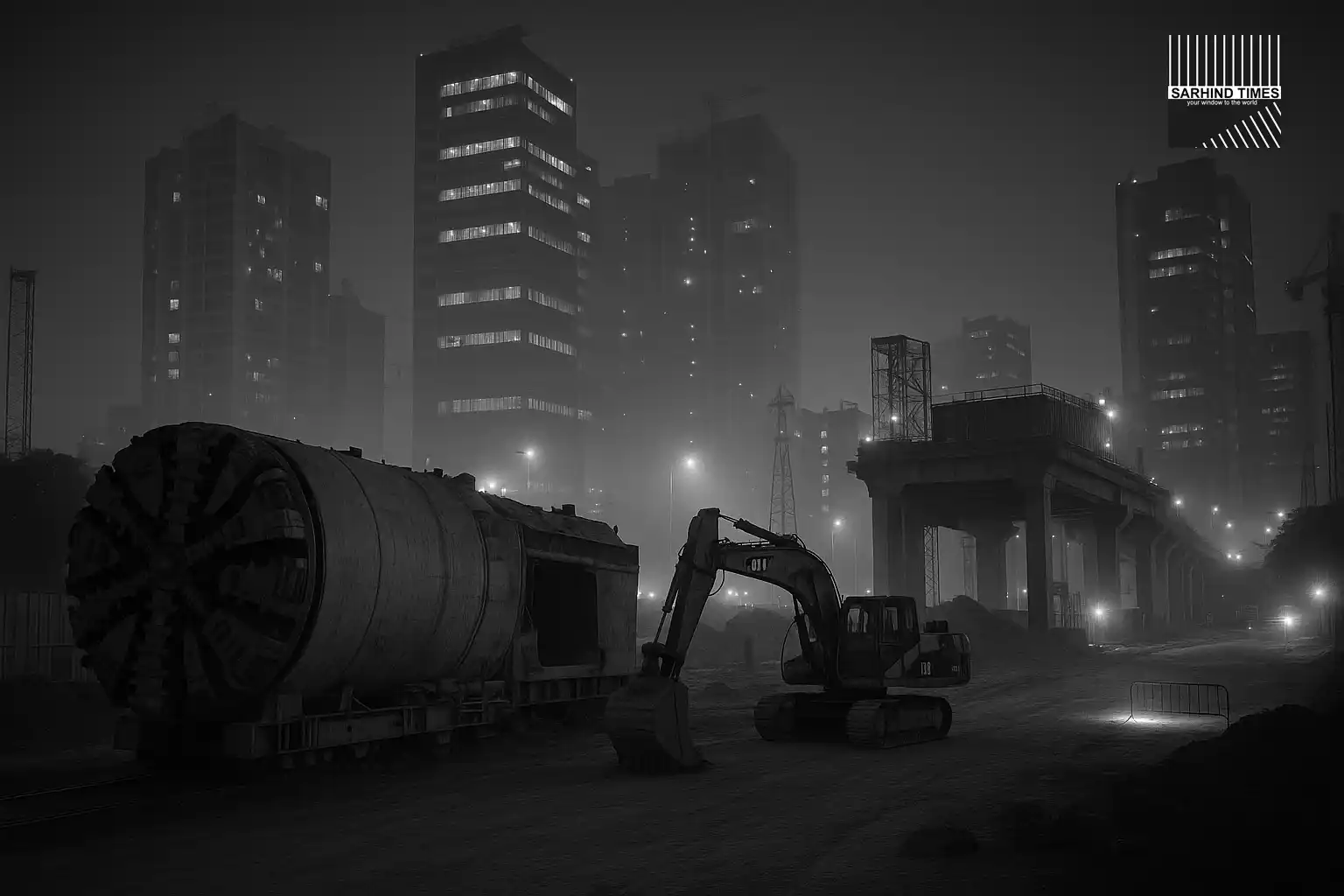
Major redesign for a planned 28-km corridor in Gurugram reshapes urban mobility ambitions
Dateline: Gurugram | 31 October 2025
Summary: The planned Phase 2 of the Gurugram Metro may shift from an elevated to an underground alignment, potentially doubling costs and delaying completion. The decision, under review by Haryana Mass Rapid Transport Corporation (HMRTC), signals a major shift in the region’s connectivity strategy, in light of land-acquisition issues and dense urban zones.
Introduction: Ambitions meet realities
City of Gurugram (formerly “Gurgaon”) stands at the edge of a transport revolution. As corporate towers, residential sectors, and industrial hubs push the city’s boundaries outward, the demand for rapid transit connectivity has surged. The planned Metro Phase 2 — initially conceived as an elevated corridor — is now under reconsideration for an underground alignment, raising cost, complexity and timelines. This development underscores the challenges of urban infrastructure in one of India’s fastest-growing cities.
The original plan envisaged a 28-km elevated corridor slicing through the city’s New Gurugram zones and connecting major transit nodes. According to media reports, the redesign could nearly double costs owing to tunnelling, advanced safety systems and the need to navigate densely settled sectors. For residents, commuters and investors, this matters: it will affect when they see the metro, how much fare/subsidy might be required, and how seamless connectivity becomes between work, home and transit hubs.
Timeline and scope of Phase 2
The plan for Phase 2 — as described in public documents and media reports — spans approximately 28 km (some reports vary) and was to link new sectors, industrial parks, residential zones and transit interchanges. The corridor’s alignment aimed to alleviate traffic pressure on arterial roads and support the city’s growing population and employment centres.
Sources say HMRTC is now re-working the alignment, possibly shifting large segments underground to reduce surface disruption, land acquisition needs, and interface with existing city infrastructure. The current stage involves feasibility studies, budget re-estimates, and discussions with the state government regarding financing and timeline changes.
Why the redesign is on the table: key drivers
Several factors have prompted the rethink:
- Land acquisition hurdles: Elevated corridors require clear linear strips over long distances; in a dense and expanding urban zone like New Gurugram and Manesar peripheries, acquiring large swathes is risky, expensive and delay-prone.
- Minimising surface disruption: Elevated tracks, pillars, station footprints affect traffic, businesses, and utilities. Underground alignment allows less interference with roadways, existing structures and traffic flow, albeit at higher cost.
- Better integration with existing rail/metro nodes: The underground option helps integrate with mainline railways/metro hubs with less elevation change, fewer escalators and more seamless interchanges.
- Urban aesthetic and land-use concerns: Elevated viaducts are often seen as visually intrusive in modern urban precincts; underground corridors free up surface land, reduce noise and enhance urban planning flexibility.
Cost, delays and financial implications
According to the media, shifting to underground may nearly double the corridor cost from initial estimates. The additional tunnelling, advanced signalling, ventilation, fire-safety systems, station build-outs and risk mitigation drive up expenditure.
Delays are another implication. Underground construction, especially in mixed soil, high water-table or built-up zones, can face unexpected challenges — geological surprises, utility relocation costs, tunnel-boring problems, and requirement for stricter safety/regulatory clearances. Projected timelines may slip by 12–24 months or more depending on scope changes.
Financing this spike in cost becomes a policy question. Will state government, central government, or public-private participation absorb the extra? Will the fare structure get impacted? Will taxes/subsidies rise? These decisions will determine economic viability of the corridor and its long-term sustainability.
Expected benefits if implemented well
Despite the cost and delay risks, the underground alignment offers significant potential upsides if executed properly:
- Improved last-mile connectivity: An underground corridor passing nearer to high-density zones can reduce walking and feeder needs, making metro usage more viable for suburban residents.
- Reduced road traffic and pollution: By enabling more commuters to shift from cars/taxis to metro, there may be measurable reductions in congestion, emissions and dependency on fossil-fuel-based commuting.
- Land-value uplift: Areas near metro stations tend to see property value appreciation, mixed-use development, increased business and commercial activity. For a city like Gurugram, still expanding into New Gurugram and Manesar periphery, this could catalyse growth.
- Urban integration and resilience: Underground systems are less vulnerable to surface roadworks, traffic disruptions or weather extremes; from a systemic perspective, they enhance resilience of the urban transit network.
Risks and challenges ahead
However, the path is far from straightforward. Key risks include:
- Cost-overruns and debt burden: If costs escalate beyond projections, the financial model may strain state resources or require higher fare/subsidy than desirable.
- Execution complexity: Tunnel work in urban zones often involves unforeseen risks — underground utilities, water-table issues, contractor disputes, safety concerns, and citizen lawsuits about disruption.
- Time slippage and service delay: Residents and businesses may have to wait longer for the metro relief they expected; that could erode public trust and delay the traffic relief or property-value uplift.
- Interim disruption: Construction over 2-3 years may severely disrupt surface traffic, access roads, local businesses, creating a temporary negative impact on quality of life.
- Integration with other transit systems: It’s not enough to build the corridor; seamless interchanges, feeder services, multimodal integration (e-buses, bikes, pedestrian links) matter. If these are weak, ridership may suffer.
- Ridership and fare-box revenue risk: With high cost, fare levels may need to be higher, or subsidies larger — both have fiscal implications. If ridership falls short of projections, the financial returns could be weak.
Context: Gurugram’s infrastructure and mobility background
Gurugram is part of the Delhi-NCR cluster and has grown rapidly as an IT/ITES and corporate hub. Residential sectors have expanded, commuting patterns have grown more complex, and pressure on road networks has increased. The planned metro zones, expressways and transit upgrades reflect the need to manage these flows.
For example, the reports indicate that the DWARKA EXPRESSWAY and other major corridors have greatly influenced real-estate decisions in Gurugram. Meanwhile, an earlier report flagged serious maintenance issues on a key 2.8-km link between Dwarka e-way and Kehrki Daula Toll Plaza – highlighting that while new infrastructure is planned, existing assets need upkeep.
In this context, the Metro Phase 2 redesign comes at an inflection point. The city needs large-scale transit intervention, but the demands and risks are equally large. The HMRTC’s decision to revisit the model is therefore understandable, though the cost and delay trade-offs will have major implications.
Stakeholder views and reactions
Government officials see the change as necessary and forward-looking. A HMRTC spokesperson (off-the-record) said the underground option was considered because “the elevated route faced land-acquisition bottlenecks in dense sectors and would have caused major disruption to residents and traffic”. The spokesperson added that the state is still evaluating cost-benefit and will present a final route, cost and timeline “within the next quarter”.
Resident welfare associations (RWAs) in New Gurugram have mixed views. One RWA leader commented: “We welcomed the metro plan because it promised direct connectivity and property-value uplift. But delays and cost-escalation worry us — what good is infrastructure if it’s late by years or cost so much that fares become unaffordable?” The comment reflects resident impatience with long project timelines and rising property valuations without commensurate delivery of infrastructure.
Real-estate developers and investors, however, are broadly positive. A developer active in Sector 102–113 corridor said: “Connectivity is the key driver now. If the Metro actually comes, underground or above, the price horizon for this corridor will shift. The investment bets are already being made.” These stakeholders emphasise that the “when” matters almost as much as the “what”.
Implications for property market and urban planning
From a property-market perspective, the redesign has multiple implications:
- Acceleration of value in adjacent sectors: Areas earmarked for stations, especially if underground, may see early picks by investors anticipating “first station” effect.
- Supply pipeline pressures: Developers develop ahead of connectivity; sequence matters. If metro delays, there could be overhang of supply and slower price appreciation.
- Urban sprawl vs densification debate: The metro can enable higher-density infill near stations (transit-oriented development) or push farther sprawl if not managed. The underground option gives more flexibility for station location near existing built-up fabric.
What to watch: upcoming milestones and decision points
Key milestones ahead include:
- Submission of revised DPR (Detailed Project Report) including revised alignment, cost estimates and funding sources.
- Approval from the state government and central nodal agency (if central funding required) including any changes in viability gap funding, loan/grant mix or PPP structure.
- Environmental clearance and geotechnical surveys for underground sections (if selected) — these can take time and may trigger public hearings.
- Contracting strategy: choice of route (underground vs elevated) will influence contractor selection, risk sharing, payment mechanisms, timelines, cost escalation clauses.
- Integration plan: how feeders, last-mile connectivity, multimodal hubs, parking and commercial development around stations will be designed.
- Monitoring and transparency: given past concerns around infrastructure execution in Gurugram, timely disclosure of work-progress, audits, and citizen accountability will matter.
How this fits broader state and national goals
The metro redesign aligns with larger policy aims. The state of Haryana is promoting new-city development, infrastructure upgrades and mobility solutions to support its smart-city and growth corridor ambitions. From frameworks such as the “Haryana Urban Transport Improvement Programme” to national schemes promoting metro expansion, this project signals the region’s push to keep pace with the 21st-century urban mobility model.
At a national level, efficient urban transit reduces private-vehicle dependency, thereby cutting emissions, energy use and congestion — all key in India’s climate and growth narrative. A well-executed metro in Gurugram would enhance the NCR transit mesh, contribute to reduced travel times, and improve regional integration with Delhi, Faridabad, Manesar and beyond.
Risks for commuters and citizens
For everyday residents and commuters, the risks are material. A delayed metro means continued traffic congestion, longer commute times, higher fuel and maintenance costs, and poorer living-work balance. If costs are passed onto commuters in the form of higher fares, equity concerns emerge — low-income workers may be marginalised.
If construction disrupts roadways and services for years without clear mitigation, quality of life may degrade temporarily. For example, earlier reports highlighted surface road maintenance problems on the Dwarka e-way link between Kehrki Daula and Gurugram—drawn from legacy infrastructure neglect.
Conclusion: balancing ambition with execution
The shift of Gurugram’s Metro Phase 2 from elevated to underground reflects a mature recognition of urban constraints, land-use complexity and the need for resilience. However, ambition must be matched with execution discipline. Cost, timeline and funding pathways must be transparent and manageable. The next 6-12 months will be crucial: if the re-design is finalised, DPR approved, and contracts let, then residents and businesses may begin to see light at the end of the tunnel (literally).
For Gurugram’s growth story to remain credible, infrastructure like this cannot just be announced — it must be delivered. If done well, the new metro corridor could become a model for transit-oriented growth in India’s fast-expanding satellite cities. If done poorly, it risks becoming another behind-schedule, over-budget project. Time will tell which path Gurugram chooses.



+ There are no comments
Add yours