
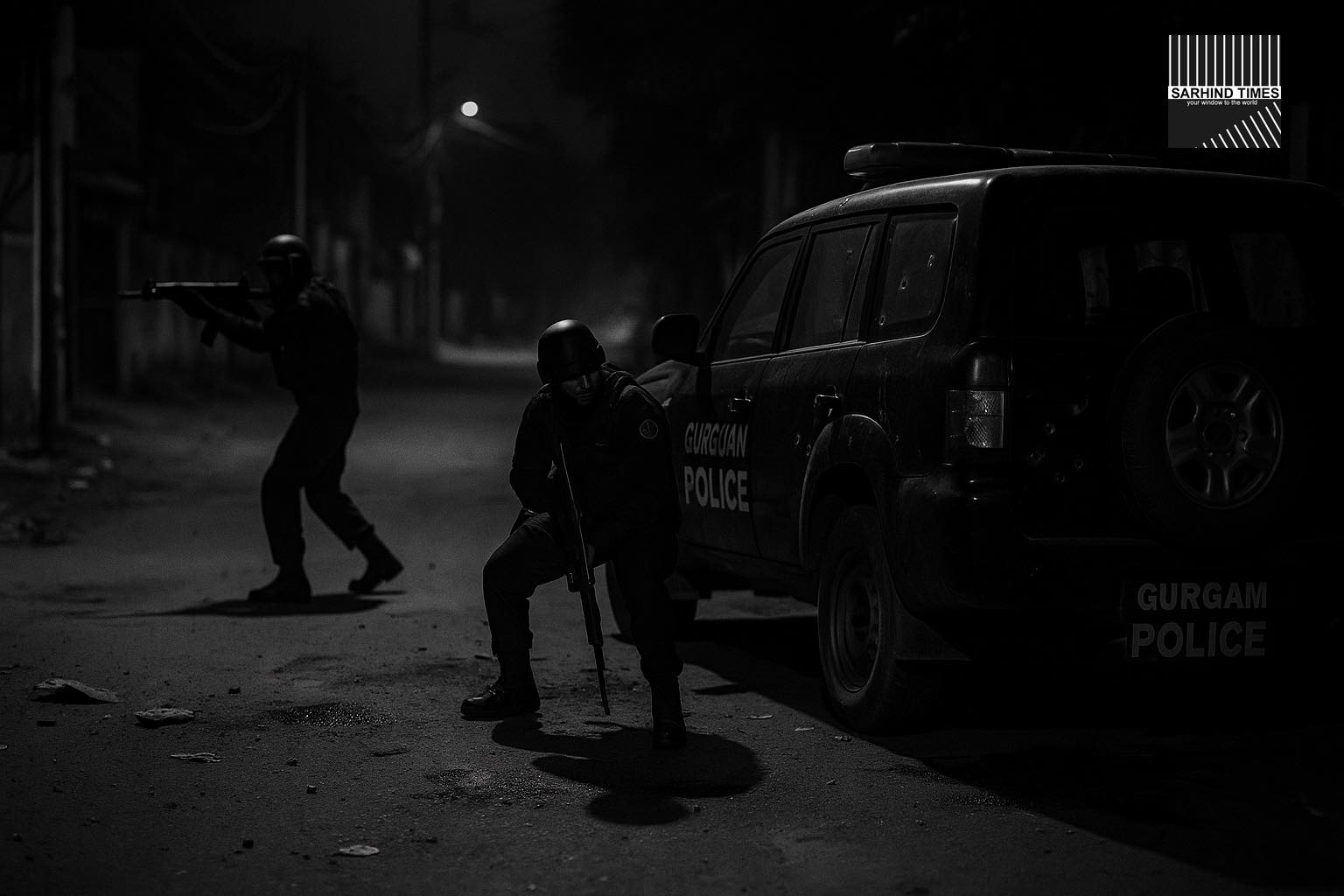
High-risk confrontation signals rising cross-state gang activity and law-enforcement responsiveness in Gurugram
Dateline: Gurugram | 4 November 2025
Summary: Two alleged members of the notorious Bambiha gang were arrested in a dramatic shootout with the Gurugram Police on Umarpur Road, firing seven rounds before being wounded and captured—an incident that underscores the deepening nexus of cross-state criminal networks, arms proliferation and local policing challenges in the NCR region.
The confrontation: what took place
In the pre-dawn hours of a recent morning in Gurugram, a specialized team of the Gurugram Police’s Crime Branch intercepted two suspects affiliated with the Bambiha Gang—a criminal outfit with strong roots in neighbouring Punjab—on Umarpur Road, an arterial route in the city’s southern periphery. According to police reports, the duo opened fire, unleashing a volley of seven rounds at pursuing officers before being shot in the legs and taken into custody. The incident has set off alarm bells within local law enforcement and city governance, pointing to evolving threats and prompting questions about preventive strategy.
The suspects, both men with multiple outstanding criminal cases in Punjab, were quietly trailed for several days before being located in Gurugram. The operation was carefully planned, executed by a combined team of the Crime Branch and special task‐force units, and ultimately led to the wounding and arrest of both individuals. Initial forensics indicate that the firearm recovered is likely a high-calibre weapon—raising concerns about availability of heavy arms in the city’s underworld.
Why this matters: cross-border crime in the NCR
The arrest of two gang-members from a Punjab-based outfit within Gurugram’s limits points to a growing trend: the migration of outlawed groups and individuals from one state into neighbouring jurisdictions seeking safe havens, easier mobility and lower detection risk. Gurugram’s location within the National Capital Region (NCR) gives it a degree of strategic importance for such groups—they can exploit major highways, real estate pockets, logistics zones and proximity to Delhi for quick transit.
Some law-enforcement analysts say this shootout is symptomatic of a deeper issue: the breakdown or bypassing of inter-state coordination in policing and intelligence. When a gang member escapes one jurisdiction, they often re-locate to nearby urban zones where enforcement might be weaker or contractual ties looser. Gurugram—despite being a development hub—has zones that still retain semi‐urban or peri-urban characteristics, offering potential cover for hiding or transit.
Arms proliferation and the nature of the weaponry
Central to this incident is the fact that seven rounds were fired at officers—indicating both willingness and capability to engage heavily armed confrontation. For city police, such violence within a relatively populated zone marks an escalation compared to brawls or small-arms incidents.
The recovered weapon is currently being examined, but preliminary indications suggest it could be a 9 mm or larger bore. The use of such weapons raises questions about traces of arms trafficking—how these firearms entered the city, whether they are locally sourced, smuggled from neighbouring states, or supplied via networks that move between Punjab, Haryana and Delhi. This incident will inevitably prompt a review of arms‐intelligence capabilities and tracking of illegal weapons chains.
Local policing response and tactics
The Gurugram Police’s swift response is notable: to carry out the interception, operate in a high-risk environment, and successfully bring the perpetrators into custody with minimal collateral damage. Police sources indicate that the team had been monitoring the movement for several nights and leveraged traffic surveillance, informant leads and covert observation.
Yet this incident also reveals gaps. For example, the suspects were able to operate within the city undetected for a period and fire multiple rounds before being contained. While the outcome was successful, the delay in detection, the initial escape attempt, and the use of heavy arms point to improvement areas in city policing, intelligence sharing, and metropolitan coordination.
Community impact and public perception</ >
For residents of Gurugram—many of whom live in gated societies, high-rise apartments and business hubs—the notion that gang violence of this nature unfolded on a city roadway is unsettling. The incident erodes perceptions of safety and raises questions about whether such rapid-growth urban zones have built enforcement and surveillance infrastructure at pace with their physical expansion.
Local homeowners, society associations and resident welfare forums have begun voicing concerns. Some are calling for enhanced police presence, better street lighting in peripheral roads, improved CCTV integration and rapid incident alert systems for crossings that sit between industrial belts and residential enclaves.
Broader gang strategy and emerging patterns
The arrestees’ affiliation with the Bambiha gang offers clues into criminal evolution. In recent years, the gang has moved beyond traditional turf crime in Punjab—extorting, trafficking, and establishing linkages into inter-state cities. The movement into Gurugram could suggest a strategy of diversification: urban logistics hubs, high-value assets, mobility corridors and real-estate adjacency might all serve as new grounds for revenue. It is plausible the gang was using the city as a staging ground, safe house location or transit point.
More broadly, firms and analysts are now tracking how gangs partner with semi-legitimate operations—transport services, rental accommodations, logistics firms—to mask movement and money flows. That this shootout occurred on a mainstream city road rather than deep in a rural hinterland reflects the shifting geography of serious crime.
Law-enforcement coordination and inter-state links
One of the key take-aways from the incident is the necessity for inter‐state intelligence and enforcement coordination. When suspects with cases in Punjab relocate into Haryana and operate in Gurugram, timely information sharing is critical. Agencies such as the state police forces, Crime Investigation Departments (CID) and the National Investigation Agency (NIA) frameworks must ensure that e-watch lists, bullet‐match databases, arms tracking logs and transit monitoring are synchronized.
The Gurugram Police have taken a lead by liaising with Punjab counterparts, but the system still sometimes functions in silos. Post-incident, there is likely to be internal review: how long had the suspects been inside Gurugram? Which pockets of the city were they using? How many logistics or real-estate nodes did they access? Such details, if compiled, will help map weaker zones of policing in the city’s periphery.
Policy implications and future risk mitigation
From a policy perspective, this incident raises several important points for the state government of Haryana, the NCR Planning Board, and municipal agencies in Gurugram.
- Peripheral policing investment: As the city continues to expand, roads like Umarpur Road, sectors adjoining national highways and industrial belts become transit corridors not just for commerce but for illicit movement. Dedicated patrols, surveillance van deployment, night-time intelligence sweeps and rapid reaction teams should be scaled up.
- Arms-trafficking crackdown: Arms movement between Punjab, Haryana and Delhi is a long-standing issue. This event could stir renewed scrutiny of small arms sales, fake licenses, smuggling tunnels, and import channels. Complementary data‐mining of criminal networks may help decode transaction flows and supply chains.
- Real-estate scrutiny and safe-houses: City peripheries sometimes host undeclared rentals, cheap accommodation geared to migrant labour or transients, and real-estate units that may serve as gang safe houses. Municipal authorities and police should map and audit high-risk zones, enforce occupancy rules, link electricity/water usage anomalies to potential misuse, and coordinate with society associations.
- Community policing and alerts: Residents should be involved. Resident Welfare Associations (RWAs) and society security committees must be engaged in an alert-system culture: suspicious vehicles, late-night drop-ins, unregistered visitors—all should trigger timely feedback to police. The city’s growth demands communal vigilance as much as formal enforcement.
Challenges ahead and strategic imperatives
Gurugram has transformed into a global services and manufacturing hub over the last decade. Its skyline, commercial zones and corporate campuses draw talent from across India and abroad. Yet rapid growth has sometimes outpaced infrastructure, regulation enforcement and social integration. The expansion of peri-urban belts, mixed land-use zones and industrial-residential – all generate complexity for policing and urban governance.
Against that backdrop, criminals see opportunity in transition: zones where land-use is unclear, society security protocols are weaker, night-time transit is frequent and detection risk comparatively low. The Umarpur Road shootout is symptomatic of this risk zone strategy.
Institutionally, the policing challenge is two-fold: first, intercepting and neutralising active threats (as occurred successfully here); second, preventing the embedding of crime clusters, rental hubs, arms stores or informal transit points across the city’s fringe.
What this means for citizens and businesses
For residents and enterprises in Gurugram, the implications are immediate. Security budgets in societies may need reassessment: more frequent patrols, better visitor management, CCTV integration with police control rooms, rapid‐response protocols. Businesses in light-industrial zones must ensure access control, secure perimeters, and inform local police about unusual movement patterns.
Additionally, given the connection to a cross-state gang, staff mobility and drop-in behaviour at factories, logistics hubs or warehouses needs monitoring. Employers should work with local police to inform about suspicious activities, especially in off-hours.
Lessons learned and outlook
The successful arrest of two gang members marks a positive outcome and speaks to policing efficacy. However, the incident serves as a cautionary tale: high-risk criminal actors are increasingly mobile, trans-regional and strategically locating themselves in urban peripheries. For Gurugram, a city growing rapidly in economic value and population, readiness must scale equally.
Looking forward, police authorities in Haryana and the city must reinforce patrol doctrine, inter‐state coordination, intelligence sharing, community liaison and infrastructure monitoring. Meanwhile, residents, RWAs and business owners must not assume that investment zones are naturally secure simply by virtue of affluence—they need active risk management.
In summary, what happened on Umarpur Road is more than an arrest—it’s a signpost. The era of small-scale theft and visible nuisance crime is giving way to organised and mobile gang threats. The response must match the scale and sophistication. For Gurugram, the stakes are high: economic growth, citizen security and urban reputation all interconnect with how effectively it manages the next wave of crime.



+ There are no comments
Add yours