
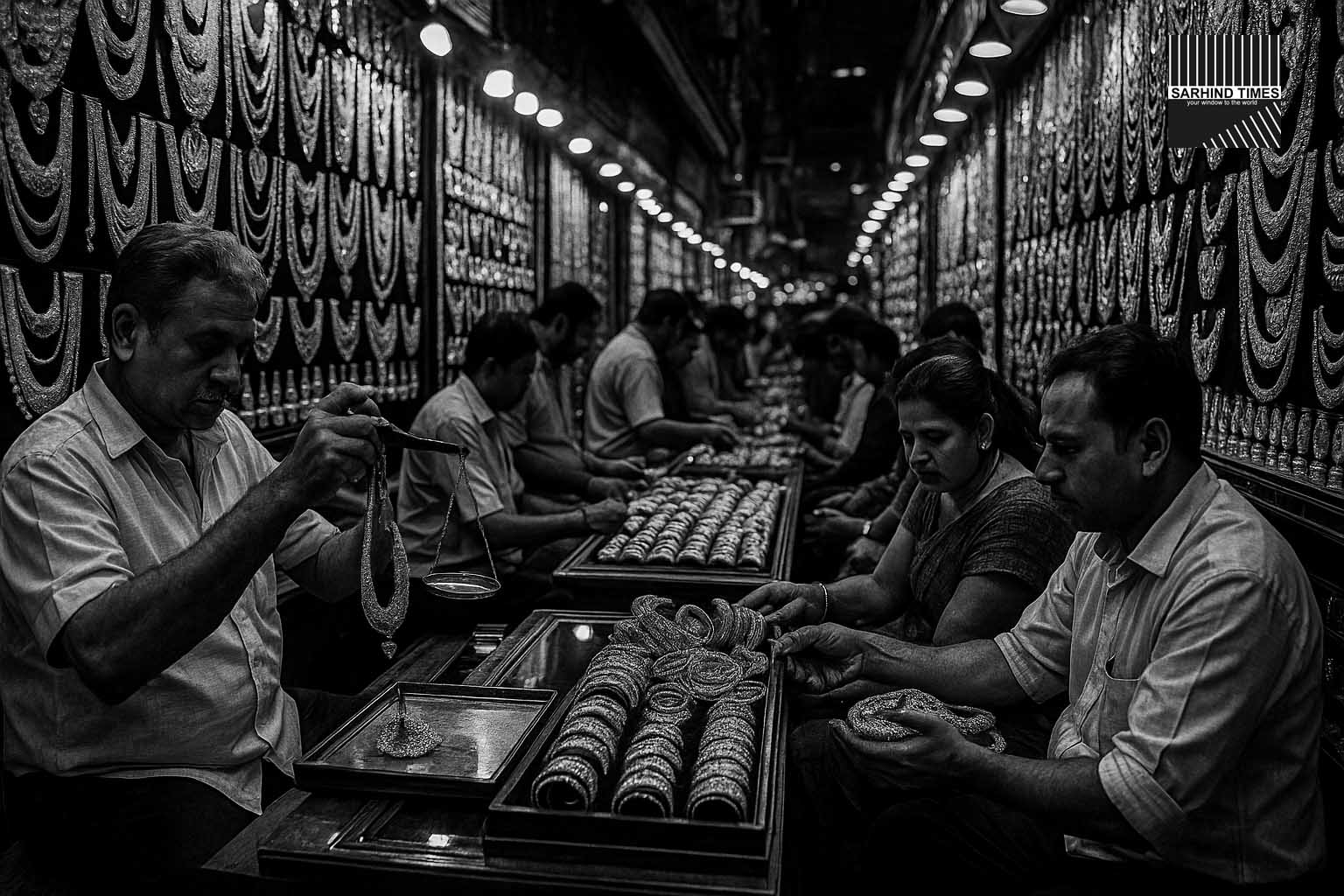
Record-high international prices push Indian buyers to the sidelines; jewellers report sharp drop in footfall even as central banks worldwide increase bullion purchases
Dateline: Mumbai | 20 November 2025, Asia/Kolkata
Summary: Gold prices in India surged sharply this week following an aggressive global rally driven by inflation fears, geopolitical risk, and rising central bank purchases. The price jump, however, has significantly weakened domestic retail demand, forcing Indian dealers to offer the deepest discounts in nearly five months. With the peak wedding season underway, the mismatch between global momentum and local affordability has reshaped the bullion market landscape, raising concerns for jewellers across the country.
Introduction: Gold rallies globally, India feels the heat
The international gold market experienced a sharp rally this week, sending prices to multi-month highs as investors worldwide sought safe havens amid geopolitical uncertainty and volatile global markets. International spot gold hovered near elevated levels on Wednesday, supported by strong buying from central banks and rising global inflationary pressures.
India, the world’s second-largest consumer of gold, saw immediate ripple effects. Domestic gold prices on the Multi Commodity Exchange (MCX) jumped sharply, pushing retail rates in major cities such as Delhi, Mumbai, Chennai and Kolkata close to record territory. But the surge triggered an unmistakable pattern: a steep fall in consumer demand.
Jewellers across Mumbai’s Zaveri Bazaar, Delhi’s Chandni Chowk, Ahmedabad’s Manek Chowk and Bengaluru’s Commercial Street all reported reduced footfall, slow-moving inventory, and high consumer hesitation despite the ongoing wedding season.
Domestic discounts reach a five-month high
To counter extremely weak physical demand, Indian dealers began offering notable discounts on official domestic prices, which include 15% import duty and a 3% GST. Discounts reached between $18 to $25 per ounce — the highest in five months — according to traders.
Such steep discounts typically emerge when local demand collapses even as global prices rise, creating significant pricing mismatch. Dealers noted that customers have continued postponing major purchases, believing that the current surge may cool down later.
A Mumbai bullion dealer said, “Even during peak wedding season, demand has not picked up. Prices are too high for average consumers, and buyers are waiting for correction. We are forced to offer aggressive discounts just to maintain liquidity.”
Why global gold prices are rising sharply
The global gold rally has been fuelled by several interconnected macroeconomic trends:
1. Inflation worries intensify. Multiple countries reported higher-than-expected inflation figures, boosting interest in gold as a hedge.
2. Geopolitical tensions escalate. Continued conflict risk in the Middle East, Europe, and the Indo-Pacific has driven investors toward safe assets.
3. Central banks increase gold reserves. Major central banks, including those in Asia and the Middle East, have increased bullion purchases to diversify away from the US dollar.
4. Weakness in global equities. Following a correction in global tech stocks, investors shifted into safer assets.
5. Expectations of interest rate adjustments. Markets anticipate a potential shift in global monetary policy, which could weaken fiat currencies and make gold more attractive.
Together, these factors have created a powerful upward momentum that has spilled into emerging markets like India.
Jewellers brace for losses during crucial wedding period
India’s October–December wedding season is historically the strongest quarter for jewellery sales, contributing up to 40% of annual revenue for many jewellers. However, soaring prices have altered buyer psychology.
Retail jewellers across NCR, Maharashtra, Gujarat, Rajasthan and Tamil Nadu reported a decline of 20–45% in customer enquiries. Lightweight items, small pendants and low-gram jewellery saw relatively steady interest, but demand for heavy bridal sets, bangles and necklaces has fallen sharply.
Some jewellers fear that unless prices correct, the entire wedding quarter could underperform.
A jeweller from Jaipur shared, “Every year we prepare for high-volume bridal purchases. This year, people are walking in, looking at designs, asking prices, and leaving. Price shock is real.”
Youth buyers turn to silver, lab-grown diamonds and lightweight designs
The younger generation, already shifting preferences toward minimalist styles, is now turning more decisively toward alternatives such as:
• silver jewellery
• platinum-coated silver
• dual-tone lightweight items
• lab-grown diamonds
• hybrid gold-plated collections
Retailers say these products offer affordability while maintaining aesthetic appeal. A Bengaluru-based chain reported a 35% surge in silver jewellery sales over the past month.
Rural demand also under pressure
Rural India — traditionally a strong contributor to gold purchases — has also slowed buying. Weather uncertainties, crop-related challenges and high inflation have limited disposable income. Dealers in Punjab, Haryana, Uttar Pradesh and Karnataka said rural demand is noticeably weaker than expected for this time of the year.
Central banks and institutions continue buying gold
Even as retail demand weakens, institutional interest remains robust. Central banks globally have increased purchases to hedge currency risks and diversify reserves. India’s own central bank has also maintained gold accumulation in recent years.
According to senior officials, the rise in gold and central bank digital currency (CBDC) adoption has reshaped asset accounting standards, prompting deeper scrutiny of reserve balancing strategies. Central banks are increasingly preparing for future economic shifts where digital currencies and traditional reserves coexist.
Gold ETFs see renewed inflows
As retail buyers avoid physical gold, investment in gold exchange-traded funds (ETFs) has seen renewed momentum. Indian investors are increasingly turning to financial gold products, considering them safer during price volatility.
Fund managers noted inflows picking up significantly in the past two weeks as investors look to hedge their portfolios amid global uncertainty.
Will gold prices correct soon?
Analysts are divided. Some believe that high volatility may be followed by short-term correction as global markets stabilise. Others expect structural factors — inflation, geopolitical risk and central bank demand — to keep gold elevated over the next few months.
Key triggers that will determine future pricing include:
• US Federal Reserve policies
• trajectory of the US dollar
• global equity market recovery
• stability in the Middle East and Europe
• central bank reserve trends
• India’s import duty structure
The impact on India’s trade deficit
Rising gold prices often dampen import demand, which may temporarily ease pressure on India’s current account deficit. However, if demand rebounds suddenly when prices cool, imports may spike again. The government continues to monitor gold inflow trends closely, especially given the macroeconomic volatility.
Jewellers push for policy changes
Several industry associations are urging the government to consider lowering gold import duty to encourage legal purchases and reduce smuggling. India’s high import duty remains a contentious issue as it directly influences price stability.
Jewellers argue that reducing duty could stimulate demand, support domestic businesses and curb illicit trade.
Digital gold and app-based buying rise steadily
Digital gold platforms reported a surge in micro-investments as consumers shifted from physical purchases to fractional buying. Many Indians now prefer investing ₹100–₹500 at a time in digital gold wallets rather than making larger physical purchases.
Fintech analysts say digital gold has become a popular hedge instrument for young investors seeking inflation protection with smaller-ticket entries.
Urban versus rural buying trends: A widening divide
Urban demand, while weak, still shows sporadic buying in high-income pockets. Rural demand is significantly weaker due to income pressures. Jewellers expect that the divergence between these consumer segments may widen further if gold prices remain high through the winter.
International comparison: India among most price-sensitive gold markets
Countries like China, Turkey, UAE and the US have seen stable or rising retail gold demand despite global volatility. India, however, remains among the world’s most price-sensitive markets. Even small price changes can drastically shift buying behaviour.
Long-term outlook: Structural demand remains solid
Despite the current slowdown, India’s long-term gold demand remains strong due to cultural, emotional and investment-linked preferences. Weddings, festivals, inheritance customs and savings behaviour ensure sustained interest over time.
Experts believe that temporary slowdowns should not be interpreted as fundamental weakness in the Indian gold ecosystem.
Conclusion: A clash between global momentum and local affordability
India’s gold market is experiencing an unusual divergence: global rally and domestic reluctance. As international prices climb due to macroeconomic uncertainties, Indian consumers are stepping back, waiting for stability and affordability.
Jewellers, caught between global momentum and local price fatigue, are turning to discounts to stay afloat. With the wedding season underway, the next thirty days will determine how deep the current demand slump truly is.
Whether prices correct or continue climbing, one thing is clear — gold remains one of the most closely watched commodities in India, and the balance between sentiment, culture and economics will shape its trajectory in the months ahead.



+ There are no comments
Add yours