
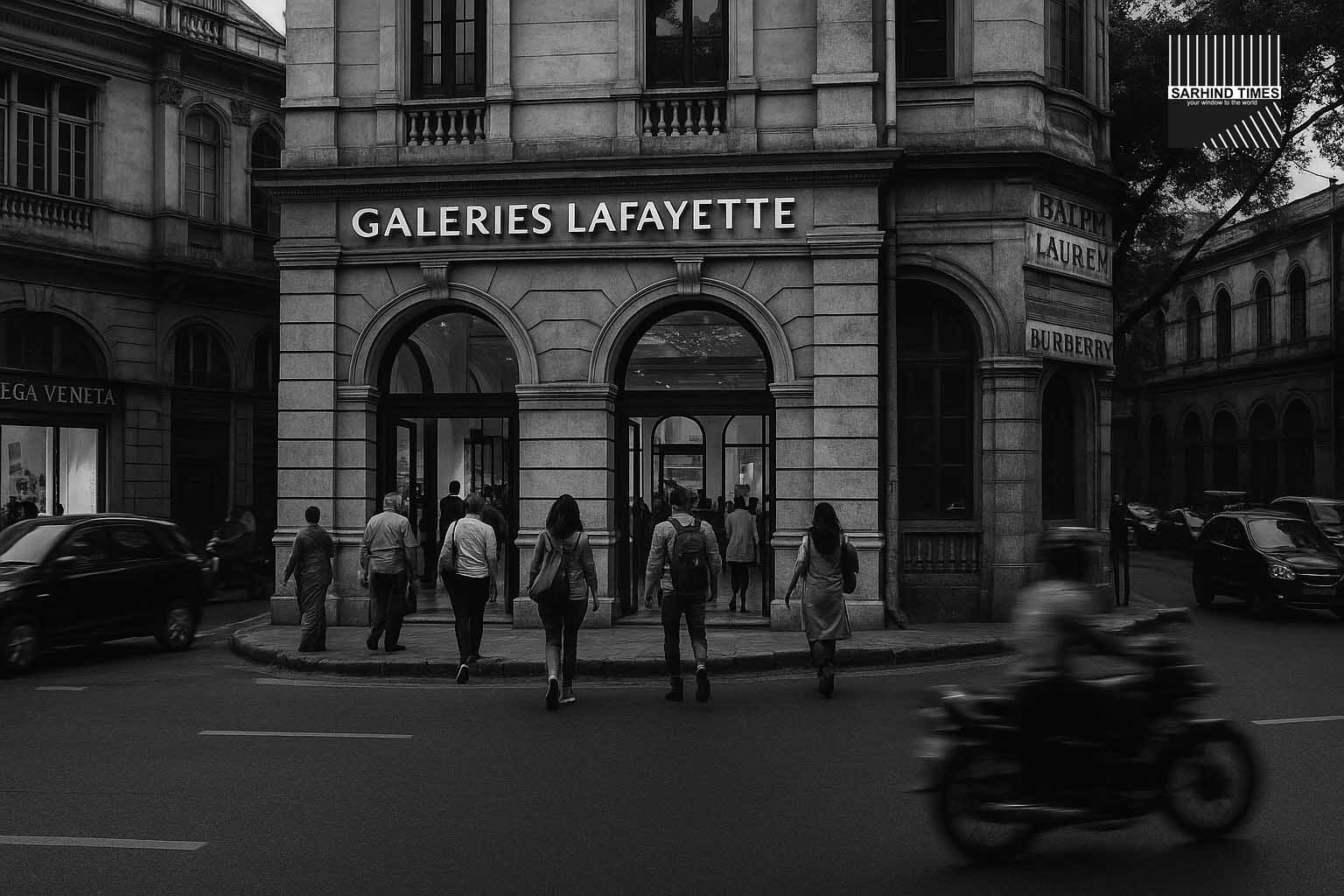
130-year-old brand selects India for its ninth international store; signals foreign brands’ renewed faith in Indian consumer power
Dateline: Mumbai | November 19, 2025
Summary: French luxury department-store chain Galeries Lafayette has chosen Mumbai as the location for its first Indian flagship, opening in the Kala Ghoda heritage precinct in November 2025. The move marks a pivotal moment for India’s luxury-retail market, as global brands increasingly recognise the country as a major destination rather than an emerging back-office zone.
Why Mumbai and why now?
After operating internationally across eight countries, Galeries Lafayette selected India as its ninth global location. The store—spanning 90,000 sq ft over two restored neoclassical buildings in the Kala Ghoda district—opens amid strong signals that India is ascending to the ranks of key luxury-consumption markets globally. Analysts estimate India’s luxury retail market could reach USD 90 billion by 2030.
For the French retailer, the choice of Mumbai is strategic: the city is India’s gateway to luxury consumption, has a deep cultural heritage, and boasts a consumer base that is both affluent and digitally connected. The store launch aligns with other signs of foreign-brand confidence: luxury auto sales, high-end real-estate and overseas travel by Indian buyers have all surged.
Inside the store and brand strategy
The Mumbai flagship will house over 250 luxury brands, including many making their Indian debut. The ground floors are dedicated to beauty and accessories, while upper levels host fashion, menswear, home décor and a curated food-and-beverage zone. Galeries Lafayette’s management describes the new store as “an immersive retail-tainment experience”—where heritage architecture, art installations, live music and luxury shopping intersect.
Notably, the brand has linked up with local conglomerate Aditya Birla Fashion & Retail Ltd (ABFRL) as local partner, leveraging the Indian group’s market-access, logistics, real-estate know-how and customer base. ABFRL’s CEO underlines that this is not entry for novelty, but an anchor investment signalling global-brand confidence in India’s long-term trajectory.
What the move means for India’s luxury economy
Luxury brands entering India isn’t new, but the scale, timing and strategic significance of Galeries Lafayette’s launch suggest a paradigm shift. Previously, international luxury retail largely catered to outbound-Indian travellers shopping at duty-free airports abroad. The new model views India as an independent destination market, not merely a passer-through.
Several implications arise:
- Foreign direct investment multiplier:</strong] The flagship store is expected to generate direct employment of more than 800 persons across retail, hospitality, logistics and services, with indirect effects estimated at another 2,500 jobs.
- High-end real-estate premium:</strong] Retail rents in Kala Ghoda, Colaba and Bandra are projected to rise 12-15 percent over the next 18 months on the back of this marquee opening.
- Up-trading of Indian consumer demand:</strong] Analysts note that Indian consumers no longer seek brands as foreign trophies—they expect full-service experiences, boutique layouts, personalised services and luxury-tech integration.
- Catalyst for local-luxury ecosystem:</strong] Entry of a major global name can boost local luxury suppliers, artisans, logistics-providers, marketing specialists and event-production firms engaged in premium retail.
Challenges and how they are addressed
Even as the announcement makes waves, observers caution that India remains complex for luxury retail. The brand must navigate high import duties, fragmented taxation, logistic delays, and diverse consumer behaviour. Galeries Lafayette’s strategy addresses these by combining multi-brand curation with local sourcing, duty-planning, digital engagement and luxury-loyalty programmes tailored to Indian preferences.
Also, luxury consumption in India is highly concentrated in a few cities—Mumbai, Delhi-NCR, Bengaluru and Hyderabad. The store’s success will depend on how effectively it draws non-resident Indian (NRI) spend, tourist purchases and local high-net-worth interest.
The consumer psychology shift
The luxury-buyer in India has matured. Earlier, status and logo visibility were primary drivers. Now, consumption is shifting toward lifestyle, experience, heritage and value. Brands entering India now need to deliver not just goods but stories—cultural resonance, craftsmanship and personalisation.
At the store launch, Galeries Lafayette incorporated Indian artisans, live curation of Indian heritage crafts, luxury-tech-experience zones and membership programmes. The firm clearly signalled that the Indian luxury consumer is discerning, digital-native and globally-aware.
Regional ripple effects and policy signalling
The entry of a major European luxury retailer at this scale sends a message to other global brands too: India’s regulatory, infrastructure and consumer-market fundamentals are now evolving to accommodate high-end retail investment. Market analysts expect this to spur further entries from fashion, lifestyle, beauty, jewellery and high-end hospitality brands.
From a policy perspective, the Government of India’s services-exports push, ease-of-doing-business reforms, luxury-tourism schemes and high-net-worth-individual (HNWI) incentives are aligning well with these retail signals. The synergy between infrastructure, retail real-estate, digital payments and luxury-logistics is turning India into a global priority market rather than side-market.
Global brand strategy realignment
For Galeries Lafayette and other global luxury chains, the India entry marks a broader repositioning. Rather than scaling everywhere, many luxury brands now focus on fewer destination-cities where consumer demand, digital infrastructure and logistics converge. Mumbai’s establishment as a flagship location puts India firmly in that bucket.
Industry commentators highlight that global luxury supply chains are shifting: India is no longer just an assembly zone—it is becoming an emphasised point of sale, consumption and brand-experience hub. This reflects a broader corporate view that growth in luxury markets is now disproportionately coming from Asia-Pacific, with India poised as one of the key nodes.
What to watch next
Key metrics to monitor over the coming months include:
- Footfall and sales trends for the flagship debut store.
- Growth of luxury-brand launches across Tier-2 Indian cities.
- Rental-premium movements in prime-luxury corridors.
- Cross-border tourist spend and its impact on Indian retail.
- Domestic luxury-brand positioning—it may face stronger competition or repositioning.
Conclusion
The opening of Galeries Lafayette in Mumbai is more than a high-end retail story. It’s a signal: India has arrived as a global destination for luxury, experience and consumption. For Indian consumers it means greater access; for local industry it means deeper engagement; for global brands it means recognition that India is no longer simply emerging—it is essential.
Whether the store will deliver breakout commercial success remains to be seen, but the strategic intent is clear and the implications broad. India’s luxury moment is here — and the world now knows it.



+ There are no comments
Add yours