
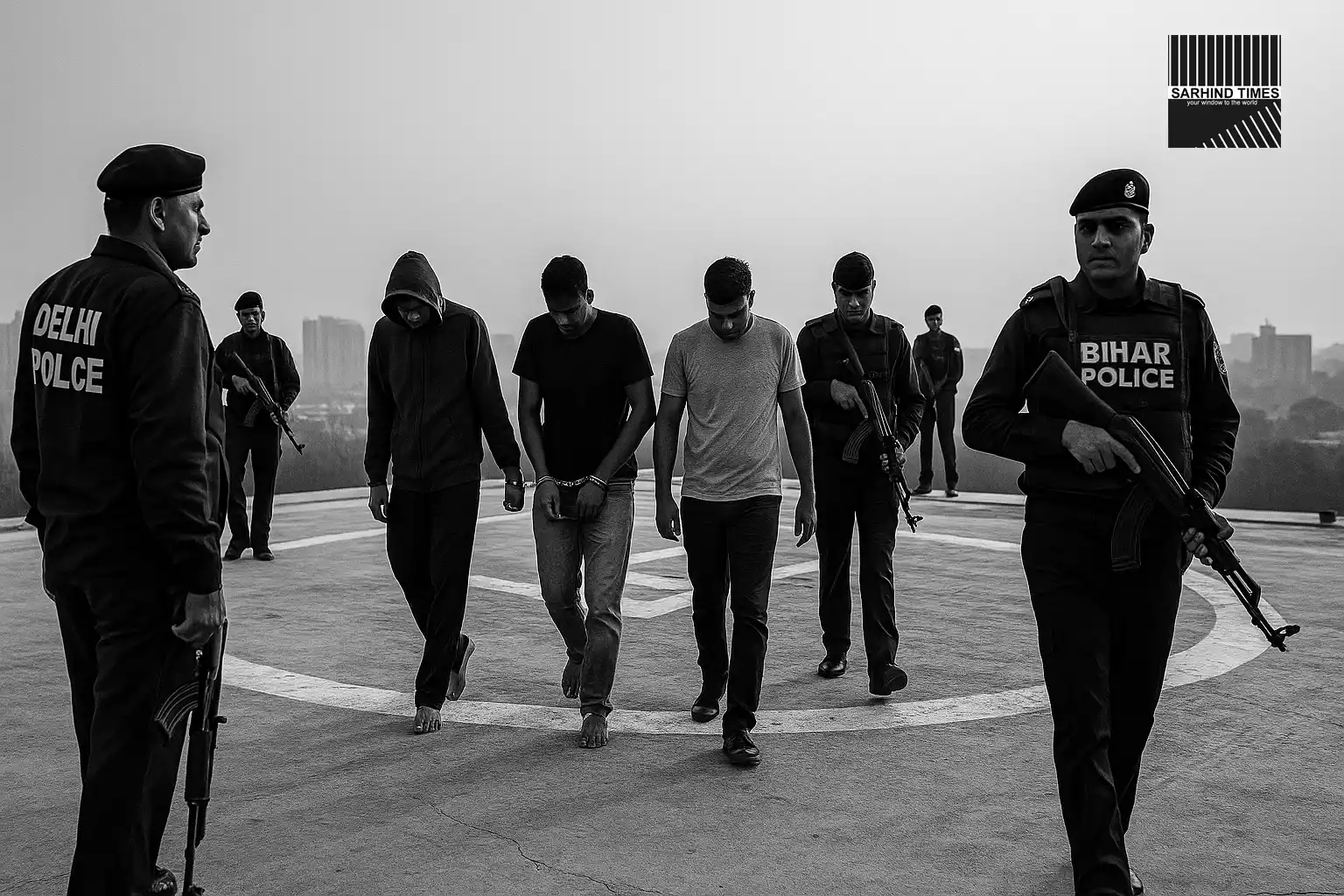
Joint operatives foil pre-election killing spree by inter-state gang; key suspect “Ranjan Pathak” among those gunned down
Dateline: Delhi / Patna | 29 October 2025
Summary: A joint team of the Delhi Police Crime Branch and the Bihar Police has killed four wanted gangsters in an encounter at Rohini, Delhi. Among the dead was Ranjan Pathak, alleged kingpin of the Sigma & Company gang, wanted in multiple murders in Bihar. The operation, conducted ahead of the Bihar Assembly elections, is seen as a major crackdown on under-world networks active across state borders.
Operation details and encounter scene
The operation unfolded late night on 23 October 2025 at a rooftop landing-pad area in Rohini, north-west Delhi. According to police sources, the joint Delhi-Bihar squad had tracked a vehicle carrying four fugitives linked to a Bihar-origin gang-network involved in serial murders, extortion and major logistical supply of arms. When challenged, the accused reportedly opened fire and were neutralised in retaliatory shooting.
Investigators revealed that one of the deceased, Ranjan Pathak, carried a reward of approximately ₹50,000 for information leading to his arrest and was allegedly involved in at least eight murder cases in Bihar’s Sitamarhi and adjoining districts. Police recovered two pistols, live ammunition and false identity documents from the scene.
Sources say the gang was planning a “pre-election violence initiative” in the run-up to the 2025 Bihar Legislative Assembly election, including targeted killings and destabilisation acts across Bihar and Delhi-NCR. The coordination between Delhi and Bihar police began after intelligence inputs about interstate mobility of the suspects and supply of arms from the capital region to Bihar.
Background of the gang and Bihar linkages
The “Sigma & Company” gang led by Ranjan Pathak had earned notoriety for contract killings, land-dispute violence and establishing safe-havens across UP, Jharkhand and Delhi-NCR. Analysts say their mobility into Delhi allowed them to evade Bihar police for years while continuing to orchestrate crime back home.
In Bihar, several murders had been linked to them, including the killing of Ram Manohar Sharma alias Ganesh Sharma in Sitamarhi. Police suspect that the gang’s network included financiers, local political patronage, arms-traffickers and logistics facilitators across states. The encounter therefore has significance not just for Delhi but for restoring law & order in Bihar ahead of elections.
Implications for Bihar’s law-and-order ahead of the election
Bihar law-and-order has been under raised scrutiny. Earlier, police data showed over 9 murders and 12 violent incidents in 24 hours in some districts — underscoring systemic pressure. The arrest and elimination of high-profile gangsters send a signal of tougher enforcement ahead of the poll phase. Political parties have seized on the encounter to position crime as a campaign issue. The ruling coalition in Bihar claims it demonstrates improved capability; the opposition argues poll-timing may be politically motivated.
For voters in Bihar’s urbanising districts such as Patna, Muzaffarpur, Sitamarhi and Darbhanga, interstate arms flows and gang-mobility had become visible threats. The Delhi-Bihar operation therefore carries the promise of countering spill-over crime from NCR into Bihar, especially as rural-urban migration and transport-corridors expand between the regions.
Challenges ahead: prosecution and deterrence
While the encounter is operationally successful, experts emphasise follow-through: the legal disposal of case-files, prosecution of remaining gang members, asset-seizure, and disrupting the supply chains. Without sustained action, “one encounter” may become symbolic rather than systemic. Lawyers and criminologists warn that unless local politics, land-crime linkages and arms networks are addressed, similar gangs will re-emerge under different aliases.
One key challenge is winning intelligence cooperation across states, ensuring witness protection, fast-track courts for gang-cases and linking criminal assets to financial-investigation agencies such as the Enforcement Directorate and the National Investigation Agency. Bihar’s police leadership has reportedly tasked the Special Task Force (STF) with targeting the gang’s Bihar-based financiers.
Local resident and civic-concerns
In Sitamarhi, residents had blamed the gang’s dominance for a string of violence around land-disputes, illegal arms, and intimidation. The encounter has delivered some relief, but civil-society groups say vigilance must not drop. They advocate stronger policing in suburban bridges, railway stations, interstate transit hubs and logistic parks that funnel crime across borders. Real-estate developers in Bihar-NCR corridor also welcomed the operation, saying removal of “gang-influence” could boost investor confidence and residential-safety perceptions.
What to watch next
Stakeholders should monitor the following over the next 4–6 weeks:
- Whether the gang’s Bihar-based ring-leaders are formally booked and arrested; how many assets are attached and who the go-betweens were.
- Movement of arms-seizures and how many cases emerge of illegal-arms flows into Bihar from NCR and Delhi; whether corridors such as NH-27 are targeted.
- The pattern of violent incidents in Bihar’s election-hotspot seats. If killings drop meaningfully, it may reflect deterrence; if they shift location or form, it may indicate adaptation.
- Coordination between Bihar Police and Delhi Crime Branch—whether integrated databases, shared warrants, mutual operations increase.
- Impact on campaign narrative: whether crime-control becomes a differentiator in candidate messaging, whether political parties revise their law-and-order pledges and whether voters cite this as a credibility factor.
Broader takeaway
The intersection of interstate crime between Bihar and Delhi-NCR, with rapidly expanding urban-corridor logistics and mobility, means that local-crime cannot any longer be treated purely as a state-centric issue. The Rohini encounter underlines how gangs exploit borders, urban centres and transport systems. A concerted multi-state policing approach—with intelligence-sharing, transit-monitoring and financial-disruption—is necessary to shift from episodic crack-downs to systemic control.
Conclusion
The killing of four wanted Bihar operatives, including the notorious Ranjan Pathak, by a joint Delhi-Bihar operation is a major enforcement success. However, meaningful change will require sustained follow-through: arrests of remaining operatives, dismantling of the supply-chain, disruption of underlying land/arms/business-crime linkages and electoral-integrity safeguards. Bihar’s next few weeks—amid election campaigning—will test whether this encounter marks the beginning of a deeper crackdown or remains a high-profile exception. For residents, politicians and investors, the message is clear: crime is being flagged as an electoral and systemic priority. What matters next is whether policing, prosecution and prevention intensify and persist.


+ There are no comments
Add yours