
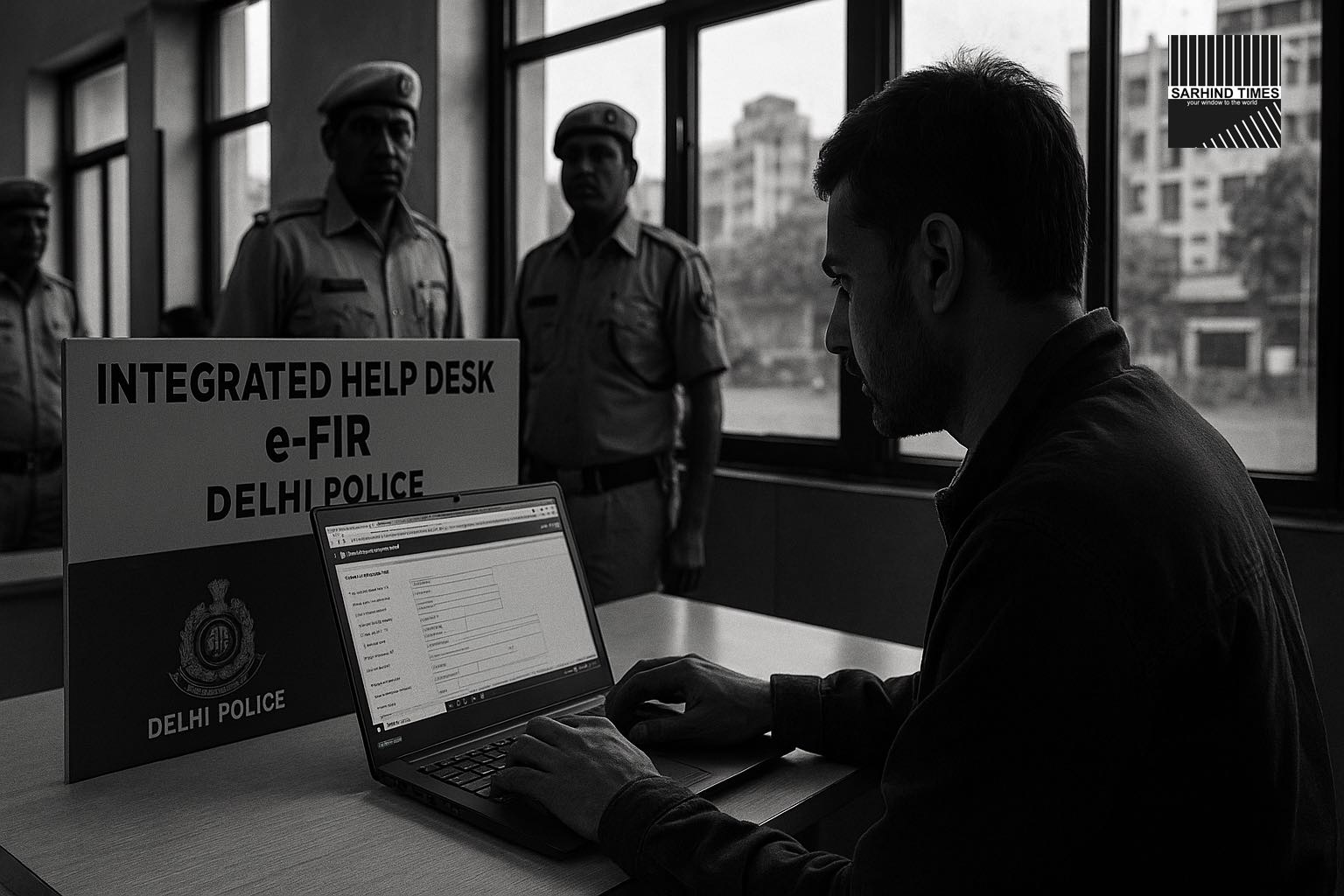
Changes effective 1 November 2025 make filing e-FIRs easier and strengthen digital policing framework
Dateline: New Delhi | 09 November 2025
Summary: The Delhi Police has announced two major reforms in its cyber-crime response arsenal: lowering the minimum amount for automatic e-FIR registration in financial-fraud cases from ₹10 lakh to **₹1 lakh**, and instituting 24×7 integrated help desks in all police stations across the capital. Both steps aim to streamline access, accelerate investigations and improve redressal for victims of online scams.
What has changed
Starting 1 November 2025, victims in Delhi who have lost ₹1 lakh or more to online financial frauds (such as fake-loan apps, UPI scams, investment schemes) will be eligible to file an e-FIR at any Delhi police station. Previously, only those defrauded of ₹10 lakh or more could access this streamlined route.
Concurrently, the police have set up **Integrated Help Desks** (IHDs) at every police station. These desks, staffed round-the-clock with trained officers (including at least one female officer per desk), serve as first contact for all complaints—including cyber-fraud, lost-property, women’s issues and general crimes. The desks are authorised to register e-FIRs, NCRs and other reports and then digitally forward cases to specialist units if required.
Under the new mechanism, after filing at the station, the e-FIR is automatically transferred to the jurisdictional cyber-police station, the Crime Branch or the IntelligenceFusion & Strategic Operations (IFSO) unit for investigation.
Why now: rising cyber-financial fraud in the capital
Delhi has experienced a steep uptick in online fraud cases. In 2024 alone, reported losses from cyber-fraud in Delhi jumped significantly. The earlier threshold of ₹10 lakh for auto e-FIR meant many victims needed to navigate more complex channels (such as the national cyber helpline 1930) or wait for local investigation units.
Police sources note that lowering the threshold to ₹1 lakh is expected to bring perhaps ten times more complaints into the formal system, enabling earlier intervention, better tracking of funds and higher recovery potential.
Implications for victims and enforcement
For victims this means:
- Visit any Delhi police station rather than hunting for the specific cyber-crime unit or national portal.
- Access help desk staff who will assist in documenting, preserving evidence and filing the e-FIR.
- Receive status updates via SMS or email as investigations proceed.
For enforcement, the benefits include: quicker registration of complaints, improved investigation timelines, stronger link-up with banking and digital payment systems (to freeze or trace funds), better intelligence on modus operandi of fraudsters and improved ability to link cases across states.
Operational details and workflow
Under the new process:
- Victim visits local police station post-fraud, speaking to Integrated Help Desk Officer (IHDO).
- Help desk verifies that the fraud amount is ₹1 lakh or above, initiates e-FIR registration instantly.
- The system auto-transfers the case to relevant cyber unit (depending on amount: ₹1-25 lakh handled by local station; ₹25-50 lakh by Crime Branch; above ₹50 lakh by IFSO unit) for investigation.
- Victim receives acknowledgement and complaint number, and can track status electronically.
- Investigating officers coordinate with banks/payment apps to freeze funds, trace accounts and gather digital evidence.
Early outcomes and promising signs
Within the first four days of implementation (1–4 November) the police registered over 90 e-FIRs under this new threshold—an indicator that victims found the new route accessible.
In addition, pilot data for the IHD programme show that in one central Delhi zone, out of 2,471 complaints lodged through the help desk, 1,976 were resolved or progressed to investigation within a short span.
Challenges and risk-points
While the reform is well-intentioned, several potential challenges remain:
- Help desk staffing: Every station must equip and train IHDOs on cyber-fraud dynamics, digital evidence management and victim-support.
- Banking/financial coordination: Freezing and tracing funds in cyber-fraud cases is time-sensitive. Delays or poor coordination with financial institutions may reduce recovery chances.
- Quality of investigation: With volume likely to rise, ensuring each e-FIR receives adequate investigative resources is crucial. Otherwise backlog may grow.
- Public awareness: Victims must know the change, how to access help desks and what documentation to carry; lack of awareness may limit uptake.
What to watch going forward
Key metrics that will show whether this reform is effective include:
- Number of e-FIRs filed under ₹1 lakh threshold each month.
- Proportion of cases where funds are frozen or recovered.
- Average investigation time and closure rate of these complaints.
- Victim satisfaction ratings and ease-of-process survey results.
- Whether fraud patterns shift (e.g., smaller-ticket frauds attempt to stay below ₹1 lakh threshold).
Broader significance
This reform is more than administrative fine-tuning. It reflects a recognition by Delhi Police that digital financial fraud is no longer a marginal issue—it is mainstream and affects ordinary citizens with modest losses every day. By lowering thresholds and bringing first-response services into local stations, the police are moving toward more inclusive, accessible, and victim-centred policing.
In the broader national context, this could signal a shift in how urban police forces adapt to the scale and pace of cyber-fraud—increasing reporting, improving traceability, and designing processes that match how people live, transact and are targeted.
For content-creators, policy-watchers and those working on cyber-safety, Delhi’s model will be worth tracking: it may become a blueprint for other metropolitan cities or state capitals.
Conclusion
The Delhi Police’s twin reforms—lowering the e-FIR threshold for cyber-financial fraud to ₹1 lakh and establishing integrated help desks at all stations—mark a constructive turn. They remove hurdles for victims, simplify process flows and aim to speed up investigative action. The true test will be in execution, resource allocation, investigation quality and public-awareness. If these reforms translate into faster cases, higher recoveries and improved victim experiences, they could help tilt the balance in favour of law-abiding citizens.
For now, this is a step in the right direction—but one that demands follow-through.



+ There are no comments
Add yours