
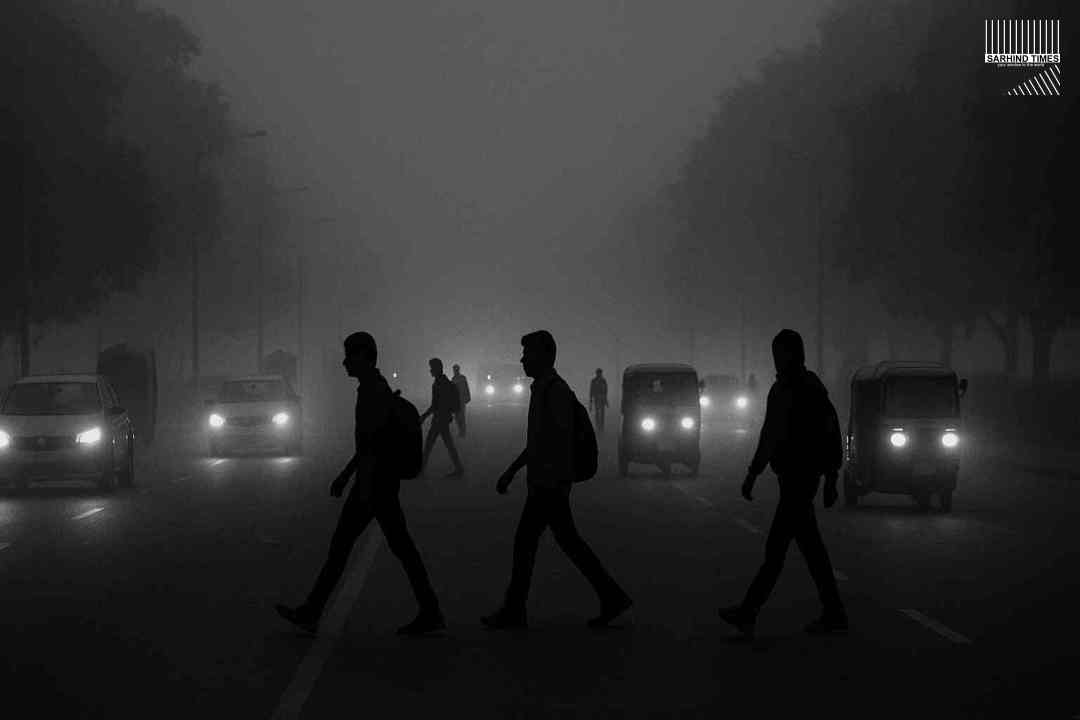
Schools face closure pressure, airports report delays, and hospitals struggle with spike in respiratory illnesses; central and state agencies clash over accountability
Dateline: New Delhi | 30 November 2025
Summary: Delhi–NCR has recorded its worst air quality levels of the season, with AQI crossing the 620 mark in several zones over the last 72 hours. Severe smog conditions triggered emergency restrictions under the Graded Response Action Plan (GRAP) as multiple agencies confronted rising public anger. Hospitals have reported a significant jump in respiratory and cardiac distress cases.
Introduction: A Capital Engulfed in Poisonous Air
Delhi–NCR has once again slipped into an environmental emergency as air quality levels entered the “Severe+” category, marking one of the most toxic phases seen in recent years. Over the past 72 hours, thick grey smog has blanketed the capital, reducing visibility, slowing traffic, and crippling public movement. Pollution monitoring stations across Rohini, Anand Vihar, Punjabi Bagh, Noida Sector 62, and Gurugram recorded AQI levels exceeding 600 — a range where even healthy individuals experience breathlessness, irritation, and fatigue.
The crisis has reignited national debate on whether India’s rapidly growing northern urban belt is facing an irreversible environmental collapse every winter. Both the central and state governments have been forced into damage-control mode as public outrage spills across social media, doctors issue health advisories, and international observers call it “a humanitarian environmental event.”
What Triggered the Sudden Spike?
Air quality experts cite a combination of factors that converged tragically this week:
- Stubble burning resurgence across Punjab and Haryana, with satellite data showing over 2,300 farm fires in the past four days.
- Cooling temperatures and a dense inversion layer trapping pollutants close to the surface.
- Low wind speed preventing dispersion of particulate matter.
- Industrial emissions from NCR cluster units running without updated scrubbers.
- Vehicular traffic surge post-festive season.
Experts say this cocktail of emissions and meteorology transformed a chronic pollution problem into an acute public health crisis.
Hospitals Struggle as Respiratory Cases Spike
Major hospitals in Delhi, Noida, and Gurugram have reported a steep rise in emergency admissions linked to pollution exposure. Doctors at Safdarjung Hospital confirmed a 24% increase in cases of asthma exacerbation, wheezing, and severe breathlessness. Apollo and Fortis chains reported a surge in elderly patients experiencing chest tightness and hyperventilation.
Pediatric cases have surged too. Many parents rushed children to hospitals due to persistent cough, burning throat, and disrupted sleep. Neonatal wards reported increased respiratory complications among infants.
School Closure Debate Intensifies
As AQI levels climbed, parents across Delhi-NCR began demanding immediate school closures. Several schools shifted morning assemblies indoors and restricted outdoor sports. However, education boards have not yet announced blanket closures, citing the unpredictability of weather improvements.
The Air Quality Commission is reviewing whether to enforce mandatory closures if AQI remains above 500 for another 48 hours.
Airports Face Delays and Diversions
Indira Gandhi International Airport witnessed multiple flight delays and at least nine diversions in the last two days. Runway visibility dropped to 250 meters during peak smog hours, forcing airlines to implement low-visibility protocols. Passengers reported long queues, cancellations, and chaotic arrangements as airlines scrambled to adjust schedules.
GRAP Emergency Measures Enforced
The Commission for Air Quality Management (CAQM) activated Stage IV of the Graded Response Action Plan, triggering the strictest anti-pollution measures across Delhi-NCR:
- Ban on all construction and demolition activities.
- Closure of brick kilns, hot-mix plants, and stone crushers.
- Restrictions on BS-III petrol and BS-IV diesel vehicles.
- Work-from-home advisories for corporates.
- Mandatory wetting of roads using treated wastewater.
Despite strict enforcement orders, compliance remains patchy, especially in industrial zones and peripheral construction hubs.
Political Blame Game Escalates
The pollution crisis has reignited political tensions between Delhi, Punjab, Haryana, and the central government. Delhi officials accuse neighboring states of failing to curb farm fires, pointing to satellite data. Punjab argues that farmers need incentives, not penalties, and blames the Centre for inadequate MSP alternatives. Haryana counters that its strict farm-fire controls have reduced local emissions significantly.
The Centre has called for a multi-state coordination meeting to reduce political friction and create actionable short-term strategies.
Voices From the Ground: Citizens Speak
Residents across Gurgaon, Delhi, and Noida expressed anger over the recurring crisis. Social media platforms were flooded with images of children wearing N95 masks, black dust settling on balconies, and car windshields coated with soot. Office-goers complained of headaches and nausea during morning commutes.
For elderly residents, the smog has been devastating. Many reported needing inhalers multiple times a day and restricting outdoor movement entirely.
Impact on Businesses and Daily Life
Retail businesses reported lower footfall as customers avoided outdoor markets. Restaurants experienced increased cancellations, and delivery agents reported health issues while working extended hours in extreme pollution.
Corporate offices have reinstated hybrid work, with several multinationals advising employees to work from home due to health risks.
Scientific Community Raises Alarm: “This Is Not Normal Anymore”
Climate scientists warn that Delhi’s winters are becoming increasingly hostile due to long-term climate change interactions. The frequency of inversion layers has risen, and moisture from western disturbances is now trapping pollution more effectively. Combined with rapid urbanization, unplanned construction, and rising vehicular density, the capital is approaching a near-permanent haze zone during winter months.
The Economic Cost: Billions Lost Every Year
Environmental economists estimate that Delhi-NCR loses nearly $8–10 billion annually due to pollution-related health issues, reduced productivity, and disrupted logistics. This crisis alone could wipe out several hundred million dollars from the local economy due to flight disruptions, hospital costs, and reduced consumer activity.
Are Masks Enough? Experts Say No
Doctors emphasize that regular cloth masks are ineffective against PM2.5. Only N95 or KN95 masks provide meaningful protection, but even these offer limited relief during severe smog conditions when toxic particles infiltrate indoor spaces.
Indoor air purifiers are seeing skyrocketing demand, with many models sold out across online platforms.
Long-Term Health Effects: A Silent Catastrophe
Medical studies highlight that prolonged exposure to PM2.5 leads to:
- Reduced lung capacity
- Increased heart attack risk
- Strokes
- Chronic bronchitis
- Premature ageing of the lungs
- Weakened immune response in children
Health experts call Delhi’s air “equivalent to smoking 20–25 cigarettes a day.”
Can Technology Help? New Solutions Under Testing
AI-driven pollution monitors, drone-based spraying of water mist, roadside smog towers, and improved vehicular telematics are being tested. While promising, these solutions are not substitutes for reducing emissions at source.
Government’s Next Steps: High-Level Meeting Scheduled
The Prime Minister’s Office has sought updated emissions reports from all NCR districts and asked the Environment Ministry to prepare a 15-day emergency action plan. Pollution forecasts indicate that the next four days will remain critical unless wind speeds improve.
Conclusion: A Region Running Out of Breath
Delhi-NCR faces an annual environmental emergency, but the severity witnessed this week underscores a deeper structural challenge. Unless agricultural, industrial, and urban emissions are collectively reduced, the region may face increasingly frequent collapses of air quality — with devastating health, economic, and social consequences.
For now, the capital waits for winds to rise, policies to tighten, and the haze to clear.


+ There are no comments
Add yours