
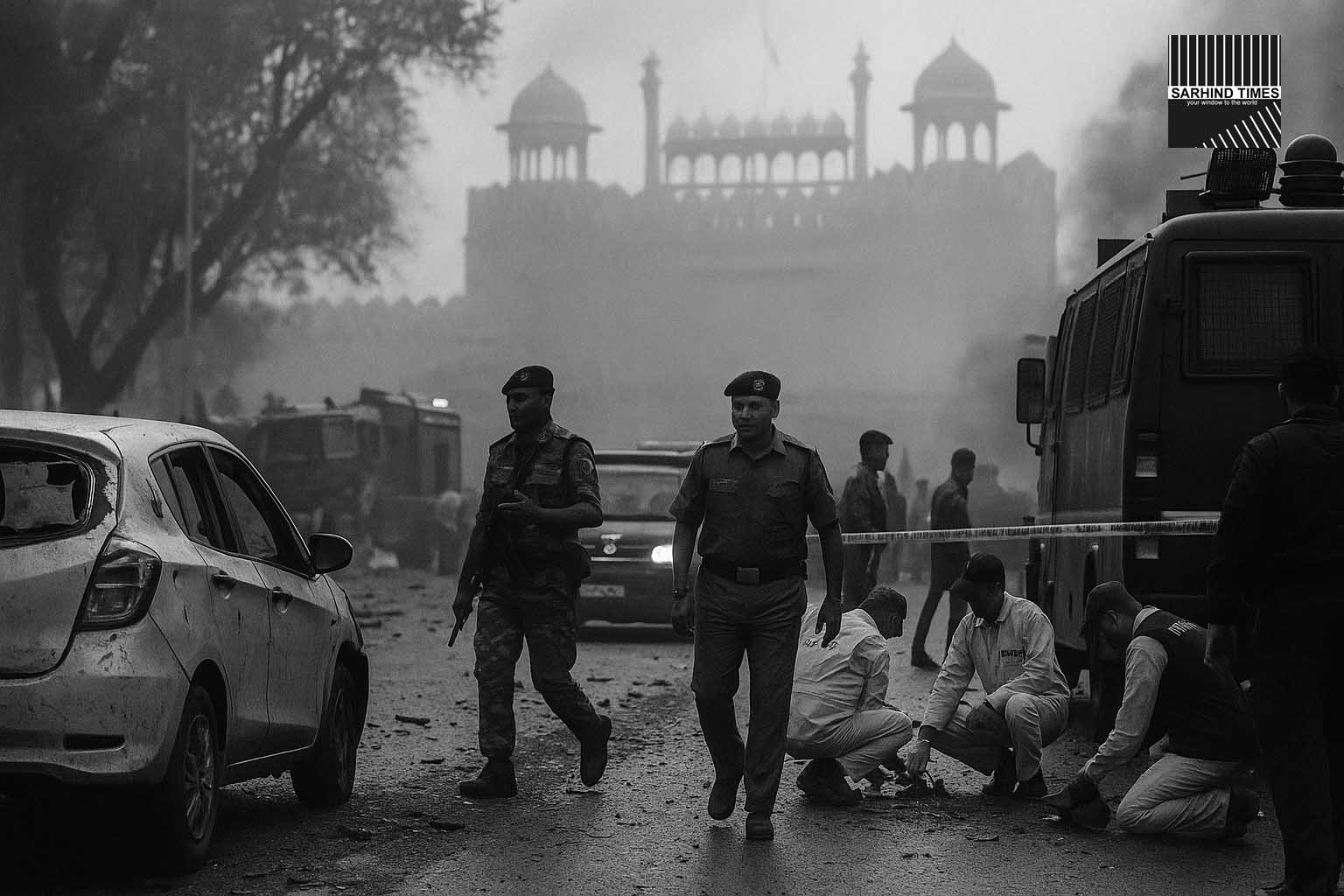
Explosion near the Red Fort kills over a dozen, triggers national security alert and a full-scale investigation under anti-terror law
Dateline: New Delhi | November 16, 2025
Summary: A car explosion outside the Red Fort in Delhi has left at least 13 people dead and over twenty injured, prompting authorities to invoke the Unlawful Activities (Prevention) Act (UAPA) and the Explosives Act. An intense security clampdown followed, with multiple agencies conducting raids, tracking suspects, and tightening commuter and courier checks across the National Capital Region.
The Explosion: What Happened
On the evening of November 10, a stationary car near Gate 1 of the Red Fort Metro Station detonated around 6:52 PM IST. The blast wounded more than 20 people and caused visible damage to adjacent vehicles and infrastructure. Investigators found traces of ammonium-nitrate-fuel-oil (ANFO) and other explosive materials inside what appears to have been a homemade device.
Eyewitnesses described a sudden flash and a loud boom, followed by billowing smoke and panic among nearby commuters. Authorities quickly cordoned off the area and launched an all-agency response. The incident has deeply shaken security planners, especially given the symbolic and high-traffic nature of the Red Fort site.
National Security Response & Legal Ramifications
The blast triggered the invocation of UAPA — India’s chief anti-terrorism law — and the Explosives Act. This legal framing indicates that authorities suspect the attack was more than a simple criminal act and is likely linked to a larger conspiracy. The involvement of professional-grade explosives suggests organised planning, possibly cross-border linkages or terror-network sponsorship.
From a legal-perspective, the invocation of UAPA enables agencies to detain suspects for extended periods without charge, freeze assets, and initiate special court procedures. Civil-liberties advocates caution that such provisions must be used judiciously and with due process safeguards.
Investigation Underway: Multi-Agency Coordination
The National Investigation Agency (NIA) has taken over the investigation, supported by the Delhi Police, forensics teams, the National Security Guard (NSG) and Intelligence Bureau operatives. Early leads suggest the vehicle may have remained parked for over three hours before detonation. CCTV footage, vehicular forensics, telematics data, and mobile phone traces are now central to the probe.
Investigators are checking local garages, courier services, parking records, fuel receipts and cross-referencing travel itineraries of suspects with known profiles. Regional police have also mounted raids in Faridabad and the NCR belt, where large quantities of explosives were recently recovered in a separate operation.
Why the Location Matters: Symbolic And Strategic Impact
The Red Fort is a UNESCO World Heritage site and a symbol of India’s independence and national identity. Targeting such a location elevates the attack from mere criminality to a provocation with high psychological, symbolic and diplomatic impact. The blast’s timing, near a major metro corridor and public area, underscores its potential to cause widespread fear and disruptions in urban mobility.
Security experts state that monuments with high tourist and commuter footfall are increasingly viewed as “soft targets” by terror actors aiming to maximise visibility and panic.
Human Impact: Casualties, Fear And Public Reaction
Among those injured were metro commuters, auto-rickshaw drivers, and passers-by. Hospitals around Old Delhi had to ramp up emergency response protocols, triaging blast victims, dealing with smoke-inhalation and blast-trauma injuries. Panic spread through social-media channels as commuters sought alternate routes or delayed travel.
For families of victims the question is simple yet haunting: why now, in the heart of the capital, and how will justice be delivered? Local businesses around the incident site reported lower footfall in the immediate hours, and metro-user numbers dipped on adjacent lines as commuters avoided the area.
Political Fallout And Administrative Pressure
The incident has stirred sharp debates in Parliament and among opposition parties. Some lawmakers are demanding immediate accountability and questioning intelligence failures. Others emphasise the need to avoid panic and ensure stability.
Officials from the Home Ministry are under pressure to detail how the blast went undetected and what reforms will be deployed to harder-target urban security. Simultaneously, the administration in Delhi has launched temporary vehicle-screening zones and enhanced local intelligence monitoring across crowded public spaces.
Intelligence Lapses: What The Experts Are Saying
The key questions remain: how did the flagged vehicle remain parked for hours near a high-security zone; why were explosive materials not tracked earlier; how did local surveillance fail to detect precursor behaviour? Former intelligence officers said the presence of ANFO and timing devices suggests a link to organised terror infrastructure and possibly cross-border supply chains.
Some analysts note that large-scale explosives recovery in the Faridabad region just days earlier may be connected, prompting speculation of coordinated planning across regional nodes. Efforts are now underway to trace funding, logistics hubs, local facilitators and dispatcher networks.
Urban Security Implications And Mobility Disruptions
The blast has generated major ripple-effects on urban mobility. Roadblocks, shutdowns and diversion plans were immediately activated around Old Delhi and the metro station; commuters faced delays and security checks. The rail and metro authorities announced additional passenger screening protocols near heritage zones and high-density stops.
Transport planners caution that such incidents push cities into reactive mode; the challenge will be to maintain mobility while sustaining security without undermining commercial or civic functionality.
Legal And Civil-Liberties Dimensions
Invoking UAPA accelerates investigative and prosecutorial powers, but also raises civil-liberties concerns. Extended detentions, secretives chargesheets, restricted exchange of information and special court procedures can clash with rights of the accused and oversight norms. Rights-groups are already calling for institutional checks, timely judicial review and transparency in how the law is applied.
On the victims’ side, there are demands for victim-compensation, fast-track trials and public updates. The legal architecture is under scrutiny for its ability to balance security and justice.
Global Ramifications: Terror-Threat Perceptions And Diplomacy
International observers are closely watching the case, especially given the symbolic target and potential for cross-border links. The attack may influence travel advisories, foreign-investment perceptions and global investors’ view of India’s internal security environment.
Diplomatic actors emphasise that visible urban terror incidents increase pressure on host nations to tighten urban security while maintaining open investment and transit ecosystems. India’s response—both operationally and legally—will be seen as a benchmark for large-aspiring -economies tackling urban terror threats.
What Happens Next: Investigation, Prosecution, Reform
Authorities have laid out immediate next steps:
- Tracing the supply-chain of explosives and concealment mechanisms.
- Freezing assets and bank accounts of suspected facilitators under UAPA protocols.
- Deploying a national forensic team to handle the crime scene and digital trace recovery.
- Setting up a special court for the case to fast-track hearings.
- Issuing revised guidelines for monument-zone vehicular screening, visible checks, parking restrictions in heritage zones and drones for surveillance.
Meanwhile, public-safety campaigns and awareness drives are being rolled out across state capitals to prepare for any follow-up incidents or copy-cat attempts.
Conclusion: A Critical Moment for City Security and National Readiness
The explosion near the Red Fort is more than an attack—it is a test of India’s urban resilience, policing capacity, legal readiness and ability to protect symbolic sites while maintaining normal civic life. The swift invocation of anti-terror law signals seriousness—but the real test will lie in how quickly investigators convert leads into arrests, how transparently evidence is shared and how resilient the city becomes to future threats.
For citizens of Delhi and beyond, this is a reminder that urban terrorism remains a potent threat—and that public safety must evolve alongside the modern city’s scale, mobility and connectivity. The coming weeks will determine whether this incident remains an isolated shock or serves as a wake-up call for systemic upgrade of urban defence.



+ There are no comments
Add yours