
Capital Implements Emergency Curbs Again; Schools, Hospitals and Workplaces Brace for Another Public Health Shock
Dateline: New Delhi | November 27, 2025
Summary: Delhi’s air quality collapsed back into the ‘Severe’ category this week as dense smog blanketed the region, forcing authorities to consider re-implementing restrictions under the Graded Response Action Plan. Public health experts warn of escalating respiratory cases, while residents fear another long winter of toxic air.
A familiar winter nightmare returns to the capital
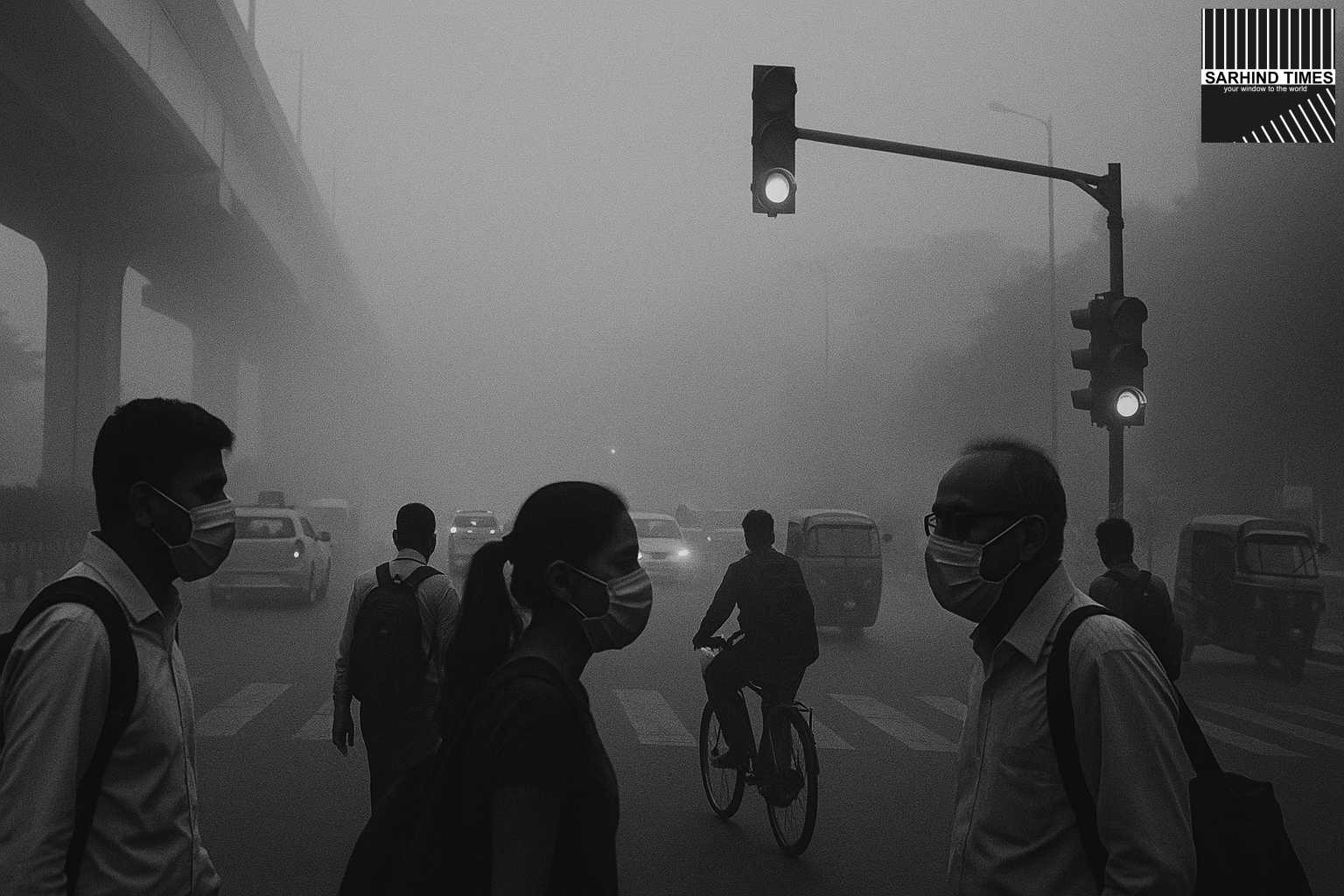
New Delhi’s skyline disappeared again this week as the Air Quality Index (AQI) slipped deep into the ‘Severe’ zone, triggering widespread concern regarding public health, economic disruptions, and civic preparedness. After a brief spell of marginal improvement earlier this month, thick layers of smog once again wrapped themselves around the capital, reducing visibility, aggravating respiratory conditions, and thrusting authorities back into emergency mode.
As of Tuesday night and Wednesday morning, multiple monitoring stations recorded AQI levels above 450. Localised hotspots in Anand Vihar, Jahangirpuri, Narela, and RK Puram reported figures close to 500 — the uppermost edge of the monitoring scale. Such levels signify that even healthy individuals are vulnerable to respiratory distress, while those with pre-existing conditions face significant risks.
Weather, stubble burning and urban emissions collide again
Meteorologists attribute this week’s deterioration to a combination of falling night temperatures, stagnant winds, and a sudden spike in local emissions. While stubble burning in neighbouring states had shown a declining trend earlier this month, several new clusters of farm fires were detected in the past 72 hours across Punjab and parts of Haryana. These emissions, combined with Delhi’s dense traffic and construction-related dust, have formed a deadly layer of trapped pollutants over the city.
Senior atmospheric scientists have warned that wind reversal and the development of a shallow temperature inversion layer could keep pollutants locked close to the ground for days. With sunlight unable to disperse accumulated particulates, the city is likely to remain in toxic conditions unless a fresh western disturbance or strong surface winds arrive.
Authorities reconvene: emergency steps under GRAP revisited
The Commission for Air Quality Management (CAQM) held back-to-back meetings this week to evaluate whether Phase IV of the Graded Response Action Plan (GRAP), the toughest level of restrictions, needs to be re-implemented. This phase includes measures such as bans on construction activities (except essential projects), closure of brick kilns and stone crushers, mandatory work-from-home advisories, and prohibition of diesel trucks entering the capital.
Officials acknowledged that delays in implementing restrictions earlier this month caused pollutants to accumulate faster than forecast. Departments responsible for road dust, waste burning, garbage transportation, and e-vehicle deployment have been told to submit updated compliance reports by Friday. Several municipal zones have already resumed anti-smog gun deployments and increased night sweeping schedules on high-traffic corridors.
Schools prepare for disruptions; parents express concerns
Schools in Delhi and NCR are once again facing uncertainty. Administrators in Central and South Delhi have begun shifting sports activities indoors, while many private schools are reconsidering hybrid learning models. Although authorities have not yet ordered blanket closures, several principals indicated they are prepared to switch to online classes if the air quality remains ‘Severe’ for the next 48 hours.
Parents expressed frustration at what they call a “perpetual winter crisis.” For families with young children, especially those with asthma, the toxic air has become an annual fear. Many parents reported keeping children indoors for days, reducing outdoor exposure, and purchasing yet another round of home air purifiers — an expensive recurring practice.
Hospitals report rising cases of respiratory distress
Hospitals across Delhi have recorded an uptick in patients reporting breathing difficulties, chest tightness, eye irritation and persistent cough. Pulmonologists at major government and private hospitals say emergency rooms have seen a 20–30 percent surge in patients with aggravated asthma, bronchitis or chronic obstructive pulmonary disease (COPD).
Doctors attribute this spike to PM2.5 — fine particulate matter that penetrates deep into the lungs and triggers inflammation. At high concentrations, PM2.5 can worsen heart conditions, raise stroke risk, and compromise immunity. Senior specialists warn that prolonged exposure, even for healthy adults, leads to long-term health consequences such as reduced lung capacity and premature aging of respiratory tissues.
Economic cost of pollution mounts: productivity dips, businesses affected
Beyond health concerns, Delhi’s toxic air continues to exert a heavy financial toll. Analysts estimate that productivity dips in offices, reduced outdoor commercial activity, and slower traffic movement have already begun affecting businesses. Delivery and logistics companies report higher fuel consumption due to engines working harder in smog, as well as increased delivery time because of low visibility.
Real estate developers say construction slowdowns — driven partly by GRAP rules and partly by worker health concerns — have halted or delayed multiple ongoing projects. Hotels and restaurants with rooftop areas face cancellations, and outdoor market sellers report fewer walk-in customers. Environmental economists believe the week’s smog could cost Delhi crores in lost productivity and healthcare expenses.
Transport networks struggle amidst haze
Early morning flights at Delhi’s international airport experienced intermittent delays due to visibility concerns. While no mass cancellations were reported, airport authorities are preparing for potential disruptions. Train services through northern corridors also operated under caution, with reduced speed in sections affected by dense fog-like smog.
On Delhi’s arterial roads, heavy smog created hazardous driving conditions. Commuters reported difficulty seeing vehicles even a few feet ahead, especially near peripheral highways, industrial belts, and areas near the Yamuna floodplains. Traffic police deployed extra personnel to manage slow-moving traffic and prevent pile-ups.
Residents adapt: masks back, air purifiers running nonstop
For residents, the latest smog spell feels like a relapse into an unwanted seasonal routine. In markets and metro stations, masks — once discarded after the pandemic eased — have made a strong comeback. Sales of N95 and N99 masks soared in pharmacies this week. Many households say air purifiers are operating continuously, leading to higher electricity bills during an already expensive winter season.
Several residents in East and North Delhi report sealing windows with thick curtains or insulation tape to prevent night-time smog leaks. Others have begun revisiting community petitions demanding better enforcement against waste burning and illegal construction dust — two major contributors to neighbourhood-level pollution.
Government response faces criticism
Citizen groups and environmental activists argue that authorities are still responding too slowly and too late. They say the seasonal nature of the crisis should warrant year-long planning, not hurried measures once the air turns toxic. Critics point out gaps in solid-waste management, delayed adoption of electric commercial vehicles, and inconsistent enforcement of industrial pollution rules.
Environmental lawyers argue that unless Delhi and its neighbouring states coordinate aggressively, the annual cycle of smog will persist. They emphasise the need for stronger deterrents for stubble burning, efficient alternatives for farmers, and region-wide monitoring systems that hold specific districts accountable for spikes.
Farmers’ perspective: old issues still unresolved
In parts of Punjab and Haryana, farmers reiterate that crop residue burning is a last resort, not a preferred option. They say the lack of timely government support, insufficient access to subsidised machinery, and delay in MSP procurement cycles push them toward burning to prepare fields quickly for the next sowing cycle.
While authorities have announced various schemes over the years, implementation gaps continue. Farmers argue that sustainable alternatives — like residue baling, in-situ management machines, or biomass procurement — are either unavailable, too expensive, or poorly supported. Until these issues are addressed comprehensively, stubble burning is likely to persist, they warn.
Scientific community calls for regional climate planning
Atmospheric researchers stress that Delhi’s pollution cannot be tackled in isolation. With wind patterns carrying emissions across states, only an integrated regional strategy can produce sustainable results. Scientists emphasise the need for real-time emissions mapping, early-warning systems, and coordinated meteorological forecasting shared across ministries.
Some climate experts recommend experimenting with urban vertical forests, decentralised green buffers, and dust-suppressing surface coatings for high-dust roads. They also highlight that climate change — altering wind flows, rainfall cycles, and winter patterns — is intensifying seasonal smog episodes.
Impact on mental health: silent but significant
Mental health professionals note a noticeable rise in pollution-related anxiety, particularly among the elderly, parents of young children, and outdoor workers. The inability to step outside, reduced sunlight exposure due to haze, and chronic breathing issues create psychological stress. Many individuals report lethargy, irritability, sleep disturbance, and fear of long-term illness — a pattern exacerbated each winter.
A look ahead: what Delhi must prepare for
Forecasts suggest that unless strong winds sweep through the region, Delhi is unlikely to see meaningful relief in the next few days. Authorities warn that AQI levels could fluctuate within the upper ‘Very Poor’ and ‘Severe’ categories based on local emissions and traffic density. Meteorological models show a weak western disturbance expected early next week — though its impact remains uncertain.
Experts recommend immediate implementation of contingency measures: reduced private vehicle usage, temporary carpool mandates, improved last-mile public buses, quick deployment of anti-smog machines, and strict action against dust-generating activities.
Conclusion: A crisis repeating itself — but still avoidable
The return of severe smog in Delhi is not simply a seasonal inconvenience; it is a public health emergency that demands systemic, long-term solutions. While annual weather conditions play a major role, the persistence of this crisis reflects deeper structural gaps in governance, preparedness, and cross-state coordination.
As millions struggle to breathe clean air, Delhi’s pollution emergency reinforces an unavoidable truth: unless authorities move beyond reactive policymaking and embrace year-round environmental planning, the capital will remain locked in this toxic winter loop. For now, residents brace themselves once again, waiting for the winds to change.



+ There are no comments
Add yours