
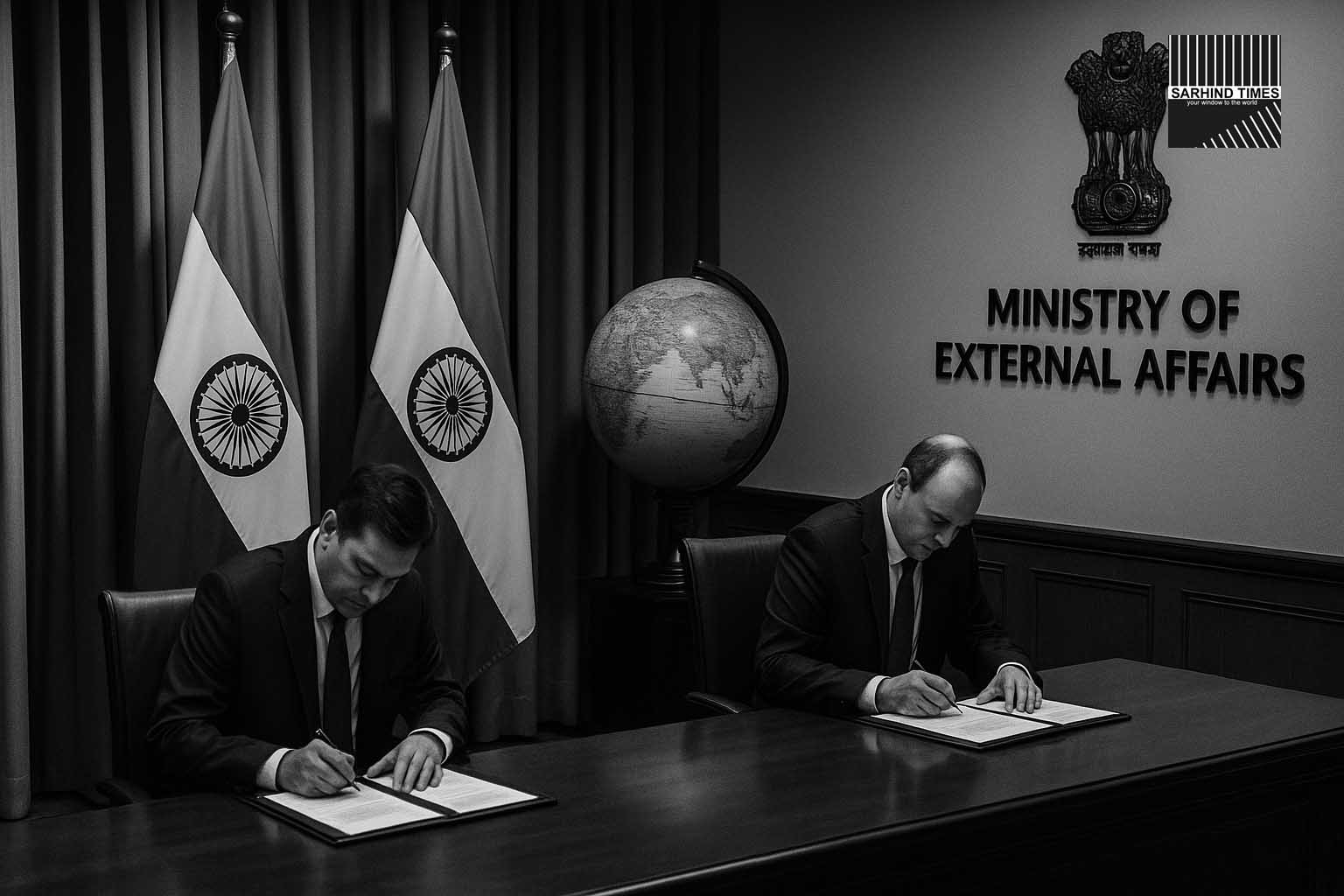
From spikes in Indo-Pak friction to renewed outreach to Afghanistan and broader region, India’s global posture is in transit
Dateline: New Delhi | 17 November 2025
Summary: In recent days, multiple developments in India’s external affairs domain are converging: heightened tension with Pakistan triggered by violent incidents, decisive movement toward upgrading ties with Afghanistan’s administration, and broader recalibration of India’s regional strategy. While these signal a more assertive Indian diplomacy, underlying risks and ambiguous outcomes remain.
1. A sudden uptick in Indo-Pak tension
The region has witnessed a sharp spike in diplomatic stress between India and Pakistan, following a pair of explosions—one in Islamabad and the other near New Delhi—which have revived fears of mis-calculations and wider escalation. The immediate incidents are still under investigation; blur of claims and counter-claims is feeding mutual mistrust. One official in Islamabad alleged Indian-backed elements; New Delhi dismissed such claims as politically motivated and lacking proof.
The rapidity of these events is noteworthy: the blasts occurred within a 24-hour window, drawing prompt reactions from both capitals. Intelligence agencies in both states have mobilised, border posts tightened, and public rhetoric hardened. While neither side is yet projecting full-scale war, security experts warn that such upticks in low-intensity conflict can slip into broader escalation unless managed carefully.
2. India’s recalibrated approach to Afghanistan
During a meeting in New Delhi between India’s External Affairs Minister and Afghanistan’s foreign minister, mutual interest in development-cooperation, trade, infrastructure and education was emphasised. India asserted its commitment to Afghan sovereignty and territorial integrity. The move can be read as strategic: by deepening ties with Afghanistan, India may be seeking to hedge regional influences—particularly those of Pakistan and China—and secure its western frontier against instability.
3. Strategic logic and timings
India’s diplomacy appears to be operating on at least three tracks: managing immediate tensions with Pakistan, expanding its regional presence (Afghanistan, Central Asia) and aligning longer-term with global strategic shifts (e.g., supply-chains, climate partnerships, Indo-Pacific norms). The Afghanistan move is timely: after the Taliban’s takeover in 2021, India has maintained a technical mission but avoided full recognition—but now the upgrade signals pragmatism in a changing regional context.
Against this backdrop, the blast-incidents with Pakistan also have to be understood not just in isolation, but as part of the larger strategic-environment. The friction may deter India from over-extending itself, even as it seeks new diplomatic avenues. For India, balancing overt conflict risk with making new strategic openings is the current challenge.
4. Risks and fault-lines
Despite the forward momentum, significant risks loom. On the Pakistan front: spill-over of violence, mis-targeted retaliation, or escalation through proxy conflicts remain real. Border skirmishes, drone intrusions, and maritime incidents can all suddenly raise the temperature beyond diplomatic control.
In Afghanistan: while upgrading diplomatic presence is a sign of engagement, the Taliban’s human-rights record, internal instability, and presence of non-state militant groups may limit the scope of the relationship. Domestic critics in India caution against legitimising a regime with contested legitimacy. If Afghan territory becomes a launch-pad for anti-India activities, this could back-fire.
More broadly, India must reconcile its ambitions with its constraints: limited diplomatic bandwidth, over-commitments in global fora, slow bureaucratic execution, and the gap between strategic vision and on-ground delivery. Diplomatic initiatives are only as strong as their follow-through—funding, staffing, intelligence-coordination, guardrails around escalation, and public-policy coherence matter.
5. Domestic impact and political framing
These moves are not just foreign-policy technicalities—they have domestic resonance. India’s government is under pressure to show that it can manage neighbourhood security and deliver results. The exposure of Indo-Pak tensions hits electoral and public-perception sensitivities. Upgrading ties with Afghanistan may also serve as a political signal: a demonstration of India’s strategic weight and independence in foreign policy.
Within India’s political system, there is conscious narrative building around “India as leader” rather than “India as recipient”. This is reflected in India’s diplomacy moving beyond being reactive to regional incidents, and toward shaping the regional agenda: connectivity, infrastructure investment, alternative markets, defence exports, digital partnerships. The external policy therefore becomes internal political currency as well.
6. What to watch next: key triggers
In the near term, some catalytic events will define whether India’s current momentum holds or stalls:
- Pakistan’s response to the recent violent incidents: Will Islamabad engage in dialogue, escalate diplomatically, or leverage third-party mediation?
- Implementation of the embassy upgrade in Kabul: staffing levels, mission budget, India-Afghan projects announced, visa/trade flows initiated.
- Any new announcements around regional alignments: Central Asia, Iran, Gulf states, maritime partnerships, supply-chain realignments.
- How India’s internal security agencies respond to border-instability: whether they escalate proactively or choose calibrated diplomacy.
- Whether India’s foreign-policy articulation filters into trade, investment, infrastructure that affects Indian enterprises and citizens rather than remaining high-level diplomacy.
7. Corporate and economy angle
From the business-perspective, India deepening its regional footprint matters. Improved security in western and northern neighbourhoods enhances investor confidence; trade corridors via Afghanistan and Central Asia may open new markets; diplomatic clarity reduces risk for multinational supply-chains seeking India as base. However, firms must also consider that escalation with Pakistan can disrupt logistics, cross-border movement, and investor sentiment just as much. Geopolitical risk remains a cost factor.
8. Regional and global implications
India’s moves should be seen within a global context where great-power competition (US, China, Russia) and regional linkages (Central Asia, Indian Ocean, Asia-Pacific) are undergoing realignment. India positioning itself both as an independent actor and regional balancer gives it space—but also exposes it to pressure from multiple directions. For neighbouring smaller states, India’s actions signal that it intends to shape regional architecture rather than simply follow it.
9. Structural issues: execution, resources and coherence
Foreign-policy ambition without institutional readiness is a recurrent risk in India. Historically, fast announcements often outpace bureaucratic follow-through, mission staffing, budget allocations and inter-agency coordination. Upgrading a diplomatic mission is a statement—but the operational and logistical work behind it is harder and slower. The same holds for frontier issues like cross-border terror, regional connectivity, infrastructure diplomacy and defence cooperation.
For India to convert its diplomatic thrust into tangible gains—trade, investment, infrastructure, adherence to rules, regional order—it has to ensure that institutional structures (MFAs, defence, trade, intelligence) are aligned, that resources flow, that back-channels function and that clarity of purpose persists. Without that, there is risk of strategic drift, over-extension, or agenda-overload.
10. Final take
India’s external environment is increasingly volatile—but also presents opportunity. The twin dynamics of escalated Indo-Pak stress and improved ties with Afghanistan underline that India’s foreign policy is not static—it is being recalibrated. The question is no longer whether India will matter globally—it already does—but how it will matter sustainably and coherently.
If India can harness the diplomatic openings, manage the risks of escalation, secure deliverables and embed follow-through, it may step into a stronger regional role. If not, the current burst of diplomacy may fade into announcements without outcomes. For now, the message is clear: diplomacy is active, but it must now translate into strategy and execution.



+ There are no comments
Add yours