
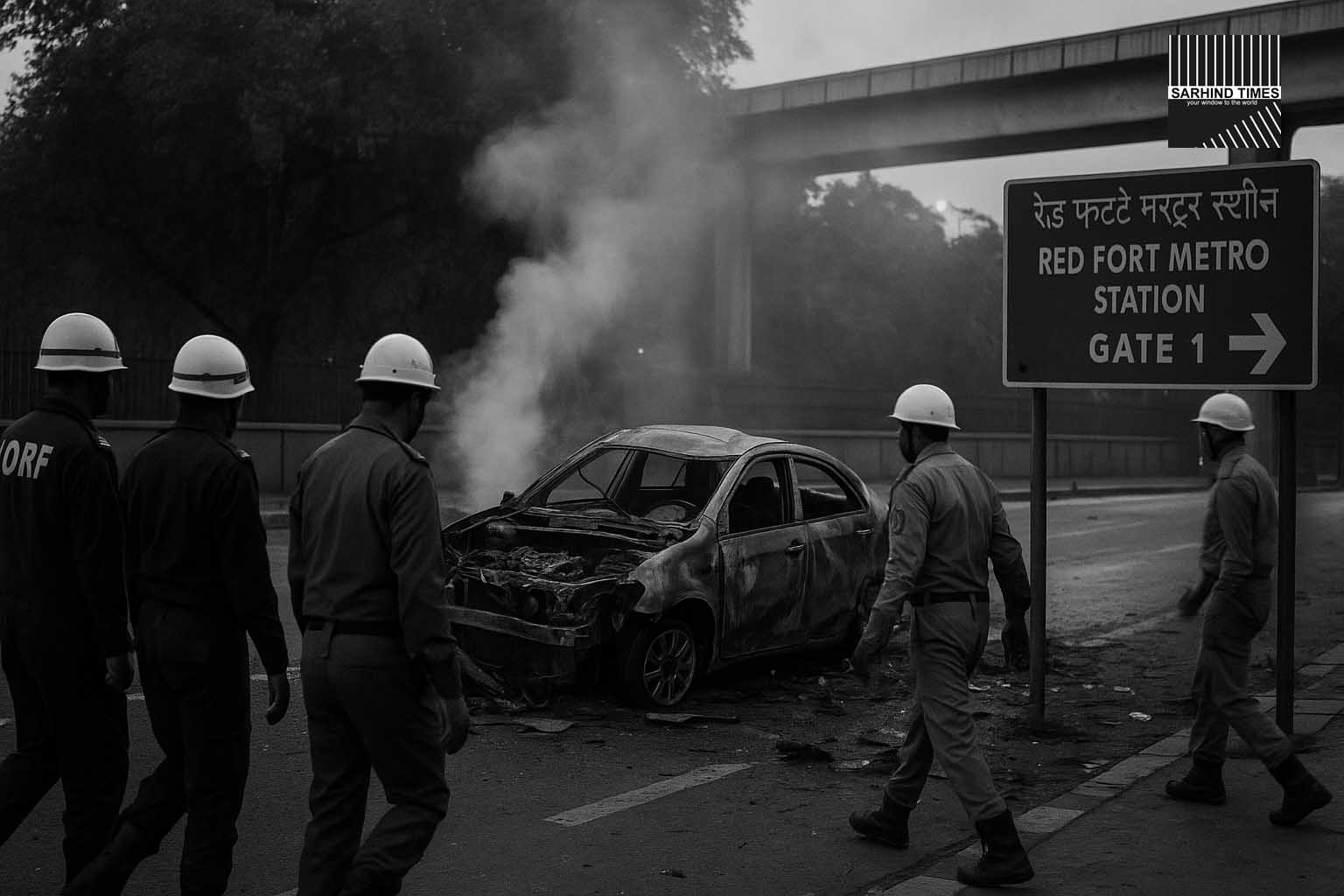
Authorities invoke counter-terror law and promise swift action as city reels from high-impact car bomb attack
Dateline: New Delhi | November 12, 2025
Summary: A car explosion near Gate 1 of the historic Red Fort Metro Station in New Delhi killed at least eight people and wounded multiple others. Investigators are treating the incident as a potential act of terrorism under the Unlawful Activities (Prevention) Act, with the National Investigation Agency (NIA) taking over the case. The government has vowed the “conspirators” will not escape justice.
The explosion and immediate aftermath
The evening of Monday saw the bustling area around the Red Fort Metro Station in New Delhi shaken when a car exploded at approximately 6:45 pm local time near Gate 1. The vehicle, described by investigators as a Hyundai i20, had been parked earlier and then detonated while being driven in the vicinity of the station, in one of the capital’s most sensitive zones. Witnesses reported hearing a massive blast, seeing flames and smoke rising, vehicles being damaged and bystanders injured. The initial response was swift: the area was cordoned off, fire tenders and ambulances rushed in and injured persons were shifted to nearby hospitals.
At least eight people have died, while more than twenty are reported injured. The fire-service noted that several vehicles nearby were damaged, windows shattered in surrounding buildings and smoke blanketed the street amid chaos and power outage. While some authorities initially described the incident as a car accident or technical explosion, the government has now elevated it to a terrorism probe, invoking preventive legislation and counter-terror agencies.
Investigation ramps up: Terrorism angle in focus
Within hours, law-enforcement agencies escalated the case. The NIA has assumed jurisdiction, with the Delhi Police filing a First Information Report under the Unlawful Activities (Prevention) Act and sections of the Explosives Act. The fact that the explosion occurred next to a major metro station and at a location of prime symbolic and tourism value—the Red Fort monument—has raised concerns about a possible plot to create mass panic, undermine public safety and challenge sovereignty.
Investigators are combing CCTV footage, tracking the car’s movement leading up to the blast, examining purchase and registration details and forensics. Early leads indicate the vehicle was stationary in a parking lot for several hours before being moved and detonated near the metro entrance. Intelligence agencies are probing links to extremist modules, cross-border support structures and internal radicalisation networks.
Government response and political fallout
Speaking from Bhutan where he was on a state visit, the Prime Minister pledged swift action: “All those responsible will be brought to justice, they will not escape.” He shifted to using English in his remarks, signalling to the international community the gravity with which the incident is being treated. On the ground, the Home Ministry has directed heightened security across Delhi and other major metros, especially around transit hubs, tourist sites and religious gatherings.
The Delhi Government and the municipal authorities raised the threat-level and activated emergency protocols. Metro services were briefly suspended, metro security intensified and additional private-security deployments were authorised. Opposition parties criticised the security failure, demanding answers and immediate arrests. Some voices questioned why an official security zone around a national-monument location allowed a vehicle to be moved when parked earlier for hours—raising questions about parking-zone policing, vehicular access protocols and urban surveillance gaps.
Public anxiety, tourism impact and business worry
The blast struck at one of Delhi’s highest-visibility districts—tourists, commuters and office-goers were in close proximity. The area around the Red Fort and Chandni Chowk is always crowded after office hours; the explosion shattered a sense of normalcy. Residents in adjoining lanes reported chaos, sirens, locked shops and abrupt evacuations. Tourists deterred in real time and many hotels and retailers reported cancellations or early closures.
Business associations noted that the incident will likely heighten security-costs, deter footfall in central Delhi, and raise insurance premiums for commercial establishments in high-risk zones. The incident also revived debate about urban counter-terror preparedness, public-transport vulnerabilities and the adequacy of protective design in high-density spaces.
Security framework: Transport, monuments and urban risk
From a security-architecture perspective, the incident highlights multiple weak links: vehicle screening near heritage zones, parking time-lags between movement and explosion, CCTV-coverage gaps and lack of integrated intelligence trigger alerts. Transit hubs like metro stations have become, worldwide, preferred targets for asymmetric attack tactics because they afford high-density casualties and media visibility.
Delhi’s law-enforcement and security agencies have layered protocols for monument-adjacent zones—vehicle exclusion areas, identification checks, bomb-sweep patrols during high-risk events—but this case suggests that routine vehicle movements over standard thresholds may not have triggered deeper inspection. The fact that the car moved from a parking lot to a vulnerable location before detonation also implies planning and reconnaissance rather than a random malfunction.
Regional geopolitics and international reactions
Given the high-profile nature of the site and its proximity to national-symbol heritage, the incident has international resonance. Several foreign embassies in India issued advisories for their citizens, and national governments offered condolences while monitoring for spill-over risk. The incident adds pressure on India’s counter-terror infrastructure to demonstrate deterrence, responsiveness and intelligence-fusion capabilities.
Analysts note that the blast may factor into India’s broader diplomacy, including how it positions itself on regional security, Pakistan-linked militant networks, domestic radicalisation and collaborative intelligence frameworks. The Prime Minister’s remarks in English were interpreted as a signal to foreign partners that India expects global cooperation in sharing intelligence, extradition frameworks and terror-financing disruption.
Legal dimensions: UAPA and prosecutorial strategy
The invocation of the Unlawful Activities (Prevention) Act is significant because it provides authorities broad powers for investigation, detention, search and seizure. It allows the NIA to lead and, potentially, to designate terror modules as “terrorist organisations”. If the attack is formally classified as terrorism, prosecution will likely involve the National Investigation Agency’s special courts, tightened bail norms and possibly cross-border cooperation requests.
At the same time, rights-groups and civil-society voices will watch for procedural fairness, evidence-based prosecution and transparency in attribution. In prior terror modules, there have been concerns about how long investigations take, disclosure of evidence and safeguarding of accused-rights. In a high-profile case such as this, balancing security-imperatives and rule-of-law standards will remain under scrutiny.
Long-term implications: Terrace for policy and urban resilience
Beyond the immediate blast and casualties, this attack has policy-repercussions. Authorities may revisit parking-access policy around heritage zones, integrate vehicle-recognition systems, upgrade blast-mitigation infrastructure at transit hubs, and tighten multi-agency intelligence funnels for rapid incident detection. Urban resilience frameworks will have to incorporate lessons around accessibility, evacuation, fire-response timing and emergency medical triage in dense settings. Business continuity plans for high-foot-traffic zones will get renewed focus.
For tourism-dependent economies, the blast reminds that urban heritage plus transit concentration equals risk. Institutional frameworks may need to emphasise “soft-target” protection rather than just hard-target security. Public-education about suspicious vehicles, unattended bags and unexpected engine idling near busy hubs might be expanded. Financial-risk modelling for commercial enterprises near transport nodes will likely factor in terror-shock scenarios more explicitly.
What to watch next
In the coming days the key indicators will include: who is arrested and how attribution is established; whether any cross-border connection is uncovered; how security protocols are revised around metro hubs and monuments; whether urban intelligence fusion centres respond with visible changes; whether tourism traffic declines or firms claim revenue loss; and whether policy-makers announce structural reforms in counter-terror infrastructure and urban security design.
Conclusion
The blast near the Red Fort Metro Station is a stark reminder that even urban centres thought to be well-protected remain vulnerable. The damage is measured not just in lives lost but in altered public confidence, economic risk and urban design stress. India’s agencies face a test—both in immediate response and longer-term deterrence credibility. For citizens, commuters, tourists and businesses, the message is clear: the risk environment has shifted, and systems must adapt rapidly. How the country responds will shape not merely a single investigation but public perception of safety in dense urban India.



+ There are no comments
Add yours