
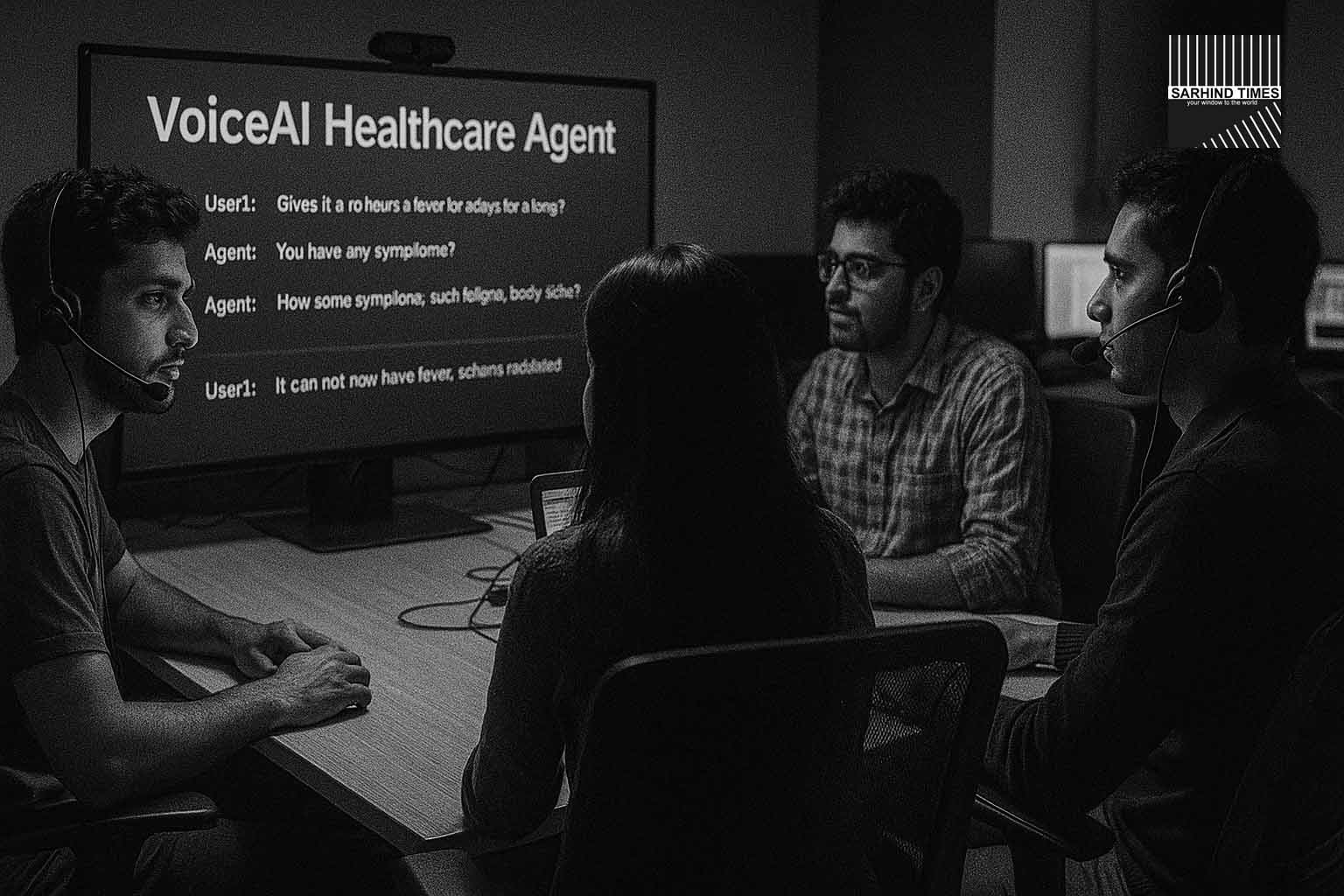
Startup targets automation of routine clinical-workflow tasks during a transformational digital-health wave in India
Dateline: Bengaluru | November 26 2025
Summary: Bengaluru-based voice-AI startup Pype AI has secured a $1.2 million pre-seed funding round led by Kalaari Capital, joined by Wyser Capital and Tenity. The firm aims to deploy specialised voice-agents to support clinical workflows in hospitals and diagnostics centres — a step into the fast-growing Indian health-tech segment as digital infrastructure expands and healthcare operations come under pressure.
The Startup and the Funding Round
Pype AI, founded in 2024 by Dhruv Mehra and Ashish Tripathy in Bengaluru, develops voice-based artificial-intelligence agents designed for healthcare environments. The $1.2 million (approx. ₹10 crore+) pre-seed round signals investor confidence in niche AI workflows for the Indian health sector, and represents one of the early voice-AI plays to focus directly on clinical-workflow optimisation rather than consumer-facing apps.
According to company data, the raise will enable Pype AI to scale its engineering team, ramp up product development and begin pilot deployments in hospitals and diagnostics chains across metro and urban-tier-2 zones. The lead investor, Kalaari Capital, brings early-stage funding experience and local network — a helpful match for a startup targeting complex regulated sectors like healthcare.
Value-Proposition: Voice Agents in Healthcare Workflows
Pype AI’s value-proposition centres on replacing or augmenting human-admin workflows using voice commands, natural-language processing and context-aware integration with hospital information systems (HIS), electronic health records (EHR) and diagnostic-lab systems. Typical use-cases include:
- Automatic dictation or verbal logging of patient intake by nurses, reducing paperwork and freeing up time for patient care.
- Voice-driven scheduling, follow-up reminders, and coordination between departments (e.g. lab, pharmacy, radiology) to streamline referral and diagnostic pathways.
- Interactive voice-bots that guide clinicians or support staff through workflows — e.g., verifying patient data, cross-checking medication histories, prompting alerts or next-steps.
- Leveraging voice analytics to identify bottlenecks in outpatient flow, department hand-offs and discharge processes — enabling management to target efficiency improvements.
The company believes that voice-first workflows can yield meaningful time savings, reduce human-error exposure, improve staff-satisfaction and support hospitals struggling with high patient throughput and tight resource-budgets.
Why Now: The Context of India’s HealthTech Inflection
India is undergoing a structural shift in healthcare delivery, digital infrastructure and operational transformation — and Pype AI’s launch fits neatly into that environment. Some of the enabling trends:
- Rapid digital-health infrastructure build-out: Government-led missions have expanded health-IDs, digital health-records and telemedicine networks. That creates the backbone on which workflow/AI tools can attach.
- Hospital-system pressure and resource constraints: Even tertiary hospitals face high patient volumes, limited nursing and clerical capacity, and complex referral chains. Workflow automation becomes a pragmatic target.
- Voice-first adoption readiness: India’s workforce is increasingly accustomed to voice-interaction (smartphones, IVR, voice assistants). Embedding voice agents in healthcare may benefit from that user-familiarity.
- Investor interest shifting to operational AI in healthcare: Earlier waves concentrated on direct-to-consumer health apps, diagnostics and telemedicine. The newer frontier is backend optimisation, process automation, data-flow/AI — where margins, impact and scalability may offer stronger business models.
Challenges and Success Factors for Pype AI
While the promise is strong, several execution-factors will determine whether Pype AI becomes more than just a novel experiment:
- Integration with legacy systems: Indian hospitals and labs often use heterogeneous HIS/EHR platforms, many with limited interoperability, patchy data-quality and minimal voice-integration capability. Pype AI will need to build robust connectors, standardise across multiple vendors and handle data-governance/safety.
- Regulatory, privacy and compliance demands: Healthcare is a regulated domain — data privacy, consent management, audit-logs, medical-device regulation (in some cases), and performance-validation are all factors. For voice-AI agents interacting with clinicians, reliability and safety are critical.
- User-adoption and training: Introducing voice-agents in high-stress hospital environments requires clinician buy-in, ergonomics design, seamless usability, minimal disruption and tangible benefit. Without user-centric design and change-management, pilots may stall.
- Scalability and business model clarity: Even if pilot successes emerge, the question is whether hospitals will pay for voice-agents, how subscription or licensing models will be structured, how ROI is demonstrated, and how the company handles localisation (languages, accents, dialects) across India’s diversity.
- Sustainable differentiation & competition: While voice-AI is niche, other workflow-automation firms (traditional automation, low-code platforms, hospital-IT vendors) may respond. Pype AI must build defensible IP, strong value-metrics and reference clients.
Impacts for Stakeholders
Hospitals and diagnostics chains: They stand to benefit from improved operational efficiency, reduced clerical burden, better staff-utilisation and potentially improved patient-throughput. For mid-sized and large hospitals in metro/urban India, voice-automation may become a measurable productivity leaver.
Investors: The raise signals that investors are comfortable placing bets beyond the consumer side of health-tech and are now looking at ‘pipes and plumbing’ of health-delivery. If Pype AI scales well, similar workflow-automation plays may attract capital and exit interest.
Clinicians & support-staff: Workflows that relieve administrative burden could enhance job-satisfaction, reduce burnout and allow more time for patient interaction and care. However, they must be trained and supported to use new tools.
Patients: Although less direct, patients may gain from smoother experiences — fewer mis-referrals, quicker diagnostics, less waiting, more consistent documentation and potentially lesser cost/duplication.
What to Watch in the Coming 12-18 Months
To judge whether Pype AI is moving from promise to traction, some early signals to monitor include:
- Announcement of pilot-customers (hospital chains, diagnostics labs) and public release of performance metrics (time-saved, reduction in referral-lag, staff-hours freed).
- Geographic rollout beyond Bengaluru into Tier-2/3 cities — crucial to scale given India’s hospital-density distribution.
- Localization of voice-agents into Indian regional languages and dialects — a necessary step for national-scale adoption.
- Establishment of business model clarity—pricing for voice-agents, subscription versus cap-ex vs outcome-linked models, reference case studies.
- Follow-on funding or partnerships—if Pype AI partners with major hospital-IT vendors, large hospital chains or health-systems, it could gain a competitive edge and demonstrate scalability.
Conclusion
Pype AI’s $1.2 million raise is a well-timed move into a promising but less crowded frontier of health-tech — voice-first automation of clinical workflows in India’s expanding healthcare ecosystem. While the path ahead is complex, the startup has unlocked capital, founder momentum and a market environment that is increasingly receptive to digital-health innovation. If it executes well, builds strong references and scales beyond pilot zones, it may become a case-study of how process-AI in healthcare can thrive in India.
In short: healthcare may often focus on diagnosis and care; Pype AI is betting on the quieter but potent domain of clinical-workflow automation — and that bet could pay off in the era of digital-health transformation in India.



+ There are no comments
Add yours