
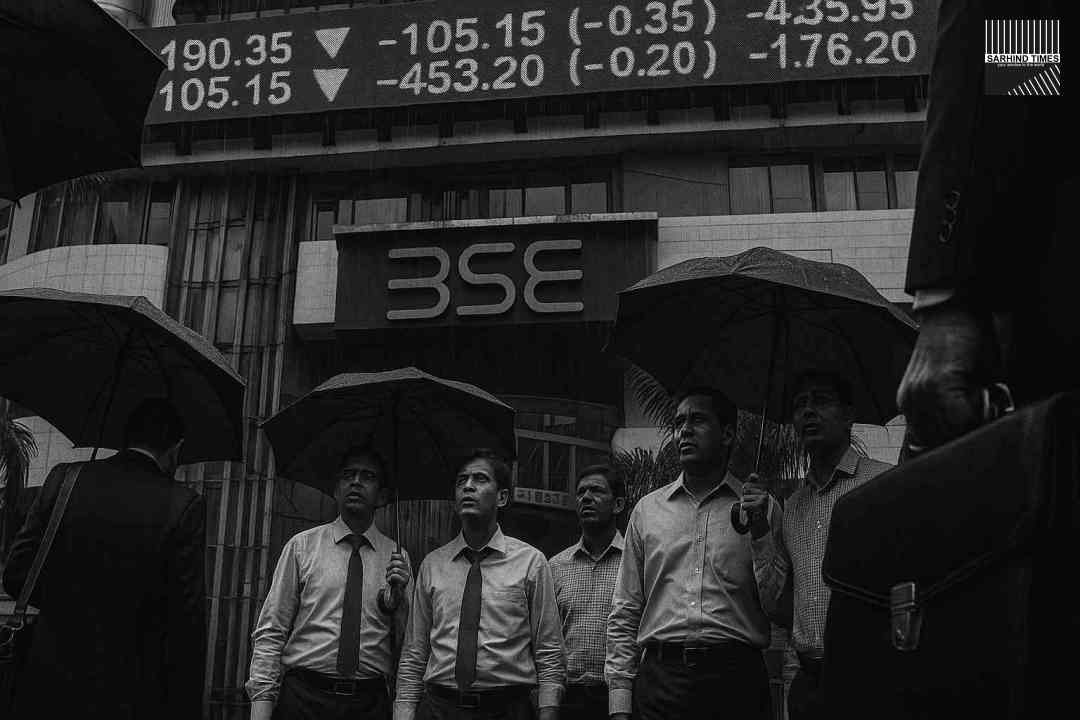
Mixed corporate earnings, geopolitical uncertainty, and foreign outflows trigger a broad sell-off across sectors
Dateline: Mumbai | 29 November 2025
Summary: Indian equities fell sharply in Thursday’s trading session as weak global cues, sustained foreign institutional selling, and caution ahead of key economic data weighed on sentiment. Analysts warn investors to expect heightened volatility in December as global markets assess geopolitical risks and inflation signals.
A Rough Day for Indian Markets
Indian equity indices witnessed a sharp downturn on Thursday, with the Sensex and Nifty closing significantly lower amid global uncertainty. The Sensex dropped over 600 points during the afternoon session, while the Nifty breached key support levels as traders offloaded positions across banking, IT, and auto stocks. The sell-off was aligned with broader global weakness as Asian and European markets mirrored similar declines.
Market participants attributed the fall to a combination of factors—unsettled geopolitical developments, cooling corporate earnings, and renewed concerns about foreign investment outflows. As global investors turned risk-averse, Indian equities were not spared, particularly after showing strong resilience over the past few sessions.
Global Cues Dampen Sentiment
Weak US futures and a sudden dip in Asian indices set the tone early in the day. Traders responded cautiously to fresh economic updates in the United States that indicated persistent inflationary pressure, raising fears that global central banks may delay expected rate cuts. European markets also opened lower, reflecting broader geopolitical anxieties and concerns about supply chain disruptions.
For Indian traders who had been anticipating stability ahead of December, the week’s global developments introduced fresh volatility. With crude oil prices fluctuating and currency markets reacting sharply to geopolitical news, global risk appetite weakened significantly, influencing domestic sentiment.
Foreign Institutional Investors Turn Net Sellers
One of the most concerning signals for domestic markets was the return of sustained selling by foreign institutional investors (FIIs). After being net buyers for several weeks, FIIs shifted to profit-taking mode, leading to outflows that unsettled large-cap and mid-cap counters. Analysts say FIIs are repositioning portfolios ahead of year-end global reviews, factoring in geopolitical turbulence and uncertain commodity prices.
Domestic Institutional Investors (DIIs) did step in to partly absorb the selling pressure, especially in banking and FMCG sectors. However, the counterflow was not strong enough to offset the broader decline across rate-sensitive and export-oriented stocks.
Sectors Under Pressure
Banking, IT, auto, and realty stocks bore the brunt of the sell-off. Heavyweights dragged the indices with persistent downward momentum.
- Banking: Major private banks saw profit booking amid concerns around global credit conditions.
- IT: Weak cues from global tech indices and fears of slower outsourcing demand hit software exporters.
- Automobile: Mixed sales projections and supply-chain uncertainties weighed on auto counters.
- Realty: High-interest expectations and delayed project timelines put pressure on developers.
Meanwhile, select pharma and FMCG stocks showed defensive strength as investors sought safer bets amid the broader market turmoil.
Rupee and Crude Oil Add to Market Anxiety
The Indian rupee showed mild weakness against the US dollar, slipping as global currencies reacted sharply to geopolitical developments. While the fall was not steep, analysts cautioned that continued global uncertainty could place additional pressure on the exchange rate in the weeks ahead.
Crude oil prices also turned volatile after a brief period of stability. With supply disruptions emerging in multiple regions, traders remain wary of sudden price spikes that could impact India’s import bill and corporate margins across energy-intensive sectors.
Corporate Earnings Signal Mixed Outlook
Domestic corporate earnings for the season presented a mixed picture. While several large-cap companies reported strong numbers, mid-cap and small-cap firms struggled with input cost pressures and squeezed margins. This divergence contributed to investor uncertainty, especially in high-beta sectors sensitive to global conditions.
Analysts noted that companies heavily dependent on global markets may face more challenges ahead if geopolitical tensions escalate. As a result, traders shifted allocations toward companies with strong domestic demand fundamentals and stable balance sheets.
Investor Psychology: Fear Takes Over
Market mood, which appeared stable at the start of the month, shifted decisively toward caution. Many short-term traders opted to reduce leveraged positions, contributing to intraday swings. Retail investors, who had been active in recent months, appeared hesitant to make fresh entries during the volatile session.
Technical analysts noted that Nifty falling below key support levels triggered algorithmic and automated trades, accelerating the downward movement. However, they also highlighted that volatility could create new opportunities for selective sector rotation once stability returns.
What Analysts Expect in December
With major global and domestic economic announcements scheduled in the coming weeks, analysts advise investors to prepare for heightened volatility. December historically sees mixed trading patterns as institutional investors rebalance portfolios for year-end accounting, while domestic traders take positions ahead of corporate forecasts for the next quarter.
Market experts point to several factors to watch:
- Global central bank commentary on interest rates
- Inflation readings in major economies
- Geopolitical developments and commodity supply risks
- Movement of the Indian rupee
- Foreign investment flows
- Domestic policy announcements
While caution dominates the near-term outlook, long-term fundamentals for the Indian economy remain strong. Investors with diversified portfolios and a medium- to long-term horizon are likely to weather the volatility better than short-term traders, analysts say.
Conclusion: Markets Await Clarity
As Indian markets navigate a turbulent global environment, the immediate priority for investors is risk management. With the world facing complex geopolitical and economic challenges, volatility is likely to persist. However, India’s robust domestic demand, improving corporate resilience, and continued policy support offer stability amidst global uncertainty. December will be a crucial month, determining how markets position themselves for the new year.



+ There are no comments
Add yours