
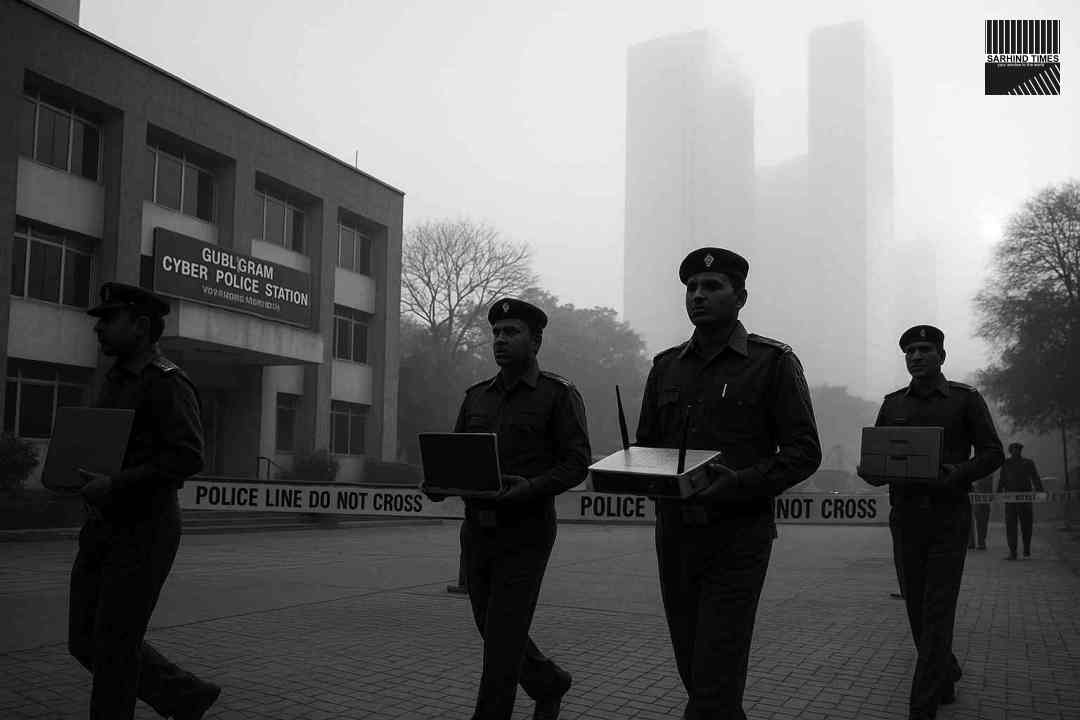
A months-long operation, multiple digital trails, and a web of shell accounts come to light as investigators crack a fast-growing cyber racket targeting thousands across India.
Dateline: Gurugram | 28 November 2025
Summary: Gurugram Police have dismantled one of the biggest cyber-fraud networks of the year, uncovering a sophisticated scam involving fake investment apps, mule accounts, call centres, and multi-layered money laundering channels. With victims across 12 states and losses exceeding ₹38 crore, the case sheds light on rising digital crime and the challenges law enforcement faces in combating it.
The Raid That Opened the Pandora’s Box
The narrow lanes of Udyog Vihar Phase-3 looked unusually crowded last Tuesday as officers from the Gurugram Cyber Crime Unit moved silently toward a basement office. The building, disguised as a generic “Digital Solutions Workspace,” had been under surveillance for nine days. From the outside, nothing suggested that the modest structure housed a complex cyber-fraud operation responsible for duping thousands through fake investment apps and fraudulent trading platforms.
Officers forced-entry into the premises at 6:30 AM. Inside, the sight was startling: rows of computers running remote-access dashboards, dozens of smartphones tethered to servers, fast-switching virtual private networks, and an array of freshly printed bank passbooks. Twenty-seven individuals—mostly young men in their 20s—were taken into custody.
Investigators quickly realized this was not a standalone scam but a central node in a much larger web of coordinated digital crimes stretching across multiple states. The raid revealed critical leads that eventually unearthed a ₹38-crore pan-India fraud involving 112 bank accounts, 46 shell companies, and a dozen call centres operating in sync.
The Modus Operandi: A New Generation of Digital Deceit
The racket used a layered system that combined psychological manipulation, market lingo, fake trading platforms, and high-tech masking tools. A senior officer described it bluntly: “This is not the old-school lottery scam. This is institutionalized cyber fraud—organized, structured, and shockingly scalable.”
The gang began by targeting individuals through social media platforms, messaging apps, and matrimonial portals. The first contact was made by operatives trained to pose as financial analysts, cryptocurrency experts, or wealth consultants. Their language was polished, their scripts refined, and their profiles loaded with curated photos from international conferences.
Victims were then directed to download a sophisticated app that mimicked real global trading platforms. The interface showed neutral market charts, user dashboards, and green indicators of small profits. “It was all fake but looked extremely real,” an investigator explained. “Even professionals could be misled.”
Once trust was built, victims were encouraged to invest more. Small initial returns were indeed credited—money recycled from other victims—to create a sense of credibility. As investments grew, access to the dashboard was progressively restricted. Eventually, users were shown a false ‘technical maintenance’ screen, after which their accounts disappeared entirely.
Following the Money: The Hardest Part of the Case
What made the scam so challenging to trace was the speed and manner in which funds were moved. Every victim deposit was routed through a chain of mule accounts, many opened using forged documents or acquired from individuals in need of quick cash.
The money was then fragmented into smaller chunks and redirected through prepaid wallets, cryptocurrency exchanges, and gaming platforms popular for microtransactions. Five different crypto mixers were used to blur the trail before converting funds back into fiat currencies or transferring them to overseas accounts.
An officer involved in the operation revealed that in one instance, ₹9 lakh was broken into 3,200 micro-transactions within a span of 13 minutes. “It’s digital laundering at machine speed,” he remarked. “The criminals know we’re watching, so they move faster than the law can react.”
The Role of Call Centres and Fake HR Departments
One of the most surprising findings from the probe was the involvement of full-fledged call centres, each equipped with dozens of agents trained to convince victims to stay invested even when doubts arose. The scripts included lines such as, “Sir, don’t panic. Markets recover,” and “Ma’am, your portfolio is showing potential for 18% growth this week.”
Investigators discovered that these call centres operated like formal corporate entities. They had HR teams, attendance systems, monthly contests for “top converters,” and even motivational sessions led by fake “market experts.” Agents were paid ₹18,000 to ₹25,000 monthly, with performance bonuses based on the volume of funds extracted from victims.
Most employees were unaware of the criminal nature of their work. Many believed they were handling customer acquisition for legitimate fintech companies. A few insiders, however, knew exactly what was happening and received higher commissions for providing mule accounts or helping to manage withdrawals.
Victims Speak Out: The Human Cost of Digital Fraud
Behind the staggering ₹38-crore figure are countless personal stories of financial loss, betrayal, and emotional trauma. A 52-year-old schoolteacher from Jaipur lost her entire retirement corpus of ₹14 lakh. “They spoke so confidently,” she recalls. “I thought I was finally doing something to secure my future. It took me months to accept that everything was gone.”
A young IT professional in Bengaluru invested ₹5 lakh over three months. “The app looked professional. I even checked reviews online—which were fake,” he said. “By the time I realized, the dashboard went blank.”
Victims across Maharashtra, Gujarat, Uttar Pradesh, Kerala, and Delhi have contacted the Gurugram police since the bust became public. “We expect the number of complainants to cross a thousand,” an official confirmed.
The Turning Point: A Small Clue That Cracked the Network
The breakthrough came when a suspicious wallet transfer of ₹92,000 originated from an IP address traced to a coworking space in Sector 44. Officers initially believed it to be a low-level scammer, but deeper checks revealed repeated connections to multiple fake trading dashboards.
Within 48 hours, investigators discovered that the same IP had logged into 128 victim accounts. This link—accidental or careless—allowed police to track down four key operatives, whose interrogation eventually led to the main Udyog Vihar office.
The operation expanded rapidly as digital forensics teams from Haryana Police and the state cyber response unit worked round-the-clock to coordinate with banks, telecom providers, and payment gateways. “Had we reached even a week later, they might have wiped out everything and shifted operations abroad,” a senior official said.
Inside the Operations: A Day in the Life of a Digital Fraudster
Based on seized documents and employee testimonies, investigators reconstructed the daily workflow inside the fraudulent trading hub:
10:00 AM – Briefing & Allocation: Agents received updated scripts, including market terminology and emotional triggers for new victims.
11:00 AM – Outreach Phase: Calls and messages were sent to potential targets based on data extracted from social platforms and compromised contact lists.
2:00 PM – Conversion Window: The most aggressive efforts were made to close “investment deals” before lunch, as people were more likely to respond positively in the first half of the day.
4:00 PM – Dashboard Manipulation: Backend teams altered fake charts to reflect small profits or minor losses tailored to each victim’s psychology.
7:00 PM – Transfers and Laundering: The accounts team fragmented incoming funds and initiated micro-transactions designed to evade automated banking alerts.
10:00 PM – Shutdown: Systems were wiped or reset daily to reduce traceability.
“It was like a corporate office—except everything they did was illegal,” one investigator observed.
How Social Media Enabled the Scam
One of the most alarming aspects uncovered during the investigation is the role of social media as a recruitment and persuasion tool. Fraudsters frequently impersonated CEOs, investment advisors, and even officers from global regulatory authorities.
Fake Instagram and LinkedIn profiles showcased luxury lifestyles, expensive cars, and overseas trips to create an illusion of financial expertise. AI-generated profile photos were used in several cases to avoid detection. Algorithms often recommended these fake profiles to users interested in finance, amplifying their reach exponentially.
What the Police Recovered
The raid and subsequent follow-up operations resulted in the seizure of:
- 94 laptops and 112 smartphones configured for anonymous communication
- 736 SIM cards used for rotating identities
- Multiple routers and VPN devices capable of masking international traffic
- 43 bank passbooks linked to mule accounts
- Four hard drives containing encrypted trading dashboards
- ₹18.7 lakh in cash
Digital forensics specialists are now in the process of breaking several encrypted partitions, which are expected to reveal additional evidence about foreign connections and potential cross-border funding sources.
Are International Linkages Emerging?
Preliminary findings indicate that a portion of the proceeds may have been routed through accounts in the UAE, Singapore, and Hong Kong. Investigators are coordinating with central agencies to trace international money trails, an increasingly common feature of high-value digital crimes originating in India.
“It’s too early to name countries or individuals, but we believe this network did not operate in isolation,” a senior officer hinted. “There are likely leaders sitting abroad while local teams handle execution.”
Legal Future: Sections Invoked and Court Responses
The accused have been booked under multiple sections of the IPC, IT Act, and Prevention of Money Laundering Act. Courts have granted police custody for 10 of the primary suspects, while the remaining 17 are under judicial custody.
Investigators are expected to seek extended custody for access to locked devices. The Enforcement Directorate is likely to join the probe to examine the laundering channels, especially given the use of cryptocurrency mixers and overseas wallets.
Experts Warn: This Is the Future of Crime
Cybersecurity professionals say that the sophistication of this racket is a sign of evolving digital crime ecosystems. With AI tools, deepfake technology, and decentralized finance platforms becoming widely accessible, criminals now have unprecedented tools for deception.
Experts note that victims are not just the elderly or digitally naïve; highly educated professionals and entrepreneurs have fallen prey to algorithm-driven scams designed to bypass traditional skepticism.
A Wake-Up Call for the Nation
The Gurugram case has triggered conversations in policy circles about the need for stronger digital security frameworks, faster bank alert systems, and aggressive public awareness campaigns. Many officials argue that a national-level real-time fraud monitoring network is essential.
As one senior officer summed it up, “Fraudsters operate like startups—innovating and scaling daily. Law enforcement must evolve even faster.”
What Comes Next?
The investigation is ongoing, and police expect the fraud amount to rise well beyond ₹38 crore as more victims come forward. Agencies are also assessing whether similar networks exist in Noida, Bengaluru, and Mumbai using the same operational blueprint.
For now, Gurugram Police are treating this as a landmark case—one that exposes the vulnerabilities of a digital-first economy and highlights the urgent need for proactive vigilance from both citizens and institutions.



+ There are no comments
Add yours