
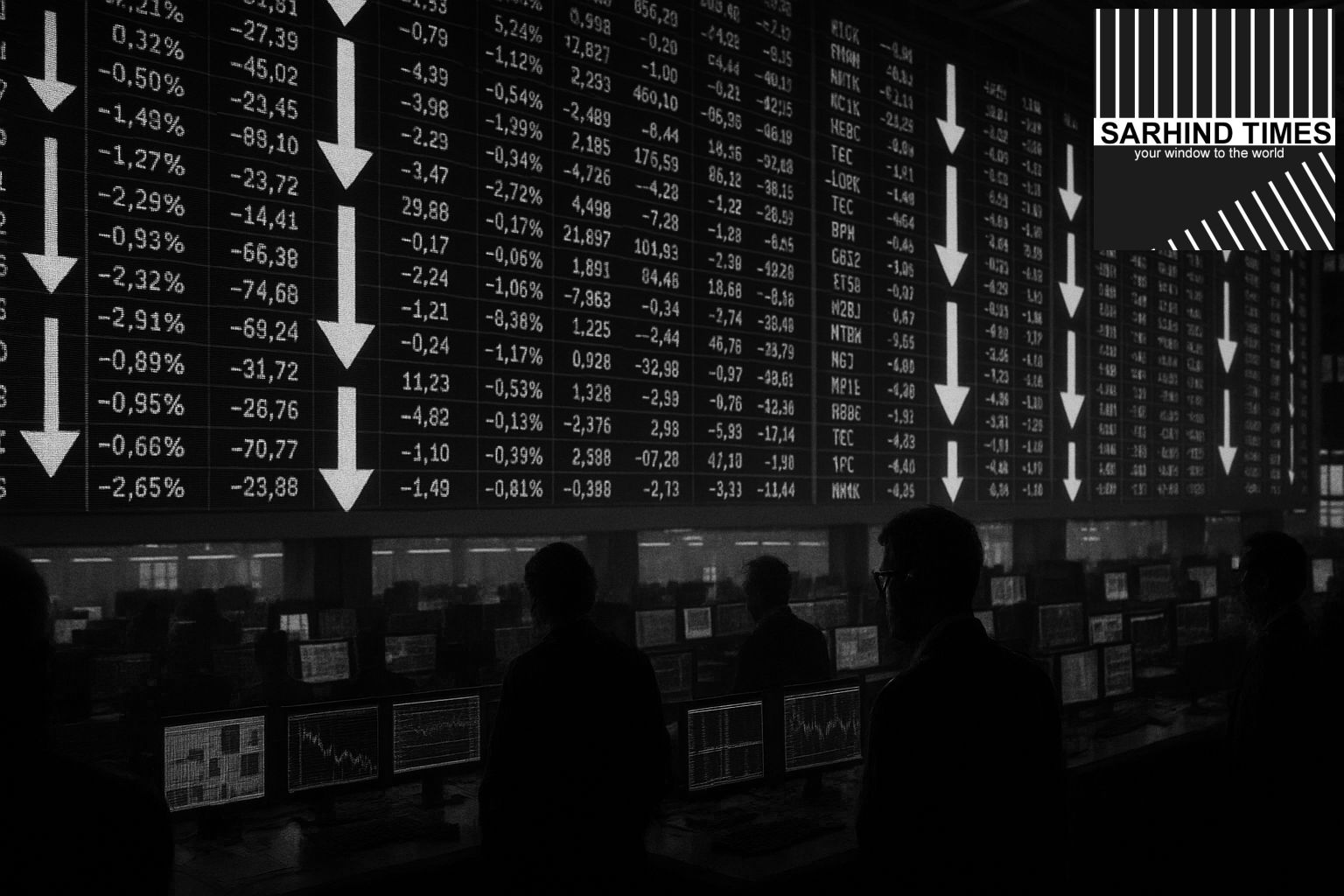
World’s largest tech companies collectively lose over $350 billion in market value, sending shockwaves from Wall Street to Asia
Dateline: New Delhi | November 27, 2025
Summary: Global stock markets suffered a major setback after the United States announced sweeping new AI regulatory frameworks, triggering a massive $350-billion selloff across tech giants. The shockwave hit Asia and Europe within hours, dragging down indices, disrupting investor sentiment, and prompting emergency responses from financial regulators.
A stunning global market rout
Global financial markets were left reeling on Wednesday after the United States unveiled a sweeping new set of AI regulatory rules — the toughest ever imposed on the technology sector — sparking widespread shock across investors and businesses. Within minutes of the announcement, shares of America’s largest tech corporations plummeted, collectively erasing more than $350 billion in market capitalisation.
The NASDAQ recorded one of its sharpest intraday drops of the year, setting off selloffs in European and Asian markets. India’s Sensex and Nifty also opened sharply lower, with tech-heavy sectors dragging benchmarks into deep negative territory. Experts described the event as a “regulation-driven earthquake” that exposed the market’s deep dependence on AI-driven growth.
The regulation that changed everything
The U.S. government’s announcement came after months of debate over AI safety, data rights, and algorithmic transparency. The new framework mandates:
• Mandatory disclosure of training data for large AI models
• Strict licensing for models exceeding specific compute thresholds
• Accountability for harm caused by AI-generated decisions
• Restrictions on training models using unverified datasets
• Heavy penalties for companies failing compliance audits
• Mandatory third-party security testing before deployment
Analysts immediately noted that complying with the rules would require billions in restructuring and legal expenses for top tech firms. The market, driven heavily by AI optimism over the past two years, reacted violently.
Wall Street meltdown: tech giants lose historic value
The biggest AI and cloud companies were hit hardest. Within hours:
• One company lost over 9% of its value
• Another recorded its single-largest daily percentage fall in two years
• Major chipmakers faced dual pressure from regulatory uncertainty and supply-chain constraints
• Cloud service providers saw their steepest correction of the year
The ripple effects extended beyond tech, dragging consumer goods, auto manufacturers, and financial stocks into negative territory.
Investors panic: “AI optimism evaporated in minutes”
Brokers on the floor described the atmosphere as “chaotic” and “fear-driven” — with many citing the scale of the regulation as beyond anything markets had anticipated. Hedge funds scrambled to rebalance, while retail investors moved into safe assets such as gold and government bonds.
By late afternoon, liquidity pressures intensified, forcing temporary trading halts on select NASDAQ counters.
Europe, Asia react sharply: markets tumble
The shock spread globally even before Wall Street closed. European markets slumped immediately, with tech-focused indices in Germany and France shedding significant value. Asian markets followed overnight, particularly South Korea, Japan, Singapore, and Hong Kong, all with heavy exposure to global semiconductor and AI-linked firms.
Analysts say this marks the first time in nearly two years that regulation — not geopolitics or macroeconomics — triggered a synchronous global correction.
Impact on India: IT giants slip, startup ecosystem nervous
India’s domestic markets were hit almost instantly. Shares of major Indian IT and digital service companies dropped sharply, given their exposure to U.S. tech clients. The Indian startup ecosystem, heavily dependent on AI venture funding, expressed serious concern over tightening global liquidity.
Founders say that if U.S. investors face regulatory pressure or stock erosion, funding for high-risk AI innovation in India may tighten over the next 12 months.
Indian regulators track developments closely
The Securities and Exchange Board of India (SEBI) held internal discussions regarding market stability. While no extraordinary measures were announced, sources confirm that regulators are watching for abnormal volatility and potential liquidity stress in tech-linked funds.
RBI officials also noted that global financial tightening could spill over into emerging markets, prompting caution in monetary policy deliberations.
Tech companies respond: compliance teams scramble
Several global AI and tech companies issued late-night statements acknowledging the new regulations and pledging cooperation. Legal and compliance teams have begun evaluating the impact on product pipelines, cloud architecture, and corporate governance.
Insiders say some firms may temporarily suspend development of ultra-large AI systems until they fully understand the regulatory exposure.
Economic consequences: slowdown risk grows
Economists warn that prolonged market turbulence may dampen investment sentiment worldwide. With AI seen as the central growth driver for the global economy, any regulatory shock carries large macroeconomic implications.
Early estimates suggest that global GDP projections may be revised downward by investment banks if the rules disrupt corporate earnings for more than two quarters.
Why the U.S. moved: political and ethical considerations
Government officials say the regulations aim to ensure AI safety, prevent algorithmic discrimination, protect consumers’ data rights, and reduce national security risks posed by unverified datasets or unchecked model training.
Political analysts note that bipartisan pressure has grown in the U.S. to rein in the power of large tech firms, particularly those operating massive AI and surveillance systems.
Global diplomatic consequences
The announcement has already triggered discussions in the EU, UK, South Korea, and Japan about harmonising AI safety standards. Emerging economies, including India, may be pushed to upgrade their own AI governance frameworks to remain competitive and ensure cross-border compatibility.
Is this a temporary correction or the start of a long downturn?
Market strategists remain divided:
• Some believe the panic selling is temporary and will correct once companies outline their compliance strategies.
• Others warn that a multi-quarter earnings slowdown is likely, given the direct hit to R&D budgets and AI infrastructure investments.
• A third segment argues that tighter regulation, while painful, could ultimately stabilise the sector.
Long-term impact on innovation: risk or reset?
Tech researchers say that while the regulations introduce short-term turbulence, they may push the industry toward safer and more accountable AI development. However, some fear that heavy compliance costs may discourage startups and consolidate power in a few mega-corporations.
Conclusion: a turning point for the global tech economy
The historic $350-billion wipeout triggered by the new U.S. AI regulations marks a defining moment for the global technology sector. It has exposed the fragility of an ecosystem built on rapid growth, high expectations, and minimal oversight. For governments, it is a reminder of regulatory responsibility. For companies, a call to rebuild trustworthy AI systems. For markets, a lesson in the volatility of overconcentration.
The world now watches to see whether this correction is merely a painful recalibration — or the beginning of a new, tightly regulated era of artificial intelligence.



+ There are no comments
Add yours