
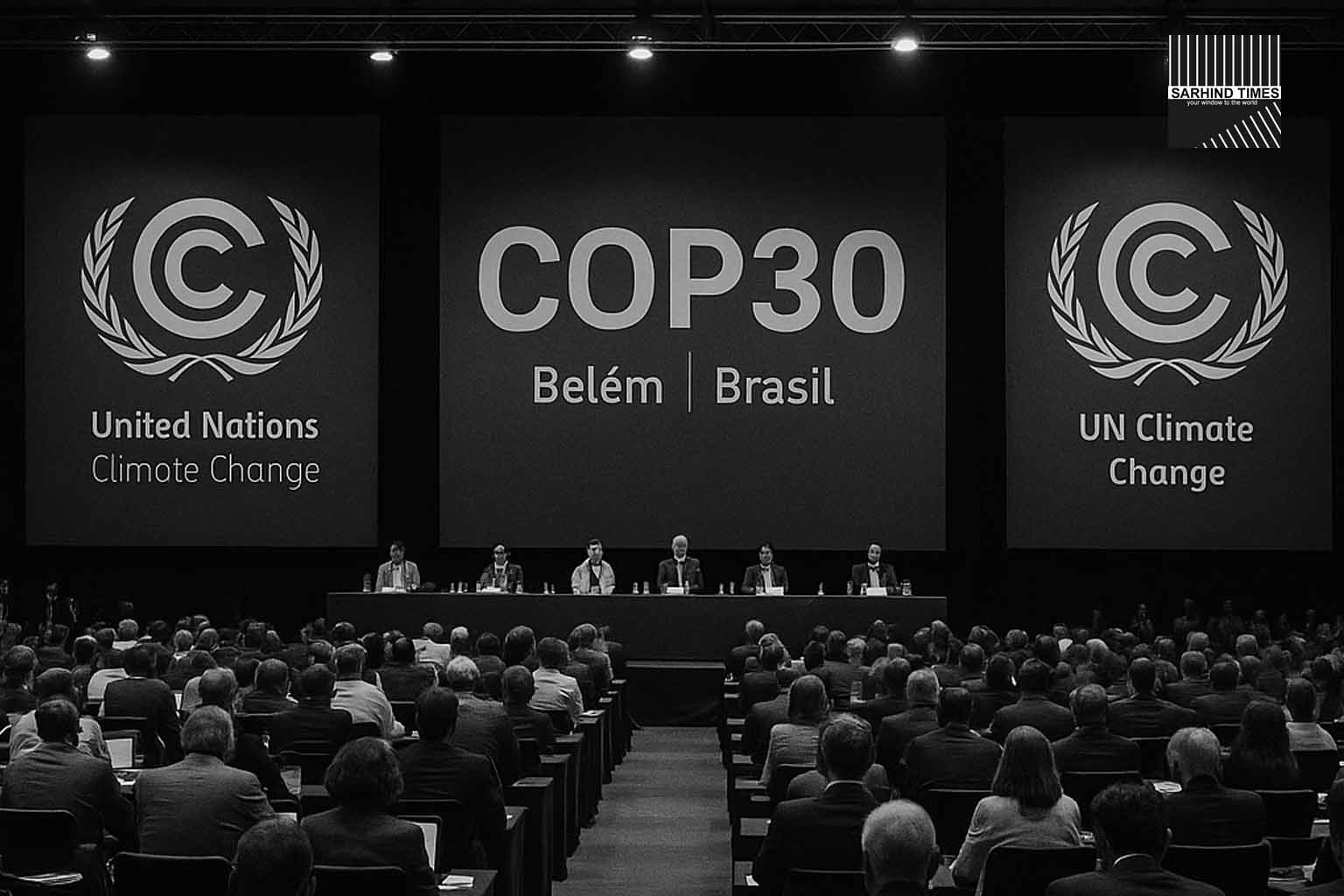
At the 2025 United Nations climate summit in Belém, India leverages its growth credentials to demand trillions in climate finance while delaying its own 2035 goals
Dateline: New Delhi / Belém | November 26 2025
Summary: India has postponed submission of its updated Nationally Determined Contribution (NDC) for 2035 at the COP30 climate conference in Belém, Brazil, shifting the spotlight onto developed nations to increase climate ambition and funding. The move underscores India’s dual posture: a champion of clean-energy growth yet cautious about locking in binding commitments while seeking massive finance for adaptation and development.
A Strategic Pause: What India Announced — and What It Withheld
During this year’s COP30, India’s environment minister delivered a clear but calculated message. On one hand, he pointed to India’s achievements: non-fossil electricity capacity has now crossed the halfway mark ahead of schedule, and the country has outpaced some of its earlier 2030 goals. On the other, he announced that New Delhi will **not** submit its updated 2035 climate pledge by the close of the summit, citing ongoing domestic deliberations and the need for equitable global burdens.
The decision triggered a ripple of reactions. Some countries welcomed India’s stance as principled — emphasising “climate justice” and the need for richer economies to lead. Others interpreted the delay as a loss of momentum for one of the world’s largest emitters and a potential blow to the overall climate-process credibility.
According to observers, the postponement was not purely tactical: it gives India time to reconcile its own development ambitions, energy security needs, and the realities of coal dependence. At the same time, India used the platform to demand that developed nations mobilise **trillions**, not billions, in climate finance for the Global South. The minister underscored that India will not bind itself to new emission caps unless “fair share” funding, technology transfer and capacity building are secured.
Progress to Date: What India Has Achieved — And What Isn’t Covered
India entered the COP30 negotiations armed with some strong numbers. Its non-fossil fuel power generation capacity is reportedly over 50 % of installed capacity, a target originally set for 2030 but achieved early. This has strengthened India’s claim that it is shifting towards a cleaner energy mix faster than many had expected.
Nonetheless, key gaps remain. India still relies heavily on coal — with more than 70 % of electricity generation coming from thermal sources. Despite solar and wind capacity building, grid integration, storage, and transmission infrastructure remain riddled with bottlenecks and regional disparities. Moreover, India’s per-capita emissions, though still below global averages, are rising in absolute terms — making it the world’s third-largest greenhouse-gas emitter in 2024 according to independent analysis.
The decision to delay its 2035 NDC means India will defer new long-term targets for reducing emissions, increasing renewable shares, improving energy-efficiency and setting stronger sectoral commitments. This puts more weight on the negotiations around finance, technology and equity than on headline numbers at this summit.
Why the Delay? Navigating Development, Energy Security and Global Expectations
Analysts point to several reasons for India’s strategic timing:
- Development imperative: With a population exceeding 1.45 billion and ambitions to become a $10 trillion economy, India cannot impose rigid constraints on energy generation, industrial expansion, urbanisation and infrastructure building without jeopardising growth pathways.
- Energy security and coal reality: Although renewables are growing fast, coal remains a key energy source — payment obligations to power-plant owners, stranded-asset risks, grid-balancing challenges and regional employment issues complicate rapid phase-out.
- Finance & technology dependency: India has consistently argued that historical emitters must bear disproportionate cost of mitigation. By delaying its NDC, India retains leverage in finance negotiations and pushes allied developing countries to secure stronger commitments from the Global North.
- Negotiating leverage: The timing allows India to stretch its domestic policy window — to finalise internal consultations with states, industry, agriculture and energy sectors before locking in next commitments. It also allows India to align its pledge with infrastructure rollout — for example green-hydrogen mission, nuclear expansion, transmission grid upgrades — which are still under development.
Global Response and Risks to India’s Position
From the international perspective, India’s stance elicited mixed responses. Many developing-country delegations applauded India for holding the line on fairness and placing emphasis on finance and capacity rather than just emission caps. However, some advanced-economy envoys and NGOs expressed frustration that India — one of the largest emitters — is signalling less ambition at a moment when global temperature-rise trajectories demand accelerated action. The delay may dilute India’s moral leadership and undermine momentum at COP30.
Climate-policy experts warn that while India retains legitimate development concerns, delaying a formal pledge risks missing the window for 2030-mid-decade alignment. If major players like India hold off, global efforts to stay within 1.5 °C of warming face increased risk. India therefore must ensure that its internal consultation process is swiftly translated into credible policy frameworks. Without this, the country may suffer reputational costs and find it harder to secure preferential finance or technology partners.
Finance, Just Transition and the Indian Ask
One of the core themes of India’s COP30 agenda was finance. The Indian delegation called for a paradigm shift in climate-investment flows: from billions to **trillions** of dollars annually. India highlighted the contrast between its early progress on renewables and the relative paucity of adaptation funding for vulnerable regions, particularly for urban-fringe zones, infrastructure resilience, Himalayan water systems and coastal-zone protection.
The minister emphasised the need for “just transition” frameworks that protect workers in coal, cement and power sectors, emphasise reskilling, ensure regional development and avoid stranded-asset fallout. India signalled willingness to accelerate its shift to clean energy but asked for matching global support in terms of technology, concessional finance, risk-sharing and capacity building. The delegation proposed a climate-finance compact linking end-use deployment to emissions reductions, with India playing an anchor role.
Implications for India’s Domestic Policy and Economy
Domestically, the delayed pledge means the Government retains flexibility but also carries higher domestic expectations. Key implications include:
- India must deliver its existing commitments credibly: continuing expansion of renewables, pushing energy-efficiency, displacing coal over time, and improving grid resilience. Failure to follow through may compromise its leverage in global negotiations.
- Multi-sector coordination becomes important: states, power utilities, industrial sectors, transport ministries and finance departments must align on decarbonisation timelines and infrastructure investments. The challenge of localisation of climate action — beyond big metros to rural and industrial belts — becomes acute.
- Investment flows into green technologies, carbon markets, infrastructure resilience and adaptation need to accelerate. India will need to absorb and deploy global finance while building credible domestic frameworks to channel it effectively.
What to Watch Going Forward
Several indicators will determine whether India’s position translates into momentum or stasis:
- When India formally submits its updated NDC and what the headline numbers look like — expected sometime in 2026.
- New announcements from India on green-hydrogen projects, nuclear capacity expansion, grid modernisation and storage deployment — given these will underpin any credible decarbonisation pathway.
- How much climate finance is mobilised or pledged to India in the near-term by developed economies and multilateral funds; the quality of such finance (grants vs loans) will matter for credibility.
- Whether India’s internal consultation between central government, states and sectors succeeds in creating implementable strategies that match the global narrative of ambition with domestic realities.
Conclusion: Strategic Pause or Credibility Risk?
India’s decision to delay its climate pledge does not imply retreat from responsibilities — the country still projects itself as a global clean-energy leader and remains the only major economy to claim over 50 % non-fossil capacity ahead of 2030 targets. However, the timeline matters. As climate negotiations intensify and global pressure mounts, the mid-decade moment (2035) becomes critical. A delayed submission prolongs uncertainty — both for India and for the broader climate-process. If India fails to submit a strong, credible NDC soon, it risks being perceived as an obstacle to global climate momentum rather than a partner for reform.
In essence, India stands at a crossroads: it can use this moment to shape the terms of its climate transition — leveraging its development agenda and global alliances — or lose strategic advantage in law-making, norms and finance flows shaping the low-carbon world of 2050 and beyond. How India chooses to act in the next 12 months will matter not just for its domestic policy but for its global climate-clout.


+ There are no comments
Add yours